
Official statement
What you need to understand
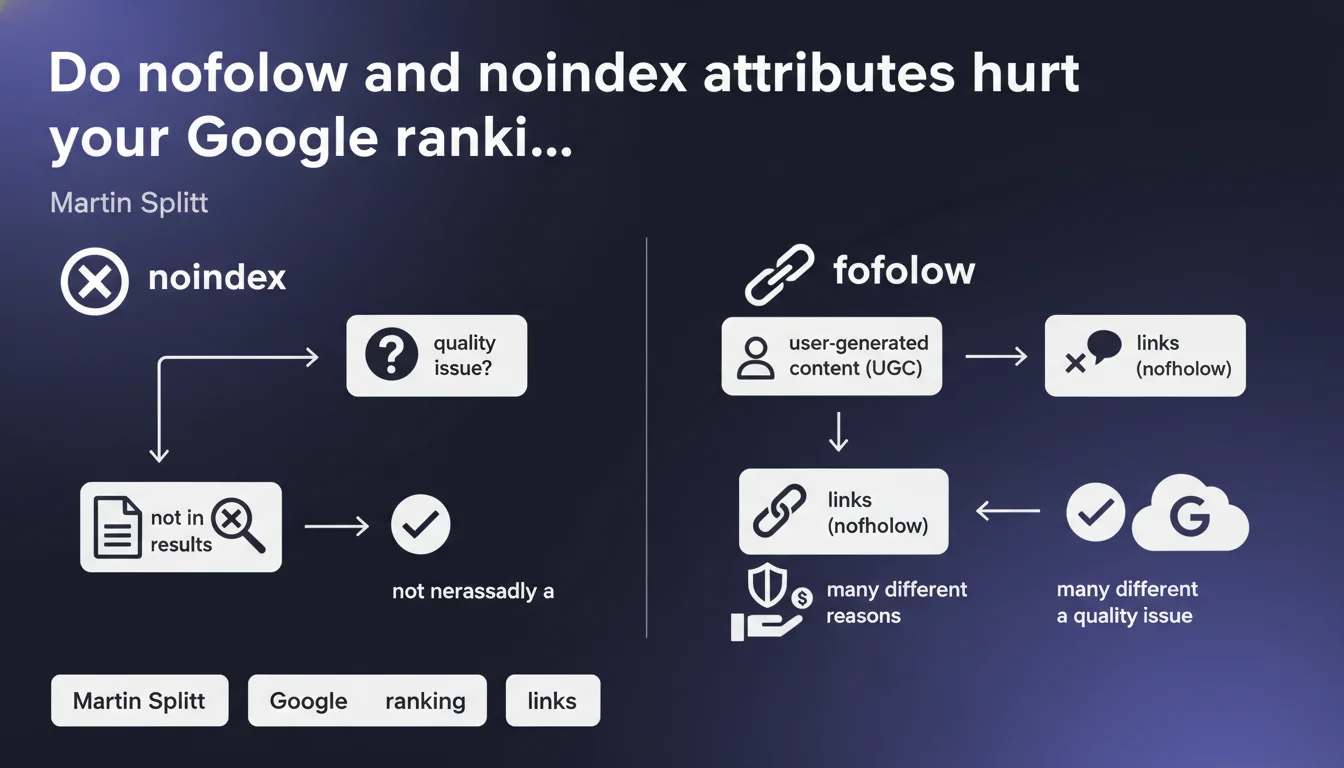
Google has provided important clarifications regarding the use of nofollow and noindex attributes. Contrary to certain widespread concerns in the SEO community, these attributes do not constitute negative signals for the ranking algorithm.
Using these tags is part of an editorial and technical management approach for the site. Nofollow allows you to dissociate from certain outbound links, while noindex excludes specific pages from indexation. Google interprets these choices as legitimate indications from the webmaster.
This official position is particularly reassuring for sites managing user-generated content (UGC). Forums, comment sections, or collaborative platforms can use these attributes without fearing negative repercussions on their overall visibility.
- Nofollow does not indicate a quality problem, but simply a desire not to pass SEO credit to certain links
- Noindex is a normal practice for excluding pages without added value for users (filter pages, internal search results, etc.)
- The UGC attribute can replace nofollow for user-generated content, offering more semantic precision
- No algorithmic penalty is applied to sites legitimately using these attributes extensively
SEO Expert opinion
This statement indeed aligns with field observations from recent years. E-commerce sites with thousands of noindex pages (filters, pagination pages) or forums with massive nofollow usage don't suffer downranking as a result.
However, an important nuance deserves attention: while using noindex or nofollow itself is not penalizing, a poorly designed architecture that requires excessive use of these attributes may reveal structural problems. For example, if 80% of your pages are noindex, this might indicate overly automated or low-quality content generation.
The transition from simple nofollow to sponsored and UGC attributes shows Google's desire to refine its understanding. Even though Google indicates it treats these attributes as hints rather than absolute directives, their appropriate use remains a best practice for transparency.
Practical impact and recommendations
- Audit your noindex pages: verify that only pages without SEO value (filters, internal search, technical pages) are excluded from indexation
- Use nofollow without fear on non-editorial outbound links, widgets, unmoderated comment sections
- Prefer the UGC attribute for user-generated content rather than generic nofollow
- Use the sponsored attribute for all commercial, advertising, or sponsored links to comply with Google guidelines
- Avoid nofollow on internal links except for very specific cases (login buttons, user actions)
- Document your strategy for using these attributes to maintain consistency over time, especially with multiple contributors
- Don't over-optimize: no need to put all your external links on nofollow as a precaution, natural editorial links to quality sources are beneficial
- Monitor the ratio of indexable/noindex pages in your Search Console to detect potential technical anomalies
💬 Comments (0)
Be the first to comment.