
Official statement
What you need to understand
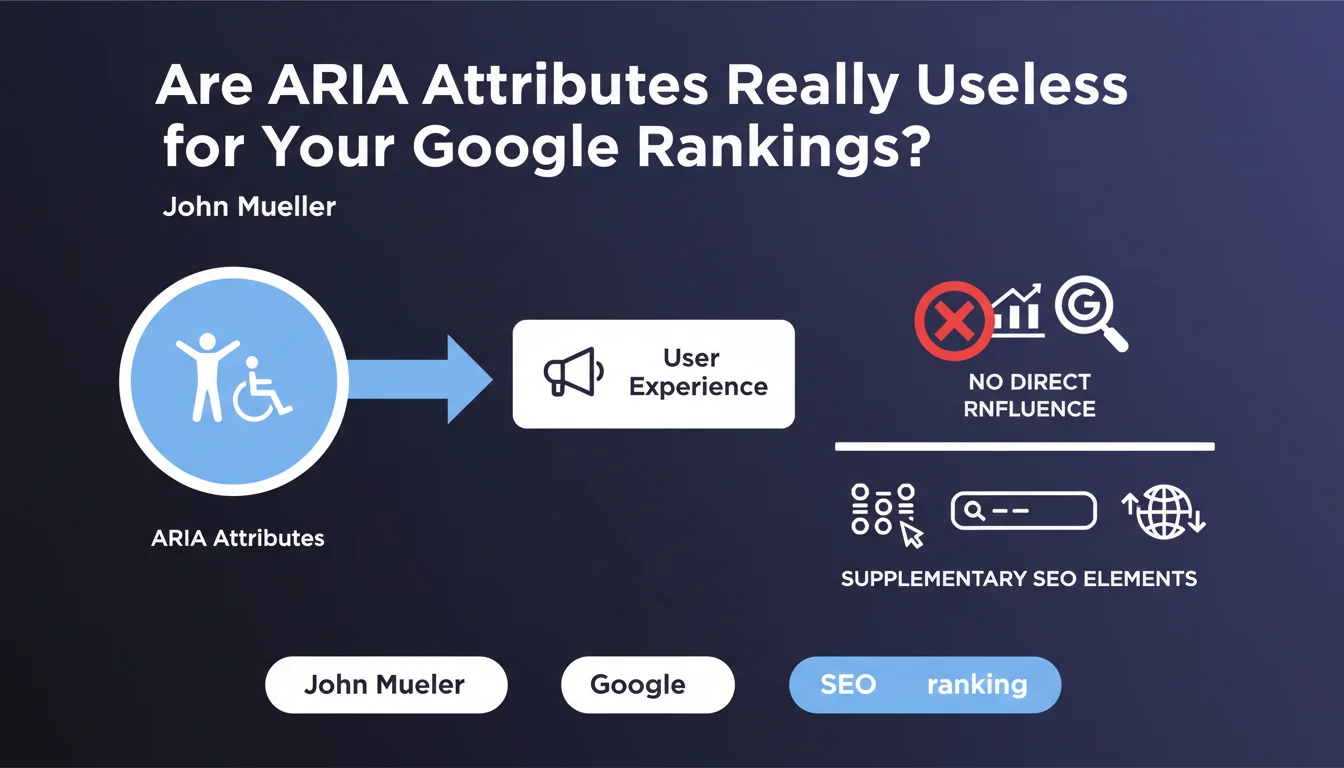
ARIA attributes (Accessible Rich Internet Applications) are technical tags designed to improve web accessibility. They allow assistive technologies like screen readers to better interpret the content of a page.
Google has clarified their position: these attributes influence neither ranking nor indexing in search results. Google's robots do not use them as relevance or quality signals to evaluate your pages.
This statement highlights a fundamental distinction: accessibility and SEO are two complementary but distinct disciplines. An accessible page is not automatically better ranked, even though both share certain best practices.
- ARIA attributes (role, aria-label, aria-describedby, etc.) do not count as ranking factors
- Google uses the DOM and standard semantic HTML to understand pages
- Accessibility remains crucial for user experience and legal compliance
- Native HTML elements (nav, header, button) are preferable to ARIA attributes in SEO
SEO Expert opinion
This position from Google is perfectly consistent with field observations. Tests show that search engines rely primarily on native semantic HTML rather than ARIA overlays. A button with aria-label="Order" provides nothing more than a standard <button> element for Googlebot.
However, an important nuance must be made: accessibility indirectly influences SEO through user experience. Clear navigation with ARIA landmarks can improve time on site and reduce bounce rate, behavioral signals that Google carefully monitors.
The real lesson here is strategic: always prioritize native semantic HTML. A <nav> is better than a <div role="navigation">, a <button> is better than a <span role="button">. Native elements offer both accessibility AND optimal comprehension by search engines.
Practical impact and recommendations
- Don't use ARIA attributes as an SEO strategy - they will never replace good semantic HTML markup
- Prioritize native HTML5 elements - <header>, <nav>, <main>, <article>, <aside>, <footer> are better understood by Google
- Maintain your accessibility efforts - even without direct SEO impact, it's essential for UX and compliance
- Avoid overloading your tags - an aria-label on a link with visible text is redundant and adds nothing to SEO
- Use ARIA only when necessary - for complex JavaScript components or dynamic content where native HTML is insufficient
- Audit your HTML structure - ensure your content is understandable without ARIA, then add ARIA for accessibility
- Optimize your headings and semantic tags - these are what really matter to Google, not role or aria-* attributes
In summary: ARIA attributes are valuable for your users' accessibility, but don't expect any direct SEO benefit. Focus your optimization efforts on semantic HTML, content structure, and overall user experience.
The articulation between accessibility, HTML architecture, and SEO performance requires in-depth technical expertise and a comprehensive strategic vision. These structural optimizations, while fundamental, can prove complex to orchestrate effectively when you must also manage the many other aspects of SEO. A specialized SEO agency can support you in this comprehensive approach, by auditing your current architecture and establishing a roadmap prioritizing high-impact actions for your visibility.
💬 Comments (0)
Be the first to comment.