
Official statement
What you need to understand
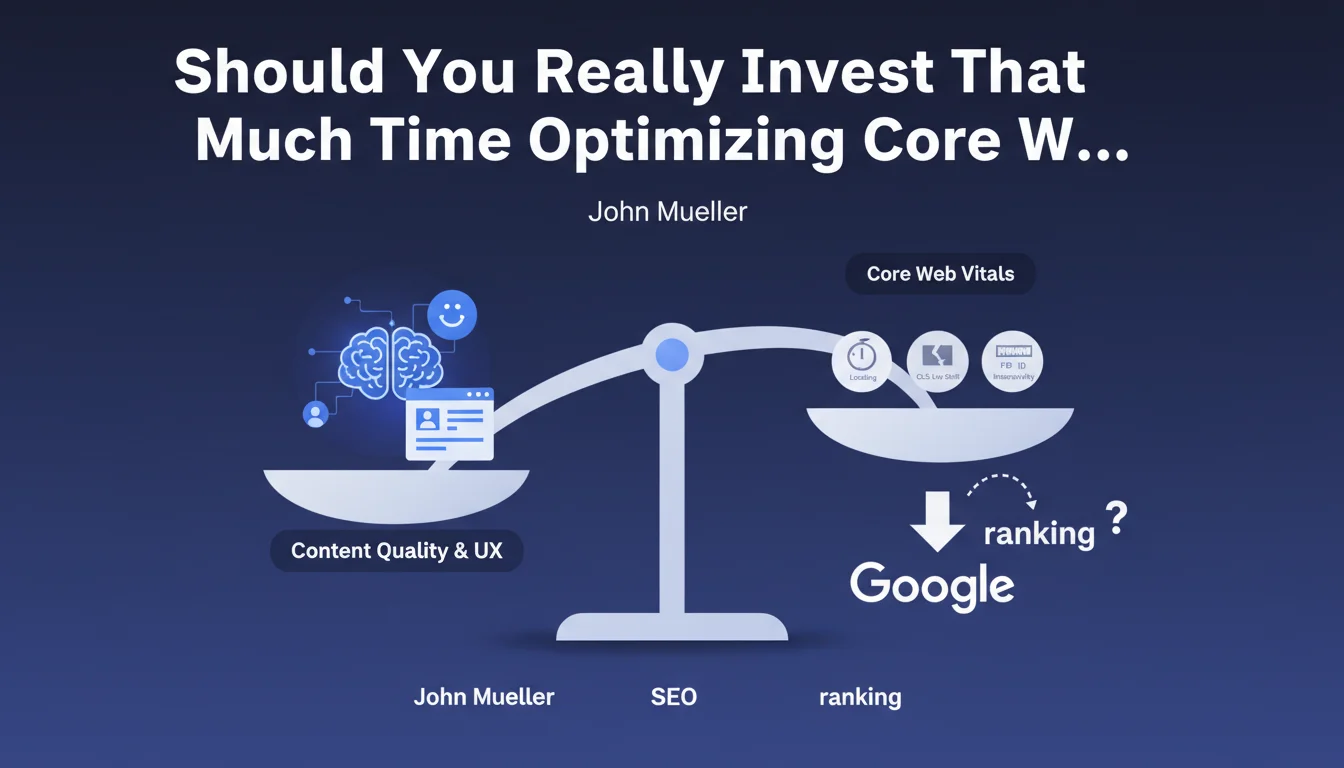
Google is reaffirming a position that still surprises many SEO professionals: Core Web Vitals are not the deciding factor that many imagine them to be for ranking in search results.
Concretely, this means that a site with perfect scores (100/100) won't necessarily outrank a competitor with average scores but offering better quality content. CWV remain a ranking signal, but their relative weight is deliberately limited by the algorithm.
This statement comes at a time when many SEO professionals have invested heavily in technical optimization. Google is trying to recalibrate priorities toward what really matters: relevance and value provided to users.
- Core Web Vitals are a minor ranking signal, not a dominant factor
- Content quality and overall user experience carry far more weight
- Average scores won't prevent you from ranking well if your content is excellent
- Obsessing over perfect scores can distract from real SEO priorities
- Google favors a holistic vision of user experience
SEO Expert opinion
This position from Google is perfectly consistent with what we've been observing in the field since the Page Experience Update rollout. Many sites with imperfect CWV continue to dominate their SERPs thanks to their authority and content.
However, an important nuance must be added: in highly competitive sectors where multiple sites offer equivalent quality content, Core Web Vitals can make the difference. They act as a tiebreaker between comparable content.
Watch out for special cases: For e-commerce sites and transactional pages, the impact of performance is twofold. Beyond SEO, Core Web Vitals directly influence conversion rates. A slow LCP or high CLS can drive your visitors away before they even make a purchase, regardless of your ranking.
The optimal approach is to aim for "good" scores without seeking perfection. Moving from "needs improvement" to "good" provides a benefit. Moving from "good" to "excellent" often mobilizes disproportionate resources for a marginal SEO gain.
Practical impact and recommendations
- Never sacrifice content quality in favor of extreme technical CWV optimizations
- Aim for the green zone ("good" scores) for the three main metrics, without seeking perfection
- Prioritize real user experience: intuitive navigation, readable content, smooth journey
- Invest first in content: relevance, depth, demonstrated expertise
- Fix critical issues (LCP > 4s, CLS > 0.25) that genuinely harm the experience
- Analyze your direct competitors: if their CWV are mediocre but they rank well, focus on their content strategy
- For e-commerce, keep performance as a priority for conversions, not just for SEO
- Measure the business impact of your optimizations: does the time invested generate positive ROI?
- Document your improvements and their correlation (or lack thereof) with ranking changes
In summary: Adopt a balanced approach where Core Web Vitals are part of your technical strategy without becoming an obsession. Make sure to reach "good" thresholds, then focus your efforts on what truly differentiates your site: exceptional content and real added value for your visitors.
This holistic optimization strategy requires sharp technical expertise while maintaining an overall strategic vision. Coordinating technical performance, content quality, and user experience represents a complex challenge that demands multidisciplinary skills. For businesses looking to maximize their visibility without spreading their resources thin, support from a specialized SEO agency provides an objective analysis of your real priorities and a personalized strategy aligned with your business objectives.
💬 Comments (0)
Be the first to comment.