
Official statement
What you need to understand
Google officially confirms that Core Web Vitals data can vary significantly between the Chrome User Experience Report (CrUX) and Search Console. This divergence is not a bug, but results from two fundamentally different methodological approaches.
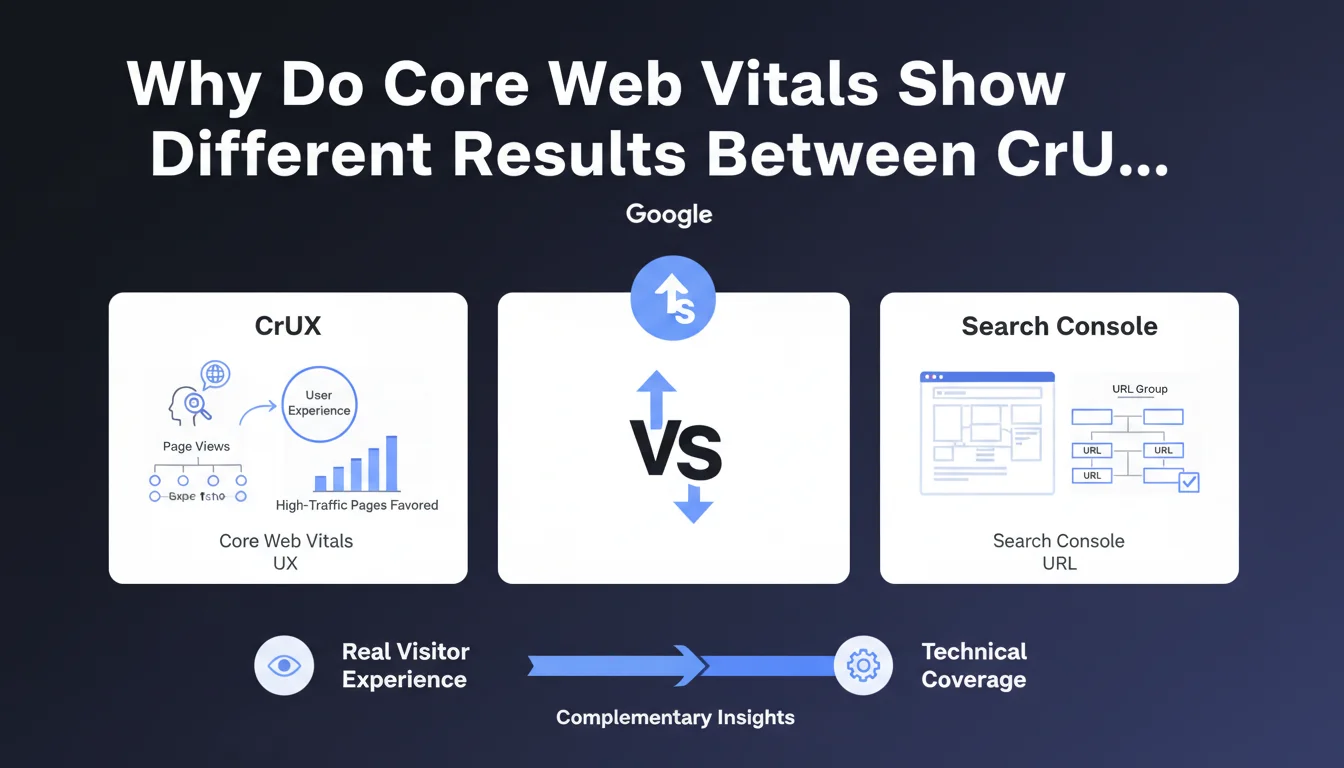
CrUX aggregates data according to actual page views, which means that each user visit is counted individually. High-traffic pages therefore weigh much more heavily in overall averages. This method reflects the experience lived by the majority of your real visitors.
Search Console evaluates technical health at the URL level or groups of similar URLs. A page with 10 visits per month counts as much as a page with 10,000 visits in the coverage analysis. This approach highlights structural issues potentially affecting the entire site.
- CrUX: end-user oriented view, weighted by actual traffic
- Search Console: technical health oriented view, equity among all URLs
- Both metrics are complementary and not contradictory
- No source is more "true" than the other, they answer different questions
SEO Expert opinion
This clarification from Google is perfectly consistent with what we observe daily in our audits. It frequently happens that a site displays an excellent overall CrUX score while Search Console flags hundreds of problematic pages. The reverse is equally true.
The important nuance to add concerns strategic prioritization of optimizations. If your goal is to improve immediate SEO ranking, focus on high-traffic pages revealed by CrUX. If you're building a sustainable and scalable strategy, Search Console alerts are valuable for detecting structural technical issues.
In e-commerce audits particularly, we find that product pages with little individual traffic can mask systemic problems. Search Console then becomes indispensable for identifying recurring patterns across thousands of similar pages.
Practical impact and recommendations
- Analyze both sources jointly: never rely on a single metric to diagnose your Core Web Vitals performance
- Prioritize according to your objectives: CrUX for immediate impact on revenue and conversions, Search Console for overall technical health
- Identify patterns in Search Console: group problematic URLs by type (categories, products, articles) to detect structural issues
- Use CrUX for ROI: focus your optimization efforts first on high-traffic pages that actually impact the majority experience
- Set up specific alerts: monitor separately the evolution of your strategic pages (CrUX) and the proportion of URLs in error (Search Console)
- Document your benchmarks: track the comparative evolution of both sources in your monthly dashboards to anticipate trends
- Test corrections at scale: when Search Console reveals a recurring problem, validate the correction on one page before applying it massively
In summary: leverage the complementarity of these two data sources. CrUX guides you toward quick wins with high business impact, while Search Console protects your technical infrastructure in the long term.
Simultaneous optimization of Core Web Vitals according to these two perspectives requires in-depth technical expertise and rigorous methodology. If you notice significant discrepancies or struggle to identify priority levers, support from a specialized SEO agency can prove valuable for establishing a personalized action plan that balances quick gains and technical sustainability.
💬 Comments (0)
Be the first to comment.