
Official statement
What you need to understand
With the gradual decline of AMP (Accelerated Mobile Pages) and many sites abandoning this technology, the question arises of how to handle obsolete AMP subdomains (typically amp.yoursite.com or m.yoursite.com).
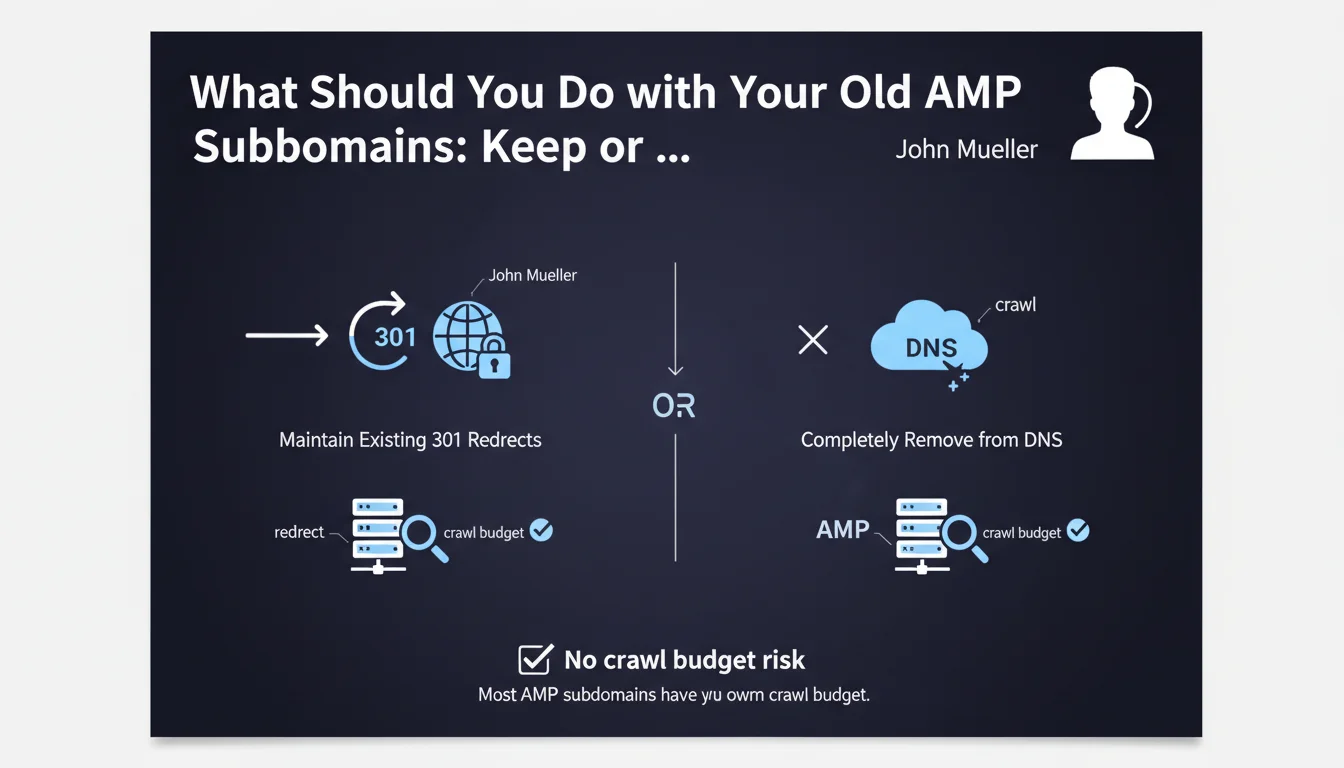
Google suggests two main approaches for managing these now-useless subdomains. The first is to maintain existing 301 redirects to non-AMP versions. The second option is to completely remove the subdomain from DNS, thus eliminating any trace of the old AMP infrastructure.
A reassuring point concerns crawl budget: AMP subdomains generally have their own crawl budget allocation. Their maintenance or removal therefore does not negatively impact the crawling of your site's main pages.
- Two valid options: keep 301 redirects or remove the subdomain from DNS
- No crawl budget risk: AMP subdomains have their own allocation
- Flexibility of choice: neither approach penalizes SEO
- End of an era: AMP is no longer a ranking factor since Core Web Vitals
SEO Expert opinion
This position from Google is pragmatic and consistent with the evolution of its mobile approach. Since the introduction of Core Web Vitals, AMP no longer offers any particular competitive advantage, making these subdomains effectively obsolete for the majority of sites.
The flexibility offered between the two options is welcome. Maintaining 301 redirects is a conservative approach that guarantees preservation of link equity and avoids 404 errors. Removing the subdomain from DNS is more radical but technically cleaner in the long term.
However, an important nuance: if your AMP subdomain has accumulated significant backlinks or still appears in search results, favor 301 redirects for at least 12 to 18 months. Immediate DNS removal could result in the loss of valuable SEO juice.
Practical impact and recommendations
- Audit your AMP subdomain: check residual traffic and still-indexed URLs in Search Console
- Analyze your backlink profile: identify how many links point to your AMP URLs with a tool like Ahrefs or Majestic
- Conservative option: maintain 301 redirects if you have significant backlinks or residual traffic
- Radical option: remove the subdomain from DNS if your AMP infrastructure is completely abandoned and without traffic
- Test before deployment: verify that all your 301 redirects work correctly with a complete crawl
- Monitor 404s: after the operation, monitor errors in Search Console for at least 3 months
- Update sitemaps: ensure no AMP URLs remain in your XML sitemap files
- Communicate internally: inform your technical teams that the AMP subdomain is no longer in use
Managing obsolete AMP subdomains requires a thorough preliminary analysis of your specific situation. The choice between redirection and DNS removal depends on your backlink history, residual traffic, and your technical infrastructure.
This migration represents a technical cleanup opportunity but requires a methodical approach to avoid any loss of visibility. Link profile analysis, proper redirect configuration, and post-migration monitoring are crucial steps that demand expertise and rigor.
These technical operations can prove complex, particularly for sites with a large historical AMP footprint. Engaging a specialized SEO agency can be wise to benefit from personalized support, avoid costly mistakes, and guarantee a smooth transition without negative impact on your organic search rankings.
💬 Comments (0)
Be the first to comment.