
Official statement
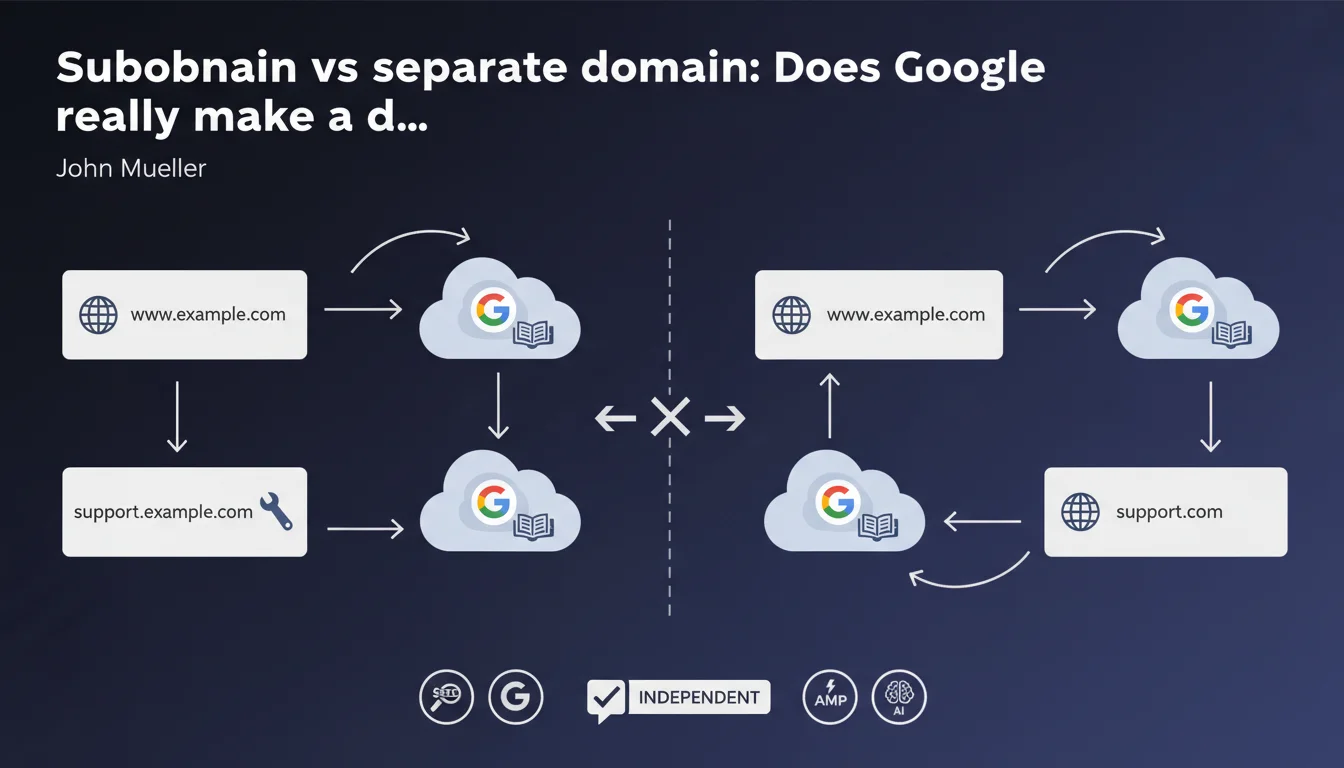
Google indexes and treats the main site and support site as two completely distinct entities, whether they're on different subdomains or completely separate domains. No automatic authority transfer, no pooling of SEO signals. Each version must be optimized independently.
What you need to understand
Why does this Mueller clarification change the game?
For years, the question of how Google treats subdomains has divided the SEO community. Some swore that a subdomain automatically benefited from the main domain's authority, others claimed the opposite.
Mueller settles the debate once and for all: support.example.com and www.example.com are treated exactly like two separate sites. No special privilege, no magical inheritance. It's the same logic as if you'd put your support on mysite-support.com.
What does this actually mean for indexation?
Google will crawl, index, and evaluate each subdomain or separate domain with its own crawl budget, its own authority, its own quality signals. Backlinks to your main domain don't automatically boost your subdomain.
If your technical support site is on a subdomain, it will need to build its own credibility — incoming links, quality content, optimized structure. Same goes for a blog hosted on blog.yoursite.com.
Does this separation also apply to same-level domains?
Yes, and that's exactly what Mueller clarifies. Whether you put your customer area on client.mysite.com or on mysite-client.com, Google applies the exact same logic: two independent entities.
The only difference lies in user perception and brand consistency, but technically, for Google, it's the same in terms of indexation and ranking.
- Google treats each subdomain as a separate site with no automatic authority transfer
- Crawl budget, backlinks, and quality signals are evaluated separately for each subdomain or different domain
- Whether you use a subdomain or a completely different domain makes no difference: the indexation logic remains identical
- No natural SEO inheritance between main domain and subdomains — each version must build its own credibility
SEO Expert opinion
Is this statement consistent with what we observe in practice?
Overall, yes. SEO professionals working with multi-subdomain architectures observe it regularly: a poorly optimized subdomain performs poorly, even if the root domain is an authority in its sector.
But — and here's where it gets tricky — we sometimes observe indirect transfers. Example: a subdomain benefits from semantic association with the main domain in SERPs, or inherits part of the trust through well-structured internal links. This isn't automatic authority transfer, it's deliberate construction.
Should you therefore ban subdomains from your SEO strategy?
No, that would be a mistake. Subdomains make sense in certain cases: very different content (blog vs e-commerce), distinct geographic targeting, or need to technically separate platforms. The key is to treat them as separate sites entirely.
The real trap is creating a subdomain thinking it will ride on the main domain's reputation without effort. Spoiler: it doesn't work. If you're not prepared to invest in its complete optimization, better stick with a standard directory (/support, /blog).
In what cases might this rule be nuanced?
Google remains vague on one point: brand recognition. If your main domain and subdomain share clearly identified entities (brand name, logo, coherent schema.org), Google might establish semantic links between the two.
But be careful, this remains an indirect signal, not a direct authority boost. Don't count on it to compensate for a poorly structured subdomain or one full of weak content.
Practical impact and recommendations
What should you actually do if you use subdomains?
First thing: stop treating your subdomains as extensions of the main site. Each needs its own complete SEO strategy — internal linking, backlinks, technical optimization, quality content.
Next, verify that each subdomain is properly declared in Google Search Console as a separate property. You must monitor crawl, indexation, and performance separately. If you have a ghost subdomain that isn't being tracked, you're flying blind.
What mistakes should you absolutely avoid with this architecture?
Don't duplicate content between main domain and subdomains thinking Google won't notice. It will, and you risk inter-domain cannibalization or worse, a penalty for duplicate content.
Another classic trap: creating a subdomain for low-quality content (satellite pages, auto-generated content) hoping to protect the main domain. Google makes connections, and a toxic subdomain can hurt your entire ecosystem, even without direct authority transfer.
Finally, avoid multiplying subdomains without strategic reason. Each subdomain dilutes your SEO efforts and complicates tracking. If a simple directory (/blog, /support) does the job, keep it simple.
How can you verify that your current configuration is optimal?
Audit each subdomain or separate domain like an independent site: crawlability, indexation, internal linking, link profile. Use Screaming Frog or equivalent tool to identify technical flaws specific to each version.
Compare performance in Search Console: if a subdomain stagnates while the main domain progresses, it's a signal that it's missing dedicated optimization or incoming links.
- Declare each subdomain as a separate property in Google Search Console
- Develop a complete SEO strategy for each subdomain: content, backlinks, internal linking
- Avoid content duplication between main domain and subdomains
- Don't create subdomains for low-quality content — this can impact your entire ecosystem
- Favor standard directories (/blog, /support) if you don't have a strong strategic reason to use a subdomain
- Regularly audit each subdomain as a standalone site
🎥 From the same video 3
Other SEO insights extracted from this same Google Search Central video · published on 06/08/2025
🎥 Watch the full video on YouTube →
💬 Comments (0)
Be the first to comment.