
Official statement
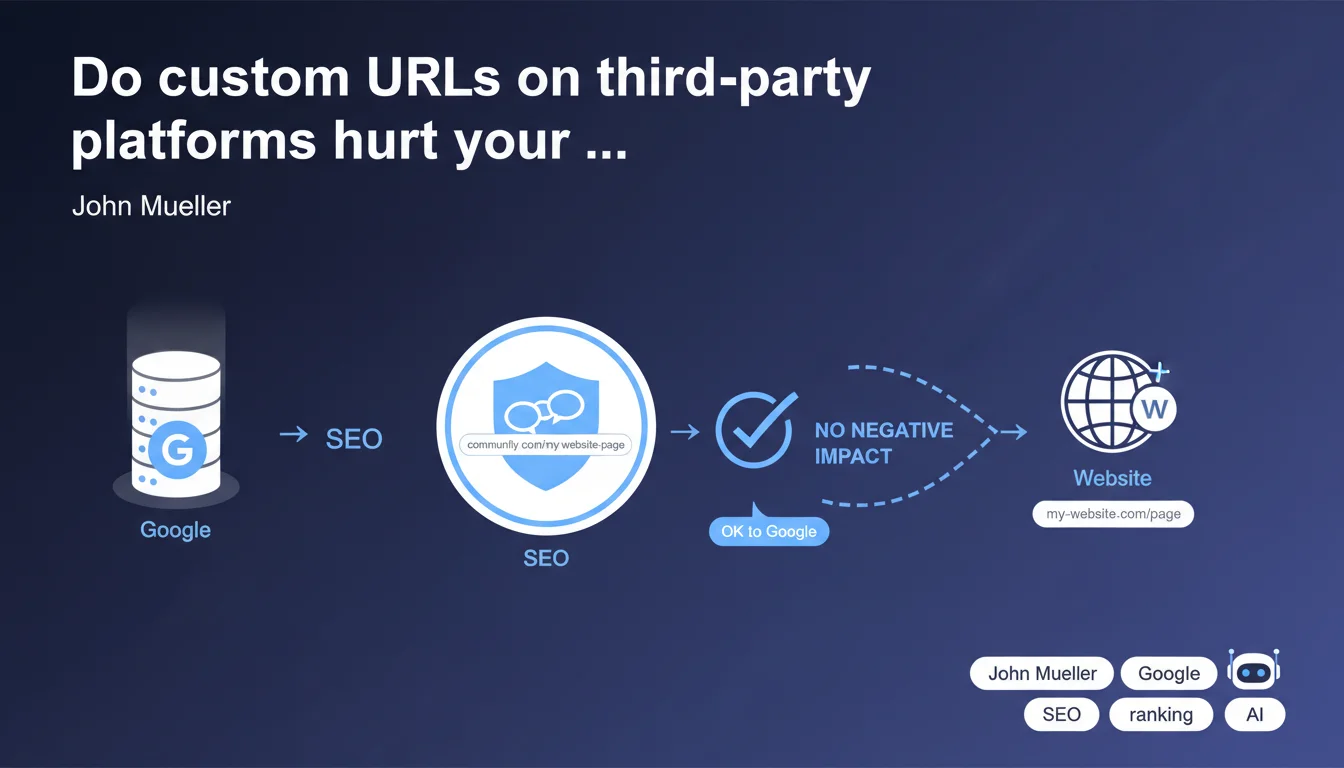
Google confirms that a custom URL created on a third-party platform (community forum, customer portal, etc.) does not negatively impact your main website's search rankings. This practice is considered perfectly legitimate and risk-free for your positioning. The signal these URLs send remains neutral or benign in the eyes of the algorithm.
What you need to understand
What exactly are we talking about?
Mueller is referring to custom URLs that some companies create on third-party platforms — typically a community forum hosted elsewhere, a customer portal on external infrastructure, or a company page on a professional network.
The SEO concern? That Google might confuse these URLs with duplicate content, subdomain spam, or an attempt to manipulate via satellite domains. But Google's answer is unambiguous: no penalty.
Why was this clarification necessary?
Because many B2B or SaaS companies use community platforms (like Discourse, Khoros) with custom URLs — for example community.yourcompany.com hosted by a third party.
The fear was that Google would interpret this configuration as an attempt at keyword stuffing via subdomains or an artificial link network. The statement is clear: no, as long as the usage is legitimate and transparent.
- Custom URLs on third-party platforms are SEO-safe
- Google distinguishes these configurations from real manipulations
- No negative impact on the main domain
- Transparency of hosting and usage remains the key criterion
What determines whether a third-party URL is "acceptable"?
Google doesn't provide a precise checklist, but we can deduce best practices: the URL serves a real user purpose (support, community, documentation), it's not stuffed with commercial keywords, and it points to original content.
If you create community.yoursite.com to host an active forum, that's acceptable. If you create cheap-insurance-best-rates.yoursite.com to redirect to a landing page, that's where it gets problematic.
SEO Expert opinion
Is this statement really new?
Not really. Google has always had a nuanced position on subdomains and third-party domains. What's changing is the clarification: Mueller takes the time to say "it's OK" to reassure.
That said — and this is where it gets interesting — this statement only covers the aspect of "no negative impact." It says nothing about any potential SEO benefit. In other words: no penalty, but no magic boost either.
What gray areas are not addressed?
Mueller doesn't specify whether Google treats these third-party URLs as completely independent from the main domain or if there's a subtle algorithmic link (for example via brand entity, Knowledge Graph).
In practice, we observe that some third-party URLs well-configured (with backlinks, real activity) end up appearing in the sitelinks of the main site. Coincidence or weak signal? Hard to tell without Google's internal data.
Should we still index these third-party URLs?
That depends on your strategy. If the third-party URL hosts high-value content (community FAQ, in-depth technical discussions), it may be wise to leave it indexed and even promote it.
If it's just a customer portal with private support tickets, it's better to block indexing via robots.txt or meta tags. No negative risk according to Mueller, but no benefit either in polluting your index with content that lacks public relevance.
Practical impact and recommendations
What should you verify on your existing third-party URLs?
First, usage intent. If you've created subdomains or custom URLs on external platforms, ask yourself: do they genuinely serve users or are they there "just in case"?
Then check the semantic consistency. A third-party URL that bears your brand but hosts content completely disconnected from your activity can create confusion — not a Google penalty, but a dilution of your brand signal.
Should we create links from the main site to these URLs?
If the third-party URL provides value (active community, useful resources), yes, link to it from your navigation or footer. This strengthens the coherence of your digital ecosystem.
However, avoid artificial internal link stuffing just to "push" a third-party URL. Google won't penalize, but you'll waste crawl budget and link juice for nothing.
- Audit all your custom URLs on third-party platforms (forums, customer portals, brand pages)
- Verify that each URL has a clear user purpose
- Ensure no third-party URL creates duplicate content with your main site
- Decide on a case-by-case basis if indexing is relevant (robots.txt, meta noindex)
- Integrate strategic third-party URLs into your internal linking strategy if they provide value
- Monitor the performance of these URLs in Search Console (if indexed)
🎥 From the same video 3
Other SEO insights extracted from this same Google Search Central video · published on 06/08/2025
🎥 Watch the full video on YouTube →
💬 Comments (0)
Be the first to comment.