
Official statement
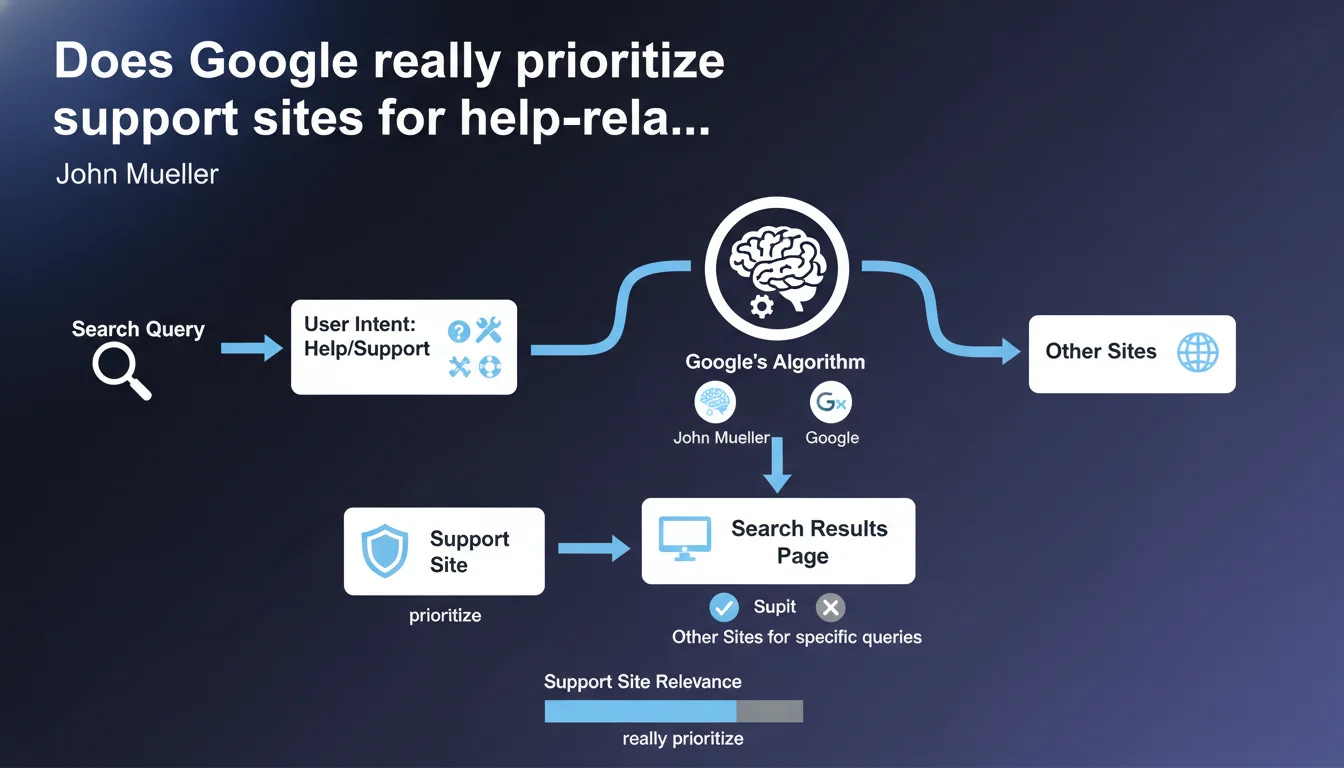
Google claims to detect support intent in queries and adjust search results accordingly. Each site appears "when appropriate," leaving considerable room for interpretation. In short: contextual relevance takes priority, but the exact mechanism remains opaque.
What you need to understand
Can Google really identify support intent?
Mueller's statement suggests that the algorithm recognizes support intent signals in queries. This implies semantic analysis of patterns like "how to fix," "problem with," "error," "not working," etc.
In practice, this means Google would attempt to prioritize help pages, FAQs, forums, or technical documentation when the query contains these markers. But "tries to recognize" is not the same as "systematically recognizes" — there's an admitted margin for error.
What does this change for a support site's ranking?
If your site offers support-oriented content, this statement confirms that there is specific treatment for these pages. They're not evaluated solely on classic criteria (authority, backlinks, etc.), but also on their contextual fit to the detected intent.
The catch? "When appropriate" remains vague. Google doesn't specify the exact criteria, thresholds, or signals that trigger this preferential display.
Does this mean all support sites are treated equally?
No. The phrasing "each site is shown in search results when appropriate" is rhetorical sleight of hand. It implies no equality of treatment — just that Google believes it's making the right call based on its own logic.
A poorly structured support site with weak content or a terrible UX won't benefit from the same treatment as a well-designed help center, even if the query intent is identical.
- Google attempts to detect support intents via semantic markers in queries
- Support pages can benefit from preferential display if they match this intent
- Contextual relevance and content quality remain decisive — no automatic free pass
- The phrasing remains vague and commits Google to no specific criteria
SEO Expert opinion
Is this statement consistent with what we observe in the field?
Yes and no. On queries explicitly oriented toward support ("WordPress 404 error," "reset iPhone"), we do see that help centers, official forums, and technical documentation rank well. Nothing surprising so far.
Where it gets tricky: on ambiguous or semi-support queries ("problem with X"), SERPs are often a heterogeneous mix — blog articles, user reviews, product pages. The boundary between support intent and informational intent remains blurry, and Google doesn't always seem to draw a clear line.
What nuances should we add to this claim?
First nuance: Mueller says "when appropriate," which is a handy exit clause. If your support site doesn't rank, Google can always invoke that it wasn't "appropriate" in this specific context — without having to justify why.
Second nuance: this specific treatment doesn't compensate for structural gaps. A site with orphan pages, broken pagination, or superficial answers won't be saved by simple support intent detection. Quality always wins.
In what cases does this rule not apply?
Let's be honest: this logic works mainly for established brands with structured help centers. A small e-commerce site with three FAQs hidden in the footer won't get any preferential treatment, even if the query has support intent.
Similarly, if your support content is duplicated (copied from generic docs), poorly written, or too generic, Google will favor richer third-party sources — community forums, Reddit, Stack Overflow, etc. Perceived authority always matters.
Practical impact and recommendations
What concrete steps should you take to leverage this?
First, structure your support content explicitly. Use appropriate schema.org tags (FAQPage, HowTo, QAPage) to clearly signal the nature of your pages. Google likes when you do the heavy lifting for it.
Next, work on your titles and H1s with clear intent markers: "How to solve," "Problem with," "Troubleshooting guide," "Error." No need to overdo it — just be explicit. And avoid internal jargon no one searches for.
Create a dedicated, visible information architecture: /support/, /help/, /faq/. Don't bury support pages in /blog/2019/misc/. A clearly identified section makes crawling easier and reinforces the contextual signal.
What mistakes should you avoid at all costs?
Don't mix commercial and support content on the same page. A page that sells AND solves a problem sends a mixed signal — Google won't know how to classify it. Separate the intents.
Avoid answers that are too short or generic. A FAQ with two-line answers will never be seen as a quality resource. Develop, contextualize, provide real value — even on simple questions.
And above all: don't count on this "automatic recognition" to compensate for poor UX. If your support pages are slow, poorly formatted, or unreadable on mobile, no algorithm will save them.
- Audit your current support section structure — is it easily identifiable and accessible?
- Implement relevant schema.org tags (FAQPage, HowTo, QAPage) on all related pages
- Rework titles and H1s with explicit, natural intent markers
- Create a clear dedicated information architecture (/support/ or /help/) if not already in place
- Enrich existing answers — aim for 300+ words per response with concrete examples
- Strictly separate commercial and support content to avoid mixed signals
- Test mobile readability and loading speed for these pages specifically
- Monitor positions on identified support queries — track monthly evolution
🎥 From the same video 3
Other SEO insights extracted from this same Google Search Central video · published on 06/08/2025
🎥 Watch the full video on YouTube →
💬 Comments (0)
Be the first to comment.