
Official statement
What you need to understand
Google officially takes a stance against using domain names composed solely of generic keywords, particularly for small businesses. This practice, once considered an SEO advantage, is now perceived as counterproductive.
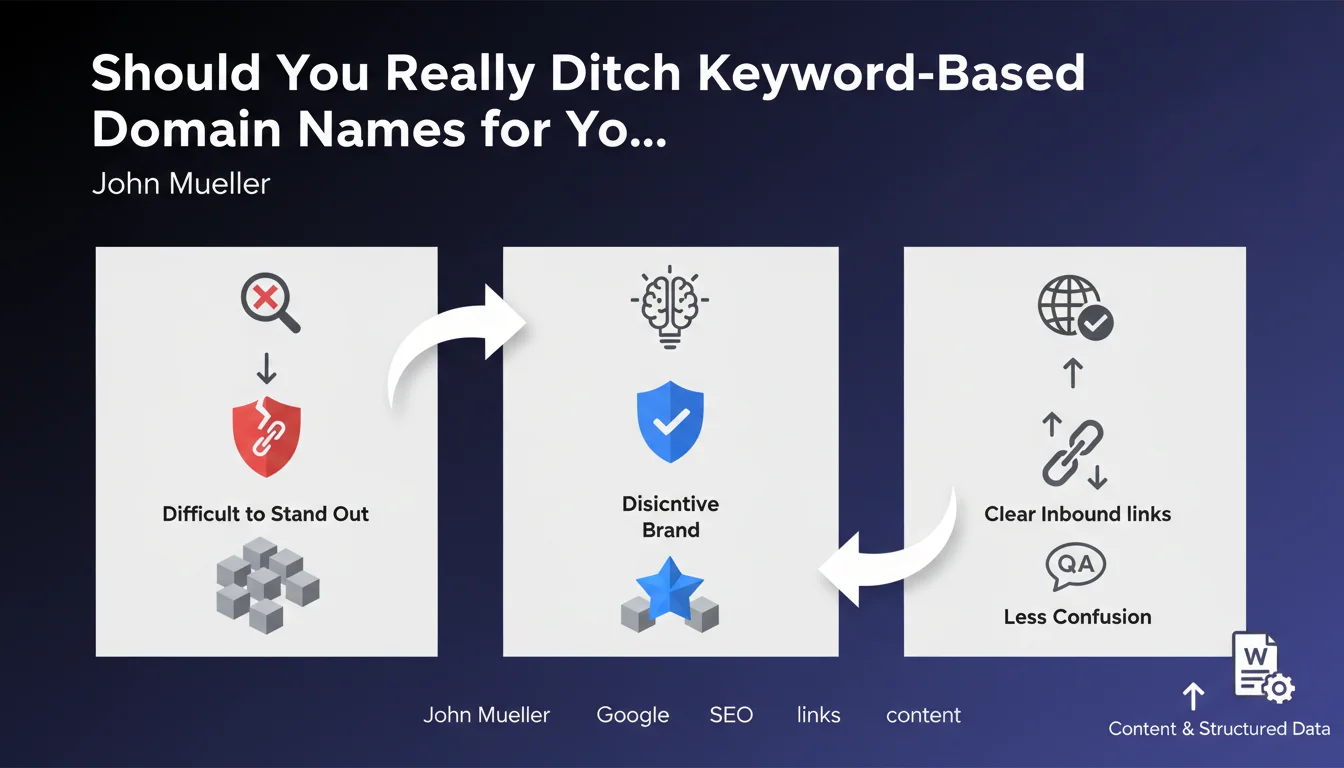
The main problem lies in the difficulty of standing out in a saturated environment. When dozens of sites use similar domains targeting the same queries, confusion reigns and memorability becomes nonexistent.
Google now favors an approach based on distinctive brand identity. A memorable name facilitates recognition, generates direct search signals, and enables obtaining inbound links with natural anchors featuring the brand name.
- Generic keyword domains hinder differentiation in SERPs
- Building a brand generates positive long-term signals
- Local SEO benefits more from content optimization and Google Business Profile
- Quality, relevance, and trust criteria take precedence over keywords in the domain
- The historical advantage of EMDs (Exact Match Domains) is a thing of the past
SEO Expert opinion
This statement perfectly reflects the evolution observed over several years in search results. Google's algorithms are mature enough to understand a site's theme without relying on the domain name.
However, nuance is needed: exact match domains retain a slight advantage in very specific and low-competition niches. For ultra-precise local queries or niche markets, an EMD can still facilitate initial positioning, but this advantage quickly disappears when faced with competitors having a real content strategy.
The real risk of generic domains lies in their long-term limitation. If your business evolves, diversifies its services, or wants to position itself on new topics, an overly restrictive domain becomes a burden. Moreover, these domains often attract increased algorithmic scrutiny, as Google has historically associated them with spam practices.
Practical impact and recommendations
- For new projects: Choose a unique, memorable, and pronounceable brand name, avoid domains composed solely of generic keywords
- Invest in branding: Develop a coherent visual identity and work on your brand awareness (branded searches, mentions, links)
- Optimize your local SEO differently: Focus on your Google Business Profile listing, customer reviews, LocalBusiness structured data, and geolocated content
- Work on your brand signals: Encourage direct searches for your name, obtain links with branded anchors, develop your social media presence
- If you already have an EMD: Evaluate the ROI of a migration based on your history, current traffic, and future development projects
- For migrating from an EMD: Meticulously plan 301 redirects, communicate extensively about the change, prepare for a transition period of 6 to 12 months
- Create quality content: Compensate for the absence of keywords in the domain with a solid editorial strategy, well-optimized pages, and clear architecture
- Don't neglect UX and technical aspects: Loading speed, mobile usability, and HTTPS security are far more impactful factors than keywords in the domain
Implementing these recommendations requires in-depth technical and strategic expertise, particularly for domain migrations or building a coherent brand strategy. Given the increasing complexity of modern SEO and the long-term visibility stakes, support from a specialized SEO agency can prove decisive in avoiding costly mistakes and maximizing the return on investment of your redesign.
💬 Comments (0)
Be the first to comment.