
Official statement
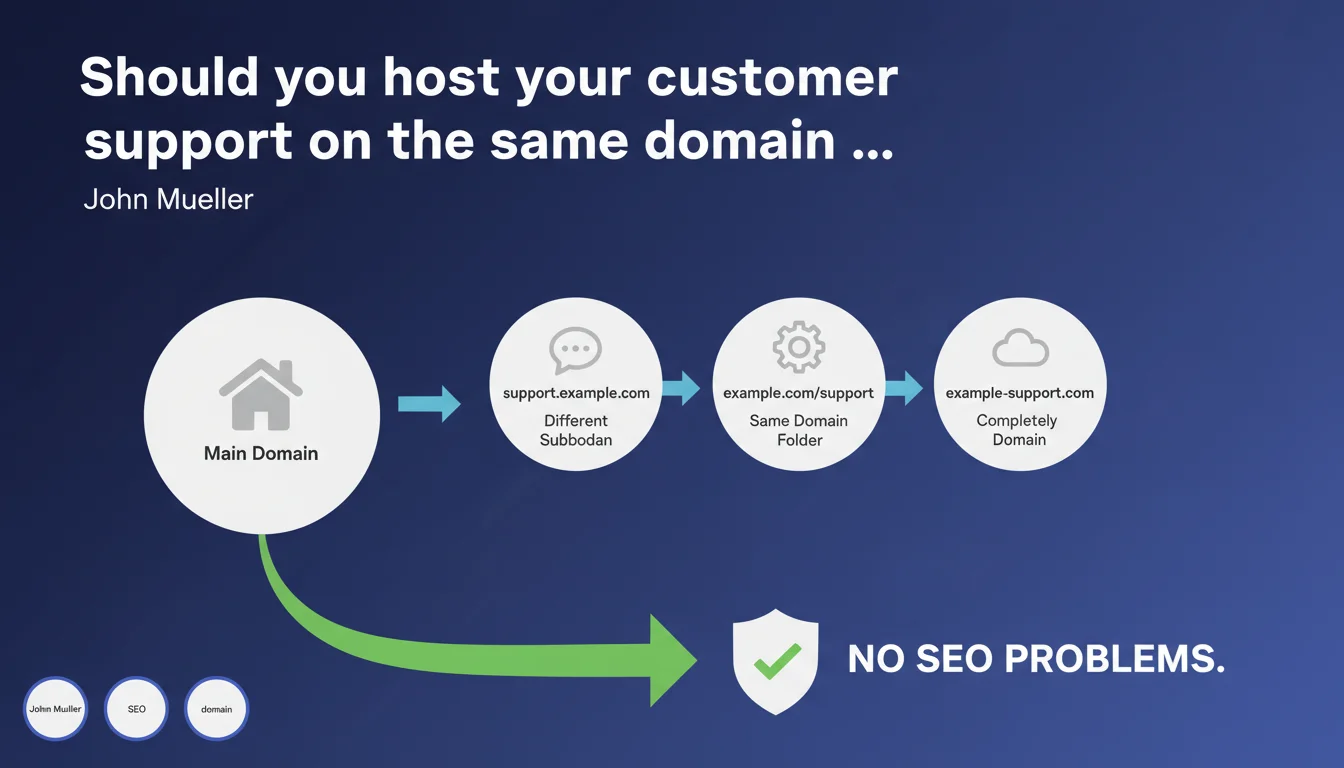
Google confirms that hosting your help center on a subdomain or a completely separate domain does not penalize your SEO performance. This common configuration poses no SEO issues according to Mueller. You can therefore choose the architecture that best suits your technical constraints without fearing any negative impact.
What you need to understand
Why is Google making this statement now?
The question of hosting technical support comes up regularly in SEO discussions. Many sites hesitate between integrating their documentation into the main domain or separating it.
The reason? A persistent belief that a subdomain would be treated as a distinct entity and would not transfer authority to the main domain. Mueller clears things up: this configuration is perfectly normal and does not hinder SEO performance.
What does this actually change in practice?
This clarification frees technical teams from architectural constraints imposed solely for supposed SEO reasons. If your support tools (Zendesk, Intercom, custom solutions) work better on a separate domain, no problem.
Google evaluates this content on its own merit — quality, relevance, user experience. The technical location becomes secondary.
- A typical subdomain like support.yoursite.com is a valid configuration
- A distinct domain like yoursite-help.com does not penalize the main site
- The choice depends on your technical and organizational constraints, not SEO
- Authority and relevance matter more than hosting architecture
- Links between domains/subdomains are evaluated normally by Google
Is this position consistent with real-world observations?
Yes and no. In practice, many sites with support on subdomains perform very well. But some professionals have observed differences in authority transmission between main domain and subdomain.
The nuance: Mueller says it doesn't cause a problem, not that it's equivalent. Content on the main domain mechanically benefits from its existing authority — a subdomain often starts from zero.
SEO Expert opinion
Does this statement really settle the subdomain vs. directory debate?
No, and that's where it gets tricky. Mueller confirms there is no penalty for using a subdomain or separate domain. That's not the same thing as saying "it's equivalent".
In practice, a directory like yoursite.com/support directly inherits the authority of the main domain. A subdomain like support.yoursite.com must build its own credibility. No penalty, certainly — but no automatic advantage either.
In what cases is it still better to separate?
When your technical or organizational constraints require it. If your support team uses a SaaS platform that doesn't allow integration on the main domain, don't fight windmills.
Similarly, if your technical documentation requires a technology stack incompatible with your main site, separation becomes legitimate. Mueller is telling you: do what makes sense for your organization.
What are the limitations of this approach?
The devil is in the implementation details. A separate domain poorly configured — without coherent internal links, without clear semantic structure — will remain invisible in SERPs.
Mueller's statement doesn't exempt you from doing good SEO on that content. It simply says that technical location isn't a blocking factor. The rest of the work remains entirely your responsibility.
Practical impact and recommendations
What should you do if your support is already on a subdomain?
Nothing special if it's working. Don't migrate solely for SEO reasons — you risk creating more problems than you solve.
Focus instead on content quality, optimizing support pages for relevant queries, and internal linking between your different properties.
How do you maximize SEO value for support on a separate domain?
Work on bidirectional links between main site and support. Ensure your documentation appears in natural user journeys, not as an orphaned appendix.
Optimize support content for long-tail queries — that's often where untapped potential lies. A well-ranked troubleshooting article can become a gateway to your services.
- Verify that your subdomain or separate domain is properly declared in Search Console
- Ensure coherent internal linking between all your properties
- Optimize support pages for informational search intent
- Use appropriate structured data (FAQPage, HowTo) on support content
- Measure support SEO performance independently to identify opportunities
- Don't migrate without valid reason — stability has value
Should you reconsider your content architecture?
Only if you're starting from scratch or have other reasons to redesign. This statement alone doesn't justify a migration.
If you're building a new site, still prioritize a directory on the main domain unless there's a strong technical constraint. It's simply easier to manage — fewer distinct properties, fewer Search Console configurations, direct authority inheritance.
🎥 From the same video 3
Other SEO insights extracted from this same Google Search Central video · published on 06/08/2025
🎥 Watch the full video on YouTube →
💬 Comments (0)
Be the first to comment.