
Official statement
Other statements from this video 19 ▾
- □ Does Google really index all languages the same way?
- □ Are nofollow links and noindex tags actually hurting your SEO?
- □ Do 404 errors really hurt your site's search rankings?
- □ Should you really redirect all 404 pages to improve your SEO?
- □ Does your image CDN speed really penalize your ranking in Google Images?
- □ Can you really reset Search Console data when you take over a website?
- □ Are regional subdomains enough to target a specific geographic market?
- □ Does Google really penalize you for publishing video transcriptions as text on your website?
- □ Why does Google reject aggregated reviews in product structured data?
- □ Does Google really crawl URL variations that have no internal links or backlinks pointing to them?
- □ Why does Googlebot keep crawling 404 pages long after they've been deleted?
- □ Is the text-to-code ratio really a Google ranking factor?
- □ Do UTM parameters with medium=referral really kill the SEO value of a backlink?
- □ Do you really need to reply to every blog comment to boost your SEO?
- □ Should you worry when robots.txt shows up as a soft 404 in Search Console?
- □ Do you really need to worry about missing X-Robots-Tag and meta robots tags?
- □ Are your automatic Geo IP redirects killing your international SEO performance?
- □ Can modifying your title tags and meta descriptions really shift your Google rankings?
- □ Can poor quality links or traffic harm your site's reputation?
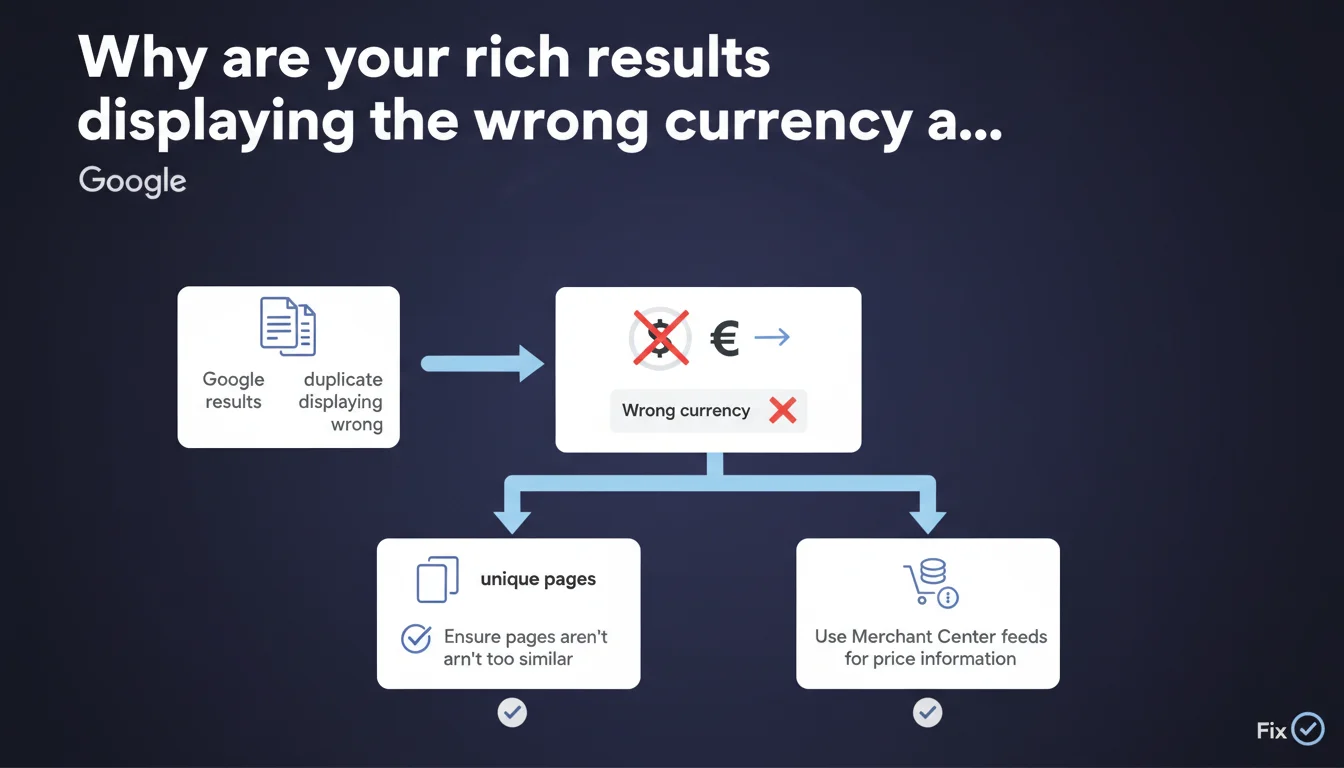
Google confirms that currency errors in rich results often stem from duplicate content detection. When the search engine considers your pages too similar, it can mix price information across different versions. The solution involves either genuine content differentiation or using Merchant Center.
What you need to understand
How does Google detect duplicate content for rich results?
The system doesn't just compare your URLs — it analyzes the substance of the content. Two pages with minor variations (just the currency changing, for example) are perceived as duplicates. Google then has to choose which version to display, and this choice can create inconsistencies.
The problem particularly affects multi-currency e-commerce sites that duplicate their product pages. One page in euros, one in dollars, one in pounds sterling — but the rest of the content remains identical word for word.
What distinguishes this situation from classic duplicate content?
Here, we're not talking about a ranking penalty. Duplicate content doesn't directly affect your rankings in this specific case. What's stuck is the display of structured data in rich results.
Google can index all three of your versions just fine, but when it generates the rich snippet, it pulls the info from whichever version it considers canonical — not necessarily the one you want.
Why is Merchant Center presented as a solution?
Merchant Center operates on a centralized product feed model. You send your data directly to Google, outside the standard crawl circuit. This bypasses the duplicate detection problem because you explicitly control which information displays for which market.
It's a workaround, not a fix for the underlying problem. But it works.
- Currency errors in rich results are a symptom of overly similar content, not a markup error
- Google doesn't penalize these pages, but it mixes their structured data
- Merchant Center bypasses this problem through a controlled product feed
- The real solution remains substantial differentiation of content between versions
SEO Expert opinion
Does this explanation really hold up in practice?
Yes and no. Google's explanation is valid for cases where content is truly copy-pasted between versions. But I've seen sites with quality localized content encounter the exact same problem. [To verify]: Isn't Google's similarity threshold too strict?
The real issue is that you have no indicator in Search Console to detect this phenomenon before it manifests to your users. You discover the problem when a customer tells you they're seeing prices in dollars when they're on your European version.
Is the Merchant Center recommendation realistic for all sites?
No. Merchant Center imposes heavy technical and operational constraints: feeds to maintain, strict product specs, eligibility limited to certain product types. For a site with 50,000 SKUs and 5 currencies, it's manageable. For a small artisanal e-commerce store, it's disproportionate.
Google presents this as an alternative, but in practice, it's often the only viable solution for large multi-currency catalogs. Substantially differentiating 10,000 product pages in 3 languages? Unrealistic.
What are the gray areas in this statement?
Google doesn't specify the similarity threshold that triggers this merging of structured data. 70% identical content? 90%? We're flying blind.
Another unclear point: what happens when you use canonical + hreflang + partial differentiation together? The priority order of these signals isn't clear. In my tests, I've observed that the canonical tag takes precedence, but this isn't officially documented. [To verify]
Practical impact and recommendations
How do you verify if your pages are affected by this problem?
First step: manually test your rich results with Google's testing tool. Compare what displays versus what you have in your markup. If the currency or price doesn't match, you're affected.
Second check: analyze your server logs to see if Googlebot crawls all your currency versions. If it systematically ignores some, that's a signal it considers them low-value duplicates.
Third verification: in Search Console, look at indexed pages versus submitted for each language/currency version. A significant gap confirms the problem.
What concrete actions should you take immediately?
If you only have 2-3 currencies and a limited catalog, prioritize content differentiation. That means: product descriptions adapted to the market (not just translated), localized trust elements, customer reviews specific to each geographic area.
For large catalogs, Merchant Center becomes essential. Set up a product feed per currency with proper specifications. Make sure product IDs match exactly between your site and the feed.
- Audit the rich results displayed for each currency version of your key pages
- Compare the markup present in source code versus what Google actually displays
- Analyze logs to identify which versions Googlebot ignores or crawls sparingly
- If limited catalog: enrich content specific to each market (minimum 30% difference)
- If large catalog: implement Merchant Center with one feed per currency/market
- Verify your canonicals don't accidentally point to the wrong currency version
- Monitor progress in Search Console after each change (allow 2-4 weeks)
Should you prioritize one approach over another?
It depends on your current technical architecture. If you already have a product feed management system (for comparison sites, for example), extending to Merchant Center will be simpler. If your content is managed in a flexible CMS, differentiation might be faster to implement.
In any case, avoid the middle ground: pages that remain too similar while not using Merchant Center. You'll accumulate the disadvantages without the benefits.
❓ Frequently Asked Questions
Les balises hreflang suffisent-elles à résoudre ce problème de devise ?
Est-ce que cette erreur de devise impacte mon positionnement dans les résultats de recherche ?
Combien de temps faut-il pour que Google corrige l'affichage après mes modifications ?
Peut-on utiliser la balise canonical pour forcer l'affichage d'une devise spécifique ?
Merchant Center est-il obligatoire pour tous les sites e-commerce ?
🎥 From the same video 19
Other SEO insights extracted from this same Google Search Central video · published on 21/08/2024
🎥 Watch the full video on YouTube →
💬 Comments (0)
Be the first to comment.