
Official statement
Other statements from this video 19 ▾
- □ Does Google really index all languages the same way?
- □ Are nofollow links and noindex tags actually hurting your SEO?
- □ Do 404 errors really hurt your site's search rankings?
- □ Should you really redirect all 404 pages to improve your SEO?
- □ Does your image CDN speed really penalize your ranking in Google Images?
- □ Can you really reset Search Console data when you take over a website?
- □ Are regional subdomains enough to target a specific geographic market?
- □ Why are your rich results displaying the wrong currency and what's the fix?
- □ Does Google really penalize you for publishing video transcriptions as text on your website?
- □ Does Google really crawl URL variations that have no internal links or backlinks pointing to them?
- □ Why does Googlebot keep crawling 404 pages long after they've been deleted?
- □ Is the text-to-code ratio really a Google ranking factor?
- □ Do UTM parameters with medium=referral really kill the SEO value of a backlink?
- □ Do you really need to reply to every blog comment to boost your SEO?
- □ Should you worry when robots.txt shows up as a soft 404 in Search Console?
- □ Do you really need to worry about missing X-Robots-Tag and meta robots tags?
- □ Are your automatic Geo IP redirects killing your international SEO performance?
- □ Can modifying your title tags and meta descriptions really shift your Google rankings?
- □ Can poor quality links or traffic harm your site's reputation?
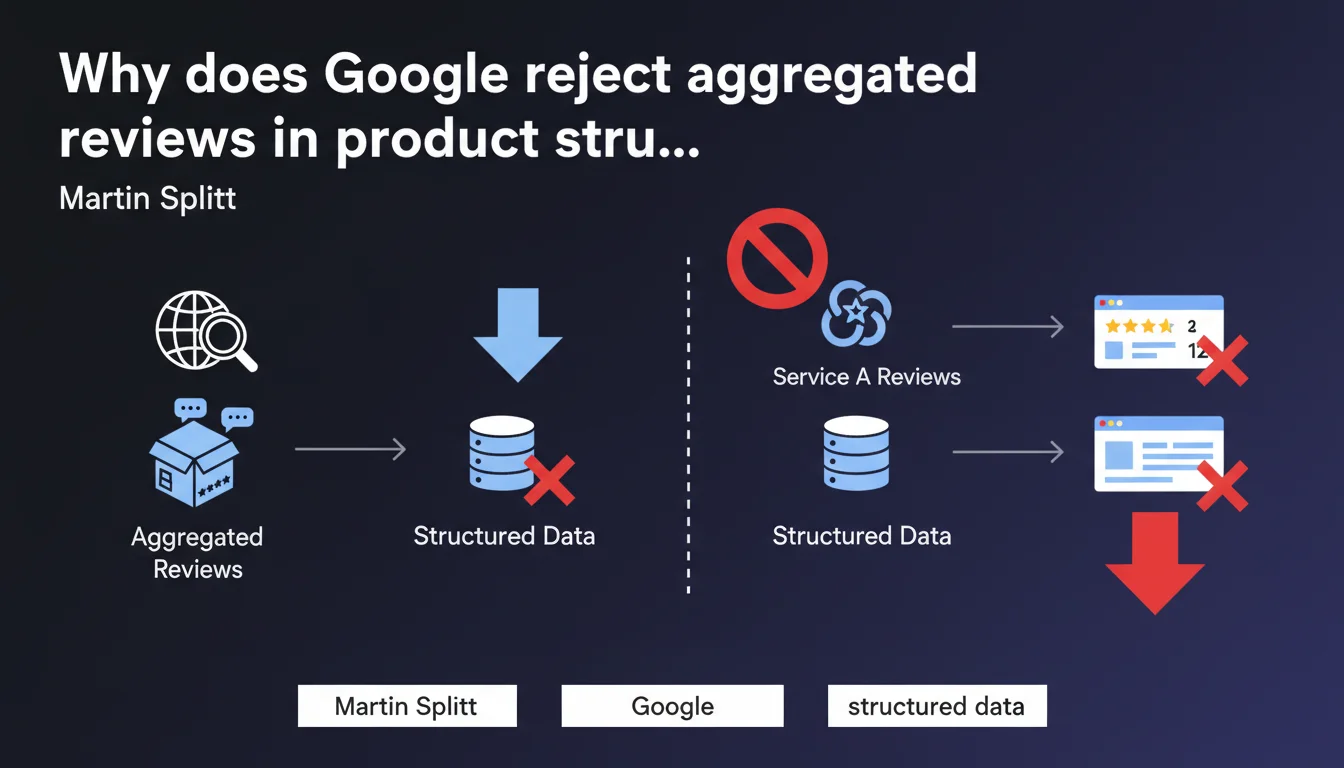
Google explicitly prohibits importing reviews from third-party platforms (Trustpilot, Avis Vérifiés, etc.) and marking them up as structured data on your product pages. This practice makes your pages ineligible for review rich snippets. Only native reviews collected directly on your site are permitted.
What you need to understand
What is the exact rule stated by Google?
Martin Splitt is explicit: aggregated reviews from an external service must not be transmitted to Google via Review or AggregateRating structured data types on product pages. This prohibition is stated clearly in Google's technical guidelines.
Concretely, if you retrieve ratings from Trustpilot, Avis Vérifiés, Google Customer Reviews, or any other aggregator, and inject them into your Schema.org markup, you are violating the rules. Google considers this practice an attempt to manipulate rich snippets.
Why does this restriction exist?
Google wants to prevent merchants from artificially stacking reviews from multiple sources to inflate their displayed ratings in the SERPs. The goal is to ensure that the stars displayed reflect the real user experience on the site in question — not a composite aggregate from third-party platforms.
Another reason: preventing abuse. Some e-commerce businesses were using external review services to circumvent Google's moderation and transparency requirements. By restricting to native reviews, Google maintains quality control over what appears in its results.
What is still permitted then?
You can mark up reviews collected directly on your site, via your own rating system or an integrated widget that stores data with you. The essential point is that the review is published on your domain and users can view it without being redirected to a third-party platform.
Reviews from your Google Business Profile listing remain eligible for local rich snippets, but they should not be manually re-injected into your site's product markup. These are two separate contexts.
- Prohibited: Importing reviews from Trustpilot, Avis Vérifiés, Yelp, etc. and marking them up as Schema.org Review/AggregateRating
- Prohibited: Displaying average ratings from external aggregators in your product structured data
- Permitted: Marking up reviews collected natively on your site, visible directly on your product pages
- Permitted: Using Google Business Profile reviews in local rich snippets (but not in e-commerce product markup)
- Gray area: Third-party widgets that display AND host reviews on your domain — the line is blurry
SEO Expert opinion
Is this guideline consistent with what we observe in the field?
Yes and no. Google does apply manual actions against sites that abuse external aggregated reviews. We've seen e-commerce businesses lose their stars overnight after injecting Trustpilot ratings into their Schema.org.
But — and this is where it gets tricky — automated detection still seems erratic. Some sites openly violate this rule for months without visible penalty. Others get flagged within weeks. [To verify]: Google has never communicated the triggering thresholds or detection methods. We're flying blind.
What nuances should be added to this statement?
First point: the wording "reviews aggregated from a specific service" leaves room for doubt. If you use a third-party widget that collects reviews but publishes them directly on your domain (without redirection), are you in violation? Technically, the review is visible on your site. But collection is outsourced.
Google has never clarified this edge case. My interpretation — based on 15 years in the field — is that what matters is where the review is first published. If it appears first on Trustpilot and then is re-imported to you, that's a no. If it's collected by a third party but published only on your site, it passes. But again: [To verify] due to lack of precise official documentation.
In what cases does this rule not apply?
Reviews on your Google Business Profile listing are not subject to this restriction — they feed local rich snippets (local pack, Google Maps) but should not be manually re-injected into your e-commerce product pages.
Third-party review platforms can still mark up their own pages with reviews they host. A site like Trustpilot can display stars in the SERPs for its own URLs. It's only cross-domain imports that are prohibited.
Practical impact and recommendations
What should you do concretely right now?
First step: audit your current Schema.org markup. Inspect your product pages with Google's Rich Results Test. Verify that marked-up reviews actually come from your own rating system, not from a Trustpilot import or equivalent.
If you use a CMS (WordPress, Shopify, PrestaShop), disable plugins that automatically inject external reviews into structured data. Many merchants get caught by poorly configured third-party extensions.
Next: implement a native review collection system. This can be a module integrated into your e-commerce platform, a custom widget, or a SaaS solution that publishes reviews directly on your domain. The key is that the review is visible on your site without redirection to an external platform.
What errors must you absolutely avoid?
Do not attempt to "hide" the origin of reviews by modifying Schema.org metadata. Google cross-references structured data with visible content — if your markup shows 4.8/5 stars but the page displays Trustpilot reviews at 4.2/5, you'll be flagged.
Also avoid combining multiple review sources on the same product page. Displaying both your native reviews AND a Trustpilot widget creates confusion — and if you mark up both, you're in violation. Choose one source and stick with it.
How can you verify your site is compliant?
Use Google's Rich Results Test: paste your product page URLs and verify that detected Review/AggregateRating data matches the reviews actually visible on the page. If the tool reports errors or warnings about reviews, investigate further.
Also monitor your Search Console: in the "Enhancements > Product Reviews" section, Google flags ineligible pages and reasons. If you see "Reviews from external source", you're out of compliance.
- Audit product pages with Google's Rich Results Test
- Verify that reviews marked in Schema.org are truly native (collected on your domain)
- Disable plugins/widgets that automatically import third-party reviews into markup
- Implement an internal review collection system if not already in place
- Do not mix multiple review sources on the same product page
- Check Search Console (Enhancements > Reviews section) to detect error pages
- Ensure visually displayed reviews match the marked-up structured data
❓ Frequently Asked Questions
Puis-je afficher des avis Trustpilot sur mes pages produit sans les baliser en Schema.org ?
Les avis Google Business Profile peuvent-ils être utilisés dans le balisage produit e-commerce ?
Qu'est-ce qu'un "avis natif" exactement ?
Que risque mon site si je balisé des avis agrégés externes ?
Comment savoir si mon plugin WordPress injecte des avis tiers dans le balisage ?
🎥 From the same video 19
Other SEO insights extracted from this same Google Search Central video · published on 21/08/2024
🎥 Watch the full video on YouTube →
💬 Comments (0)
Be the first to comment.