
Official statement
Other statements from this video 19 ▾
- □ Does Google really index all languages the same way?
- □ Are nofollow links and noindex tags actually hurting your SEO?
- □ Do 404 errors really hurt your site's search rankings?
- □ Should you really redirect all 404 pages to improve your SEO?
- □ Does your image CDN speed really penalize your ranking in Google Images?
- □ Can you really reset Search Console data when you take over a website?
- □ Are regional subdomains enough to target a specific geographic market?
- □ Why are your rich results displaying the wrong currency and what's the fix?
- □ Does Google really penalize you for publishing video transcriptions as text on your website?
- □ Why does Google reject aggregated reviews in product structured data?
- □ Does Google really crawl URL variations that have no internal links or backlinks pointing to them?
- □ Why does Googlebot keep crawling 404 pages long after they've been deleted?
- □ Is the text-to-code ratio really a Google ranking factor?
- □ Do UTM parameters with medium=referral really kill the SEO value of a backlink?
- □ Do you really need to reply to every blog comment to boost your SEO?
- □ Should you worry when robots.txt shows up as a soft 404 in Search Console?
- □ Do you really need to worry about missing X-Robots-Tag and meta robots tags?
- □ Are your automatic Geo IP redirects killing your international SEO performance?
- □ Can poor quality links or traffic harm your site's reputation?
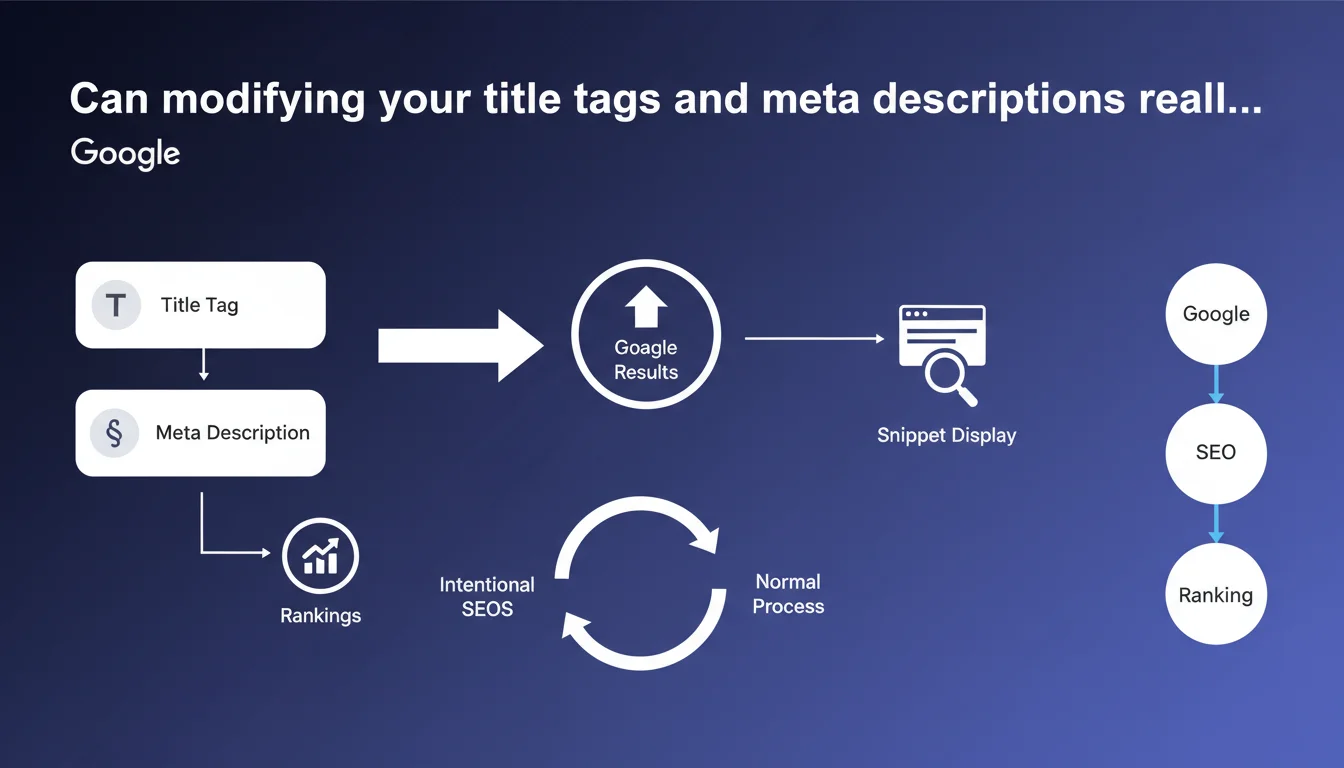
Google confirms that modifying titles (title tags, H1-H6) can affect positioning, while changing the meta description only impacts snippet display. These fluctuations are normal and part of everyday SEO — but you still need to understand why and how to anticipate them.
What you need to understand
Why does Google distinguish between titles and meta descriptions in this statement?
The nuance is essential: titles (title tag and H1-H6 headings) are thematic relevance signals that Google uses to understand what a page is about. Modifying an H1 or title tag potentially redefines the page's main subject in the search engine's eyes.
The meta description, on the other hand, has played no role in rankings for years. Its sole function: to drive clicks through the snippet displayed in search results. Changing a description can therefore modify click-through rate (CTR), but not directly affect algorithmic positioning.
What does it concretely mean when "changing the title can affect rankings"?
Google isn't saying that every modification will systematically boost or drop a page. It's simply reminding us that modifying a relevance signal triggers a re-evaluation. If you shift from a generic title to one tightly focused on a specific query, you can gain positions. Conversely, diluting an optimized title can cause you to lose ground.
The search engine must reindex the page, recalculate its relevance against targeted queries, and reposition the document in its indexes. This process takes time — anywhere from a few hours to several days depending on your site's crawl frequency.
Is this a risky practice or a common one among SEOs?
Google clarifies that these adjustments are "often done intentionally by SEOs," thereby acknowledging that continuous title optimization is a normal practice. There's no penalty to fear, as long as modifications remain relevant and consistent with the page's content.
That said, overly frequent or erratic changes can create instability: Google hesitates, recalculates, and positioning fluctuates without clear direction. The key remains thematic consistency.
- Modifying a title or H1 = relevance signal recalculated, possible impact on rankings
- Modifying a meta description = no algorithmic impact, but potentially modified CTR
- Post-modification fluctuations are normal and expected
- No penalty if changes are coherent and intentional
- Allow time for Google to reindex before judging the effect
SEO Expert opinion
Is this statement consistent with on-the-ground observations?
Absolutely. For years, we've observed in practice that reworking a title on a target query can shift positions within days. Google's statement officializes what every SEO experiences regularly: the title remains a major tactical lever.
What's missing from this statement is nuance on the amplitude of the effect. Google doesn't say whether modifying an H2 or H3 carries the same weight as a title tag. We know empirically that the title tag and H1 have far greater impact than subheadings, but Google remains vague on the hierarchy of importance.
What nuances should we add to this claim?
The devil is in the details. Modifying a title can affect rankings — but in which direction? It depends entirely on how relevant the modification is to search intent. A better-targeted title improves positioning. A vague title or one stuffed with irrelevant keywords degrades it.
Another point: Google doesn't mention the indirect impact of CTR. If a new meta description boosts click-through rate, this can positively influence rankings over time (user signal). Saying the description has "no impact" is technically true for the algorithm, but reductive from a strategic standpoint.
In which cases does this rule not really apply?
On very weak pages lacking backlinks and authority, modifying the title will change nothing if the page has no chance of ranking. On-page optimization cannot compensate for a severe deficit in off-page signals.
Similarly, on ultra-competitive queries, a simple title adjustment never suffices. Ranking then depends on a much broader bundle of signals (backlinks, EAT, freshness, etc.). [To verify]: Google doesn't clarify whether title modifications carry the same weight on transactional versus informational queries — it's likely the impact varies by query type.
Practical impact and recommendations
What should you concretely do before modifying your titles?
Before any modification, make sure you understand why you're doing it. If it's to better target a query, first verify that your content actually answers that intent. An optimized title on off-topic content will only increase bounce rate.
Document your changes: note the date, old and new title, initial position. Then give yourself at least 7 to 10 days before drawing conclusions — Google needs time to reindex and recalculate.
What mistakes should you absolutely avoid when making these modifications?
Never change all your titles at once. Testing page by page allows you to isolate effects and understand what works. A global overhaul without tracking turns your site into a black box.
Also avoid modifying a title that's already performing well, unless you have a solid hypothesis. Optimizing for optimization's sake is a waste of time — potentially counterproductive.
- Modify a title or H1 only if you have a clear strategic intent
- Verify that the page's content supports the new title well
- Document each change (date, old version, new version, initial position)
- Wait at least 7 to 10 days minimum before evaluating impact
- Test page by page, never in bulk
- Monitor CTR alongside rankings (Search Console)
- Verify that Google hasn't rewritten your title in the SERPs
How do you ensure these adjustments produce measurable results?
Search Console is your best ally: compare performance before/after over the relevant period. Track both average positioning and CTR — a good title improves both.
If you notice a drop after modification, don't panic immediately. Google may test different title variants in the SERPs before stabilizing. Wait 2 to 3 weeks before rolling back.
❓ Frequently Asked Questions
Modifier une meta description peut-il quand même influencer le classement indirectement ?
Combien de temps faut-il attendre après avoir modifié un title pour voir un effet ?
Google peut-il ignorer mon title et afficher autre chose en SERP ?
Est-ce risqué de modifier les titles de pages qui rankent déjà bien ?
Les H2, H3, H4 ont-ils le même poids que le H1 dans cette logique ?
🎥 From the same video 19
Other SEO insights extracted from this same Google Search Central video · published on 21/08/2024
🎥 Watch the full video on YouTube →
💬 Comments (0)
Be the first to comment.