
Official statement
Other statements from this video 19 ▾
- □ Does Google really index all languages the same way?
- □ Are nofollow links and noindex tags actually hurting your SEO?
- □ Do 404 errors really hurt your site's search rankings?
- □ Should you really redirect all 404 pages to improve your SEO?
- □ Does your image CDN speed really penalize your ranking in Google Images?
- □ Can you really reset Search Console data when you take over a website?
- □ Are regional subdomains enough to target a specific geographic market?
- □ Why are your rich results displaying the wrong currency and what's the fix?
- □ Does Google really penalize you for publishing video transcriptions as text on your website?
- □ Why does Google reject aggregated reviews in product structured data?
- □ Does Google really crawl URL variations that have no internal links or backlinks pointing to them?
- □ Why does Googlebot keep crawling 404 pages long after they've been deleted?
- □ Is the text-to-code ratio really a Google ranking factor?
- □ Do UTM parameters with medium=referral really kill the SEO value of a backlink?
- □ Do you really need to reply to every blog comment to boost your SEO?
- □ Should you worry when robots.txt shows up as a soft 404 in Search Console?
- □ Do you really need to worry about missing X-Robots-Tag and meta robots tags?
- □ Are your automatic Geo IP redirects killing your international SEO performance?
- □ Can modifying your title tags and meta descriptions really shift your Google rankings?
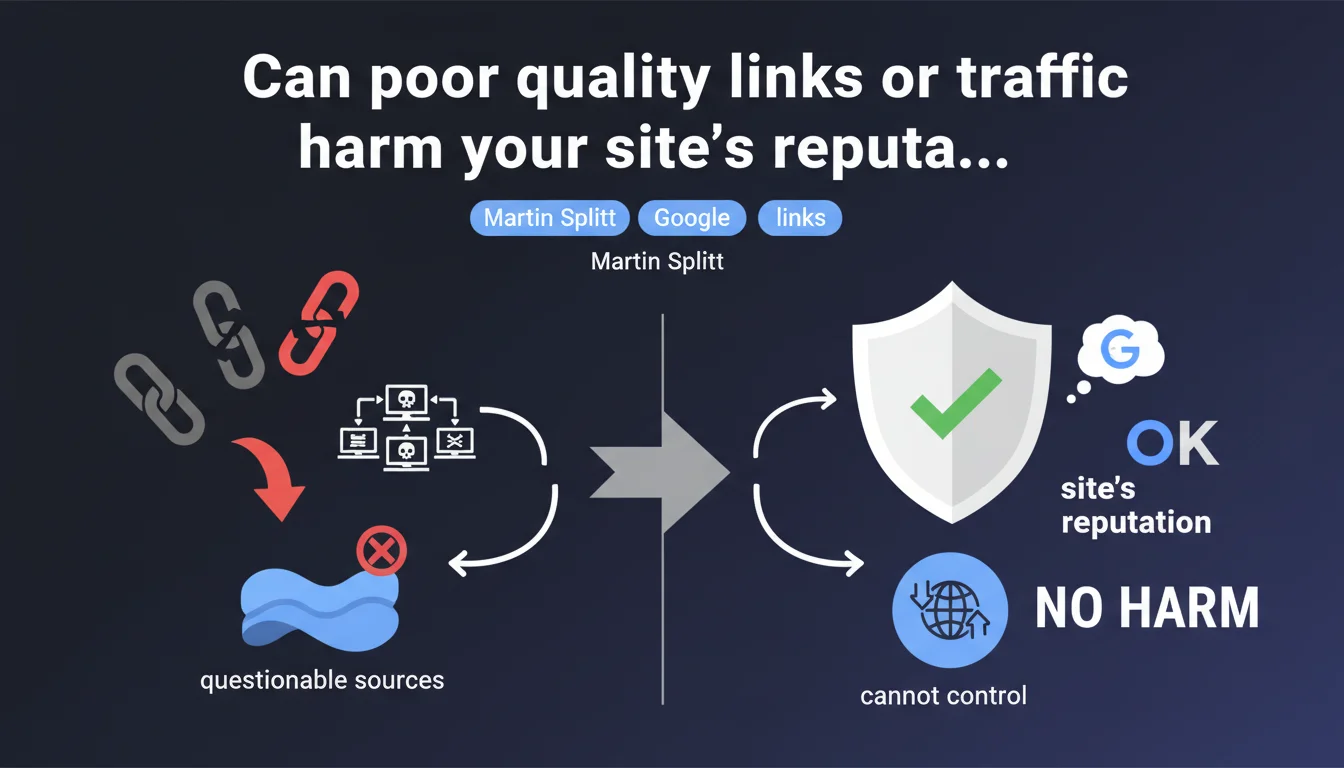
Google states that receiving traffic or links from questionable sources does not penalize a site. No one has complete control over where their backlinks or visitors come from, and the search engine does not judge a site's reliability on this basis. In theory, a competitor therefore cannot sabotage you by sending you toxic links.
What you need to understand
This statement from Martin Splitt is consistent with a position Google has been defending for years: you cannot be punished for signals you don't control. The context is straightforward — many SEOs still wonder if negative SEO through spam links or bot traffic can degrade their rankings.
Why does Google insist on this point?
Because the alternative would be a major security flaw. If anyone could harm a site by sending it poor-quality backlinks, the system would be unmanageable.
Google has therefore implemented filters that ignore suspicious links rather than count them negatively. The engine seeks to identify natural patterns and filter out noise.
What does "questionable sources" actually mean?
We're talking about spammed sites, link farms, automated platforms, and bot traffic. In short, anything that isn't the result of legitimate editorial work or genuine human behavior.
Google has massive behavioral data that allows it to distinguish a real visitor from a poorly configured bot. As for links, the algorithm analyzes context, topic relevance, and the history of the source domain.
Does this rule also apply to direct traffic?
Yes. If someone sends 10,000 visits from a botnet to your site, Google won't suddenly consider it unreliable. Engagement metrics (bounce rate, session duration) will act as a natural filter.
That said, a massive influx of aberrant traffic can trigger security alerts on the server side — but that's not an SEO issue, it's an infrastructure problem.
- Google does not penalize a site for backlinks or traffic it doesn't control
- Dubious links are simply ignored, not counted negatively
- The engine has filters to automatically screen out spam
- Pure negative SEO through toxic links is therefore theoretically ineffective
- Be aware, however, of indirect impacts (server overload, polluted analytics)
SEO Expert opinion
Is this statement consistent with real-world observations?
Yes, in the majority of cases. We rarely see sharp drops in organic traffic directly attributable to spam link attacks. When it does happen, it's often because there were already weaknesses in the site's link profile.
On the other hand, some practitioners report cases where a massive influx of toxic backlinks coincides with a drop in visibility. Correlation is not causation — but doubt remains. [To be verified] through thorough audits with precise timelines.
What nuances should be added to this claim?
Google says the engine will not judge a site's reliability on this basis. Fair enough. But what about manual actions? If a human reviewer comes across your site surrounded by clearly spammy links, even if you're not responsible, they might have questions.
Additionally, a site receiving thousands of backlinks from mass-redirected expired domains can see its internal PageRank diluted by noise. Google ignores these links — granted — but that doesn't mean they're 100% neutral. They pollute the graph.
In what cases does this rule not apply?
If you actively participate in a link network, even as a recipient, you're no longer in the "I don't control anything" scenario. Google can detect link exchange patterns, paid exchanges, and coordinated schemes.
Another edge case: sites displaying unfiltered advertising or third-party widgets that inject links. Technically, you don't control every outbound link, but you chose to integrate these tools. Google can hold you responsible.
Practical impact and recommendations
What should you do concretely if you receive suspicious links?
First step: don't panic. Google Search Console will alert you in case of manual action. If you have no notifications, the engine is already handling the problem internally.
Next, analyze the scale. A handful of spam links? Nothing to do. Several thousand in a few days? Then it might be wise to document the attack — screenshots, server logs — in case a human reviewer gets involved.
Is the Google disavow tool still necessary?
Google keeps saying the disavow tool is almost never needed. In 99% of cases, that's true. But if you have a history of black-hat SEO, or if you bought a domain with a toxic past, disavowal remains a safeguard.
Use it as a last resort, after trying to remove the links manually. And be surgical: only disavow what's clearly harmful, not everything you dislike.
How do you monitor and anticipate these types of risks?
Set up automated monitoring of your link profile. Tools like Ahrefs, Majestic, or SEMrush allow you to configure alerts for abnormal spikes in new backlinks.
On the traffic side, set up rules in Google Analytics to filter out aberrant sources (referral spam, known bots). This changes nothing for SEO, but it cleans up your reports and prevents false alarms internally.
- Check Search Console weekly for any manual actions
- Configure alerts on your preferred backlink tool (threshold: +50 links/day for example)
- Document any massive attack with dates, screenshots, logs
- Only disavow if you have a proven problematic history
- Filter bot traffic in Analytics to keep your KPIs clean
- Regularly check referring domains to spot suspicious patterns
❓ Frequently Asked Questions
Un concurrent peut-il me nuire en m'envoyant des milliers de liens spam ?
Dois-je désavouer tous les backlinks que je ne reconnais pas ?
Le trafic bot peut-il affecter mon classement SEO ?
Comment savoir si je subis une attaque de negative SEO ?
Les liens depuis des sites piratés ou hackés sont-ils dangereux pour mon SEO ?
🎥 From the same video 19
Other SEO insights extracted from this same Google Search Central video · published on 21/08/2024
🎥 Watch the full video on YouTube →
💬 Comments (0)
Be the first to comment.