
Official statement
What you need to understand
Duplicate content is one of the most common concerns among SEO practitioners, often mistakenly perceived as a penalty factor. Google's clarification provides essential insight: there is no direct penalty associated with duplicate content.
In reality, the problem lies elsewhere. Duplicate content creates operational complications that can indirectly impact your performance. When multiple versions of the same content exist, Google must make choices, and these choices don't always align with your preferences.
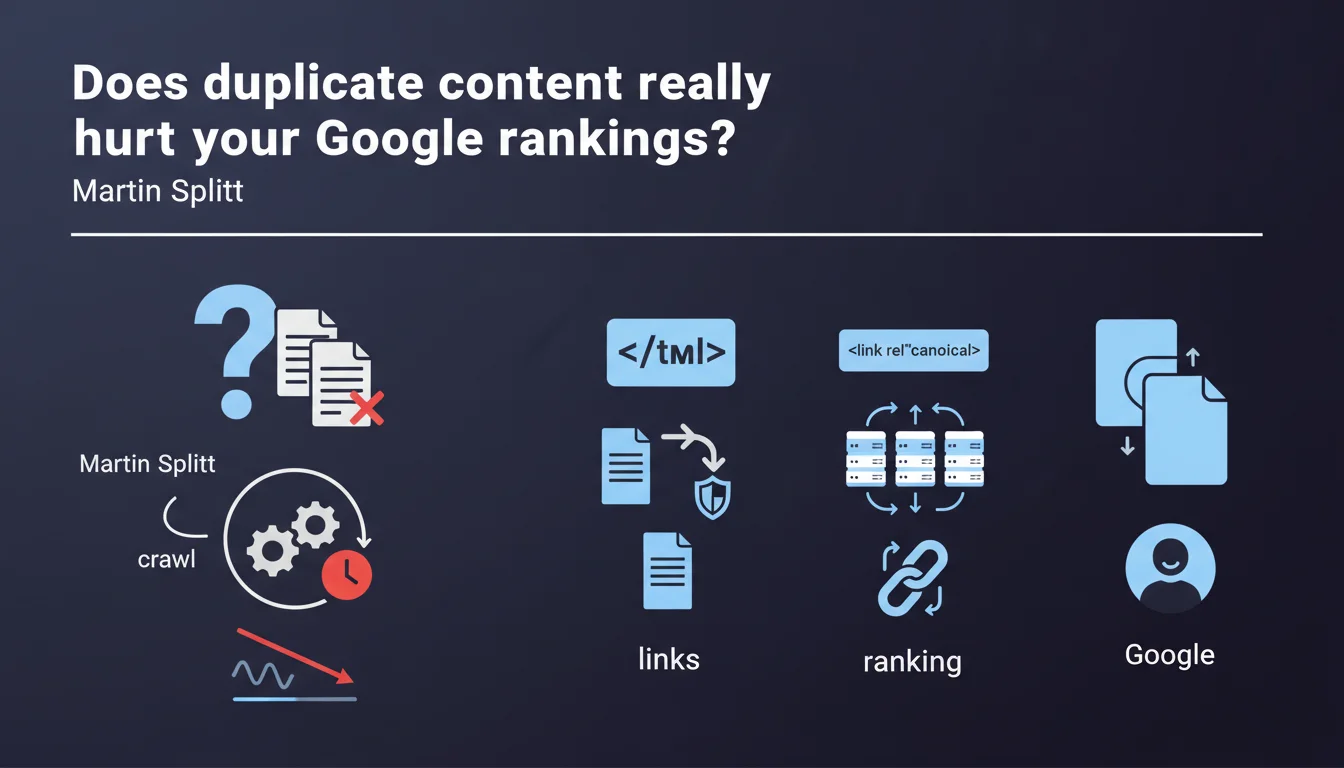
The concrete consequences primarily affect two critical aspects: crawl budget and dilution of relevance signals. Your site consumes its crawling resources on redundant pages instead of focusing on your strategic content.
- No algorithmic penalty is applied for duplicate content
- The main problem is the slowdown of crawling by Googlebot
- The dispersion of signals complicates tracking actual performance
- Google may index the wrong version of your content
- Backlinks and authority become fragmented across multiple URLs
SEO Expert opinion
This statement perfectly reflects what I've been observing in the field for years. Sites with duplicate content don't disappear from search results, but they do indeed suffer from systemic inefficiencies that limit their potential.
The important nuance concerns e-commerce sites and content aggregators. For these platforms, duplicate content is sometimes structural: similar product descriptions, supplier descriptions, filters generating multiple URLs. In these cases, canonical management becomes absolutely critical, not optional.
There are also situations where duplicate content across domains poses a bigger problem. If your original content is systematically copied and published elsewhere before your indexing, you risk not being identified as the source. Indexing speed then becomes a major competitive factor.
Practical impact and recommendations
Following this official clarification, here are the concrete actions to implement to optimize your duplicate content management and maximize your SEO efficiency.
- Systematically audit your site to identify all forms of duplication: URL parameters, HTTP/HTTPS versions, www/non-www, trailing slash, pagination, filters
- Implement canonical tags on all duplicate pages pointing to the priority version you want indexed
- Configure 301 redirects for unnecessary technical duplications (protocols, subdomains) to consolidate the signal
- Optimize internal linking by ensuring you only link to canonical versions, never to variants
- Use the robots.txt file to block crawling of non-strategic duplication-generating parameters
- Monitor Search Console to detect crawled but not indexed pages, often a symptom of a duplication problem
- Consolidate very similar content by merging pages with low differentiation to create unique and comprehensive resources
- Prioritize originality in your content strategy, particularly for product descriptions in e-commerce
- Avoid automatic scraping or mass republishing that disperses your authority
- Monitor your crawl budget regularly to identify crawling inefficiencies
In summary: Duplicate content won't directly penalize you, but it constitutes a significant brake on your SEO efficiency. Rigorous management of canonicals, redirects, and consolidations allows you to maximize your crawl budget and the clarity of your signals.
Implementing these technical optimizations requires deep expertise and an overall vision of your architecture. Between comprehensive auditing, technical implementation of canonicals, internal linking restructuring, and impact monitoring, these projects can prove complex to orchestrate alone. Working with a specialized SEO agency will allow you to benefit from personalized support, professional analysis tools, and a proven methodology to effectively address these structural issues without the risk of costly technical errors.
💬 Comments (0)
Be the first to comment.