
Official statement
What you need to understand
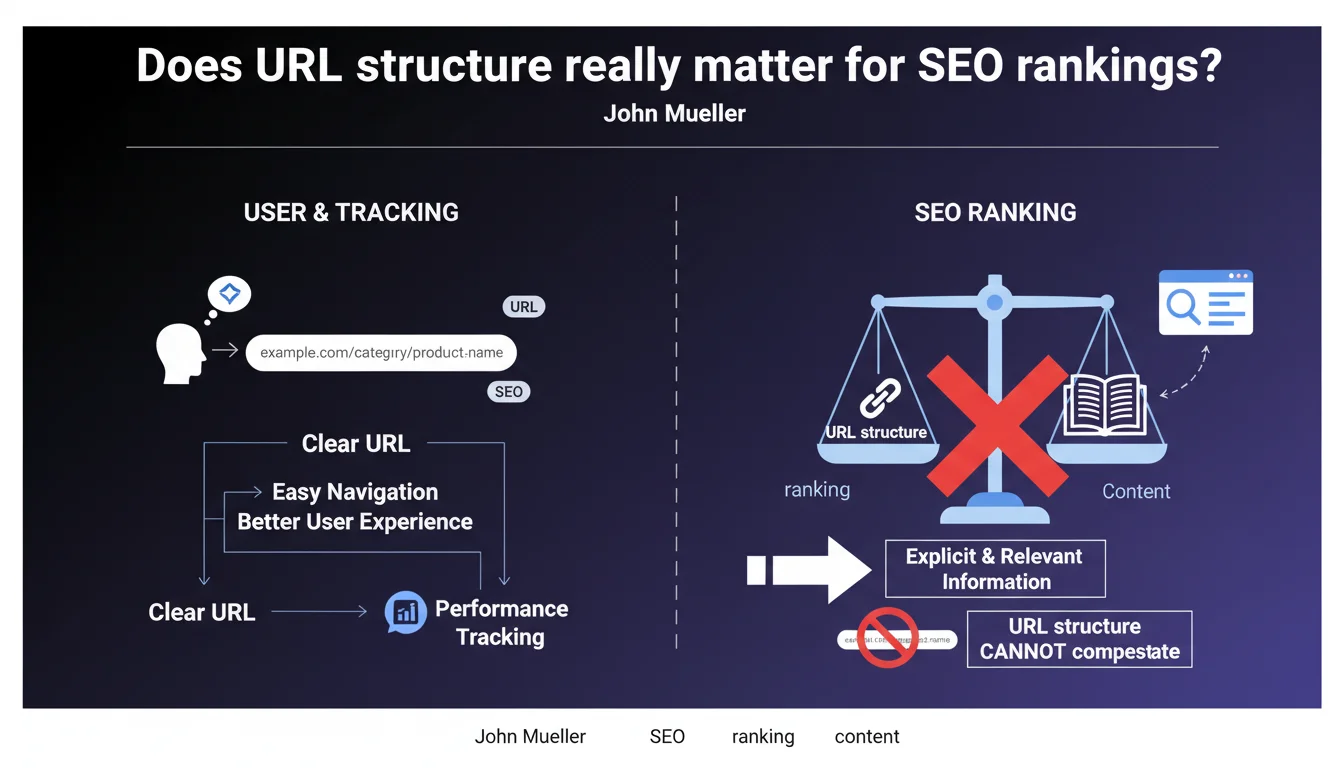
This statement from Google puts into perspective the relative importance of URL structure in the ranking algorithm. Contrary to a widespread belief among SEOs, URL architecture is not a major ranking factor.
Google clarifies that while a clear and descriptive URL has advantages, it can in no way compensate for weak or irrelevant content. The algorithm prioritizes above all the quality and depth of the page's content.
The real benefits of an optimized URL structure lie elsewhere:
- Enhanced user experience: a readable URL inspires trust and helps understand the page's topic
- Easier analytics tracking: a consistent structure simplifies tracking and performance analysis
- Potentially better click-through rate: a clear URL in the SERPs can encourage clicks
- Sharing and memorization: understandable URLs are more easily shared and remembered
In summary, URL optimization remains a best practice, but it should be considered a secondary element compared to creating quality content.
SEO Expert opinion
This position from Google is entirely consistent with what we observe in the field. Many sites with technical URLs or complex parameters rank excellently thanks to their exceptional content. Conversely, sites with perfectly optimized URLs but mediocre content stagnate.
However, an important nuance must be added: URL structure plays a role in the site's overall architecture. A consistent URL structure often reflects a logical content organization, which helps Google understand the hierarchy and relationships between pages. It's not the URL itself that matters, but the structure it reveals.
The pragmatic approach is to define a logical URL structure from the start, then focus primarily on content. Avoid wasting time perfecting every URL or restructuring an existing site solely to improve URLs.
Practical impact and recommendations
- Do: Establish a simple and consistent URL convention for new content (keywords separated by hyphens, logical structure)
- Do: Prioritize creating and improving existing content rather than redesigning URLs
- Do: Keep URLs reasonably short and descriptive for user experience
- Avoid: Launching a massive URL restructuring project for an established site solely for SEO reasons
- Avoid: Spending hours debating the perfect URL structure at the expense of working on content
- Avoid: Believing that an optimized URL can save a page with weak or duplicate content
- Special case: If you absolutely must modify URLs, make sure to implement permanent 301 redirects
- Recommended focus: Concentrate your resources on semantic enrichment, depth of analysis, demonstrated expertise, and content freshness
Implementing this balanced approach often requires a comprehensive strategic vision of your digital ecosystem. Between content auditing, prioritizing genuinely impactful technical optimizations, and quality editorial production, these projects can quickly become complex. Engaging a specialized SEO agency allows you to benefit from personalized support to precisely identify where to focus your efforts and achieve the best return on investment.
💬 Comments (0)
Be the first to comment.