
Official statement
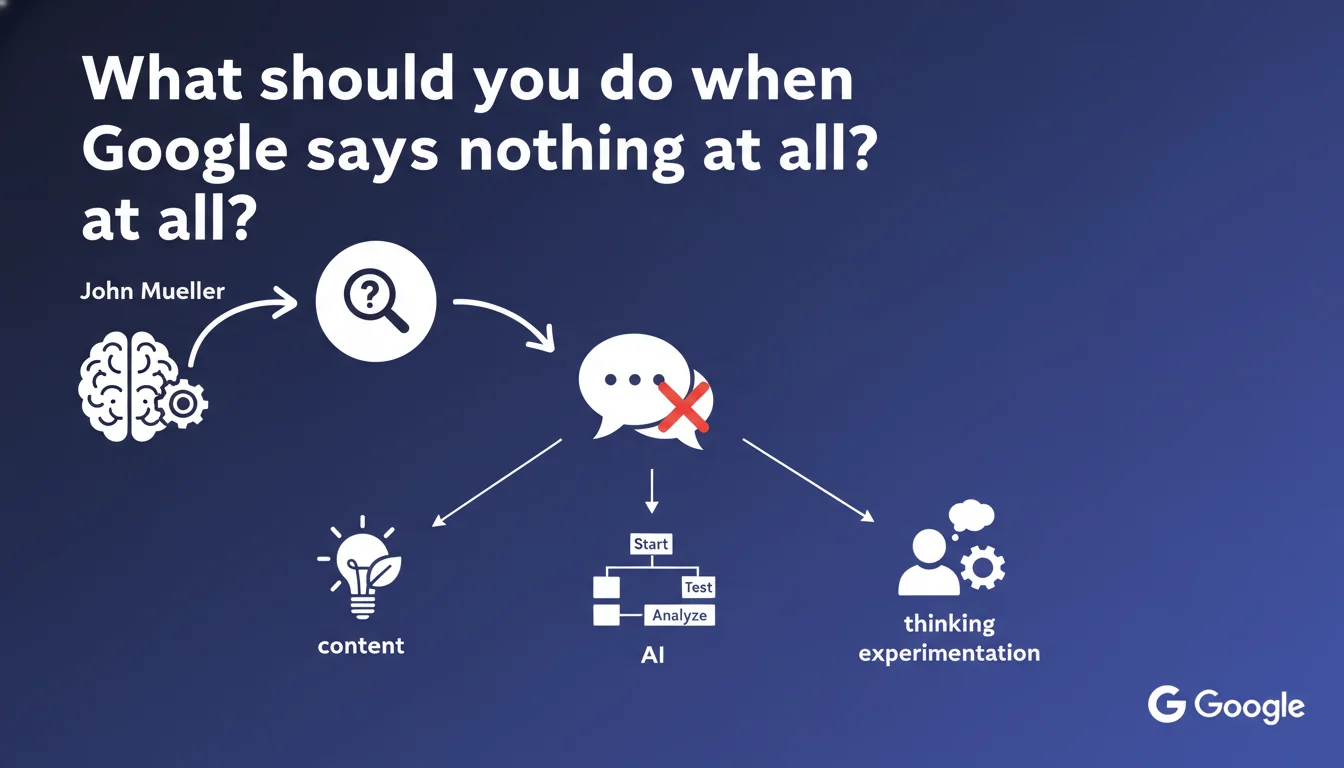
The transcript contains no verbal statements from John Mueller — only background music. It's impossible to extract an official Google position on any specific SEO topic. This case illustrates the recurring difficulty in interpreting fragmentary or incomplete sources.
What you need to understand
Why does an empty transcript create a problem?
A transcript with no verbal content prevents any factual analysis of a Google position. SEO professionals rely on explicit statements to adjust their strategies. Without a verbatim record, there's no reliable quote, no clear optimization angle to act on.
This type of situation occurs when an audio or video file contains only ambient music, a technical recording issue, or a non-verbal segment. Nothing to interpret, nothing to action.
How do you distinguish a usable source from empty content?
A usable source contains precise statements: ranking criteria, crawl behaviors, technical recommendations. Empty content — like this transcript — delivers no actionable elements.
SEO practitioners must verify source quality before investing time in analysis. Listening to the original audio, cross-referencing with other transcripts, or consulting alternative versions helps avoid wasting time on nothing.
What are the consequences for SEO monitoring?
An incomplete or empty transcript creates a blind spot in your monitoring efforts. If a professional relies on this type of document to guide strategy, they risk missing critical information published elsewhere.
The multiplication of fragmentary content forces professionals to diversify sources: Google Hangouts, Mueller's Twitter, official documentation, Search Central forums. A single transcript is never enough.
- A transcript without verbatim provides no actionable data
- Checking source quality before analysis saves wasted effort
- Diversifying SEO monitoring channels reduces blind spots
- No practitioner can build a strategy on empty content
SEO Expert opinion
Is this lack of content revealing a broader problem?
Yes. Google statements are sometimes evasive, fragmentary, or buried within hours of video. This extreme case — an empty transcript — illustrates the chronic difficulty in obtaining clear answers. Even when Mueller speaks, responses oscillate between generalities and "it depends."
SEO practitioners waste enormous amounts of time deciphering fuzzy sources. When a transcript contains nothing, it's frustrating, but at least it's clear: no statement = no analysis. More problematic: ambiguous statements that create the illusion you've learned something when you're actually left wanting more.
Should you systematically search for alternative versions?
Absolutely. An empty transcript doesn't necessarily mean no statement was made. Technical issue, failed extraction, poorly isolated segment: multiple explanations are possible. Before concluding, you must trace back to the original source — YouTube video, podcast, raw recording.
If after verification no verbal content exists, move on. But neglecting this step can cause you to miss key information published elsewhere in another format.
What level of trust should you place in automatic transcriptions?
Automatic transcription tools (YouTube, Whisper, etc.) make errors: truncated words, phonetic confusion, missing segments. An empty transcript can also result from an algorithmic failure if audio quality is poor or if speech is covered by music.
Always cross-reference with human listening when possible. [To verify]: some Mueller statements are only available as raw audio, without official transcription. In these cases, the SEO community sometimes publishes summaries — but be careful of biased interpretations.
Practical impact and recommendations
What should you do when faced with a transcript with no content?
First, trace back to the source: listen to the original audio, check the full video, verify if other versions exist. If after verification there's truly nothing, move on without wasting time.
Documenting the absence of content remains useful: it prevents other SEO team members from investing time in the same empty file. A simple "empty transcript" tag in your monitoring tool is enough.
How can you optimize your SEO monitoring to avoid this kind of time waste?
Implement quality filters before analysis: video length, presence of official captions, comments from other SEO professionals. If a source is flagged as incomplete or problematic, skip directly to the next one.
Automating collection isn't enough. A human must validate that extracted content contains actual exploitable statements. Otherwise, you accumulate information noise with no value.
What errors should you avoid when interpreting Google sources?
Never extrapolate from empty or fragmentary content. If a transcript contains nothing, don't invent an official position. If it's ambiguous, clearly signal that the interpretation remains uncertain.
Don't rely on a single source: cross-reference Hangouts, tweets, official documentation, and field tests. A robust SEO strategy never rests on a single Mueller verbatim.
- Systematically verify the original source before analyzing a transcript
- Document the absence of content to prevent duplicates in your monitoring
- Filter sources upstream to eliminate empty or defective files
- Never extrapolate a Google position from incomplete content
- Cross-reference multiple official channels to validate information
- Train teams to distinguish factual statements from interpretation
💬 Comments (0)
Be the first to comment.