
Official statement
What you need to understand
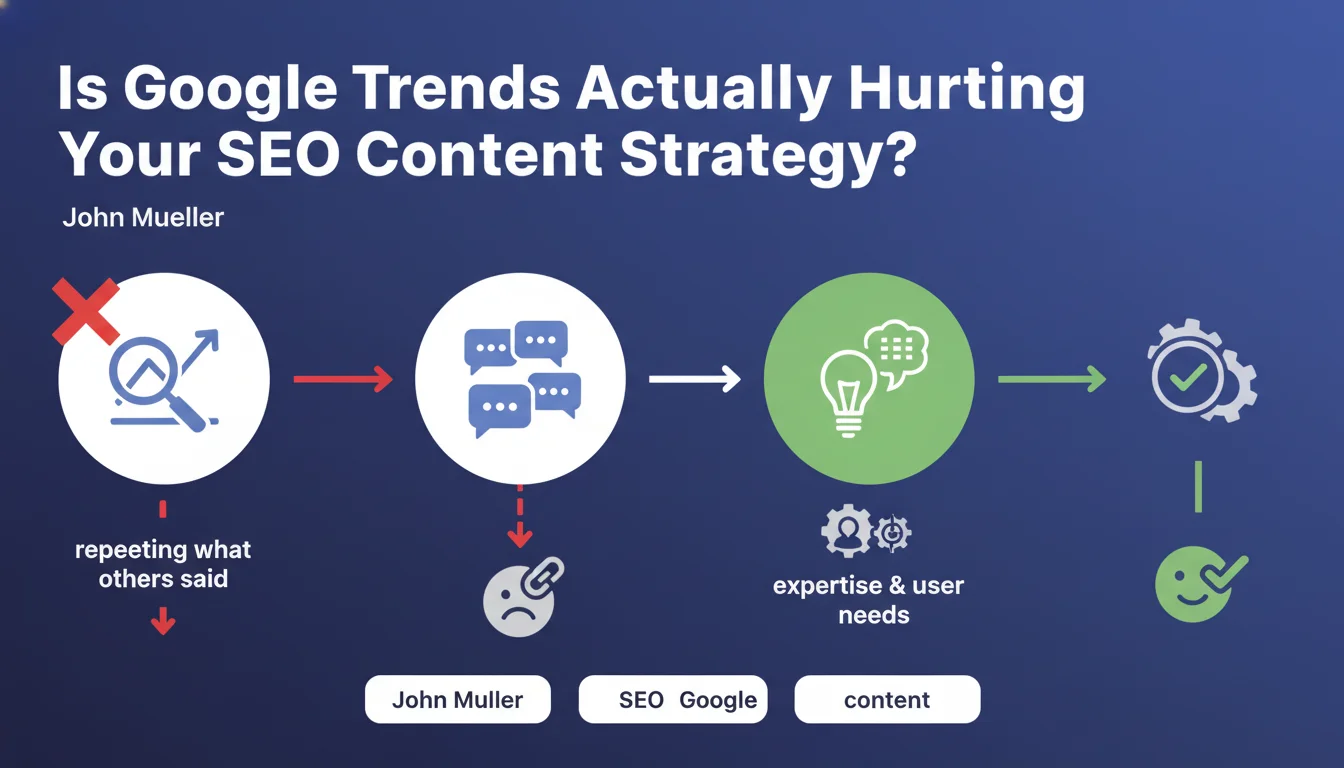
Google Trends has become an essential tool for identifying popular topics and anticipating search trends. However, its intensive use can lead to a phenomenon of large-scale editorial duplication.
When hundreds of sites follow the same trends and publish on the same topics at the same time, the result is a saturation of similar content. Google then finds itself with thousands of articles that essentially say the same thing, without providing a unique perspective.
Mueller's warning highlights a fundamental problem: the tool does not replace editorial strategy. Simply following Google Trends spikes leads to creating reactive content rather than content that demonstrates real expertise.
- A topic's popularity does not guarantee its relevance to your specific audience
- Blindly following trends creates intense editorial competition on saturated topics
- Google favors content that provides distinctive added value, not simply a rephrasing
- Authentic expertise and understanding user needs remain priorities over a topic's temporary popularity
SEO Expert opinion
This recommendation is perfectly consistent with the evolution of Google algorithms towards a qualitative evaluation of content. Recent updates precisely target generic content created en masse without distinctive value.
Nevertheless, it's important to nuance: Google Trends remains a valuable tool for keyword research and validating editorial hypotheses. The problem is not the tool itself, but its use as the sole source of inspiration.
Sector expertise combined with intelligent trend analysis remains the best approach. It's about using Google Trends as one indicator among others, not as an automatic editorial planning generator.
Practical impact and recommendations
- Avoid basing your editorial calendar solely on Google Trends - diversify your sources of inspiration by including customer feedback, frequently asked questions, and your industry expertise
- Before following a trend, ask yourself three questions: Do you have real expertise on the topic? Can you provide a different angle? Does it match your audience's needs?
- Prioritize depth over reactivity - it's better to publish less frequently with real added value than to follow every trend spike with superficial content
- Use Google Trends as a validator, not as a generator - verify interest in topics you master rather than searching for which trending topics to exploit
- Create evergreen content based on your expertise that provides lasting solutions rather than hot takes on ephemeral trends
- Differentiate yourself through angle and depth - if you cover a popular topic, provide exclusive data, case studies, or a unique expert perspective
- Document your real expertise with concrete examples, measurable results, and authentic experience feedback
Effective SEO content strategy now relies on a subtle balance between opportunity and expertise. It's not about ignoring trends, but about intelligently filtering them through the prism of your unique added value.
This approach requires a structured editorial methodology that combines audience analysis, expertise mapping, and strategic monitoring. Implementing such a strategy can prove complex, especially for coordinating all these elements coherently.
For companies looking to optimize their content strategy without falling into the traps of editorial conformity, support from a specialized SEO agency enables structuring a personalized approach that values your expertise while maintaining optimal visibility in search results.
💬 Comments (0)
Be the first to comment.