
Official statement
What you need to understand
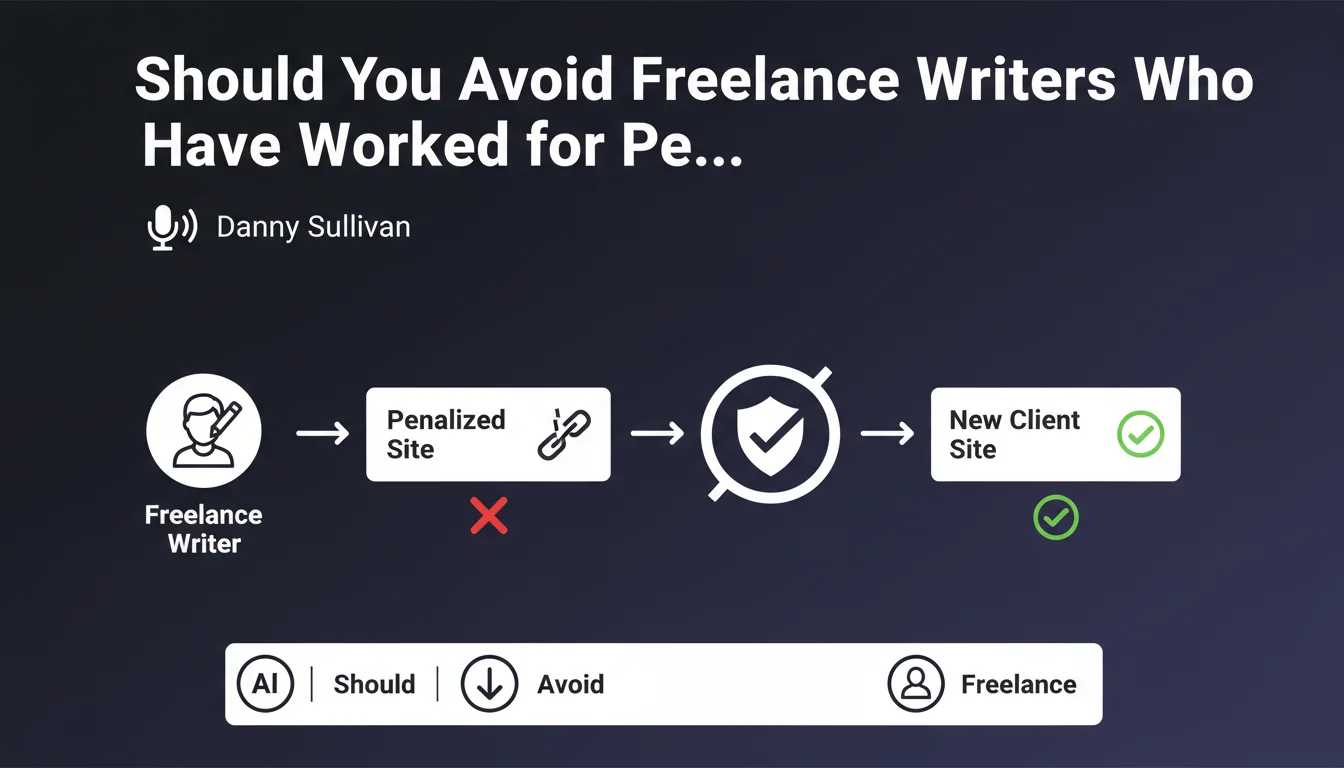
Google has officially clarified its position regarding freelance writers and algorithmic penalties. There is no negative authorship signal that would follow an author from one site to another.
Concretely, this means that a writer's history does not affect the sites they work for subsequently. If a freelancer has written content for a site that received a manual action, this "stain" does not transfer to other projects.
This clarification puts an end to a widespread fear in the SEO industry: that of contamination by association with authors who participated in projects sanctioned by Google.
- No negative authorship signal: Google does not track individual authors from one site to another to propagate penalties
- Freedom for freelancers: they can work for new clients without carrying the weight of past problems
- Security for publishers: hiring a freelancer who worked for a penalized site represents no SEO risk
- Focus on current content: it's the quality of the content produced now that matters, not the professional history
SEO Expert opinion
This statement is consistent with Google's technical approach to content evaluation. The search engine analyzes signals at the site and content level, not at the level of individual author identity.
However, this position needs to be nuanced. While Google does not technically track authors, patterns of low-quality content can repeat themselves. A writer who produced problematic content on one site may reproduce the same mistakes elsewhere, not through algorithmic contamination, but due to lack of skills.
Similarly, human reputation remains important. If an author is publicly associated with questionable practices (spam, plagiarism, mass-generated content), this can affect perceived credibility, even if Google does not directly penalize this association.
Practical impact and recommendations
This clarification frees publishers and freelancers from unjustified constraints, but does not exempt from qualitative verification of produced content.
- Publishers: You can recruit freelancers based solely on their skills and the quality of their current work, without auditing their complete client history
- Freelancers: You don't need to hide or minimize your experience with sites that have had SEO problems in the past
- Focus on quality: Concentrate on evaluating the produced content (depth, expertise, originality) rather than on writers' resumes
- Editorial process: Establish clear editorial guidelines for all your contributors, regardless of their background
- Skills testing: Favor practical tests and content samples rather than complex background checks
- Don't over-interpret: This statement doesn't mean all freelancers are equal; maintain high quality standards
- Internal documentation: Formalize your selection criteria based on real and measurable skills
Implementing a robust content strategy, with adapted recruitment and evaluation processes, often requires deep expertise in Google's quality criteria. These editorial and SEO optimizations can prove complex to orchestrate alone, particularly when coordinating multiple contributors while maintaining consistency and quality. Support from a specialized SEO agency can help you effectively structure your editorial approach and ensure that every published content meets the expertise and quality standards expected by search engines.
💬 Comments (0)
Be the first to comment.