
Official statement
What you need to understand
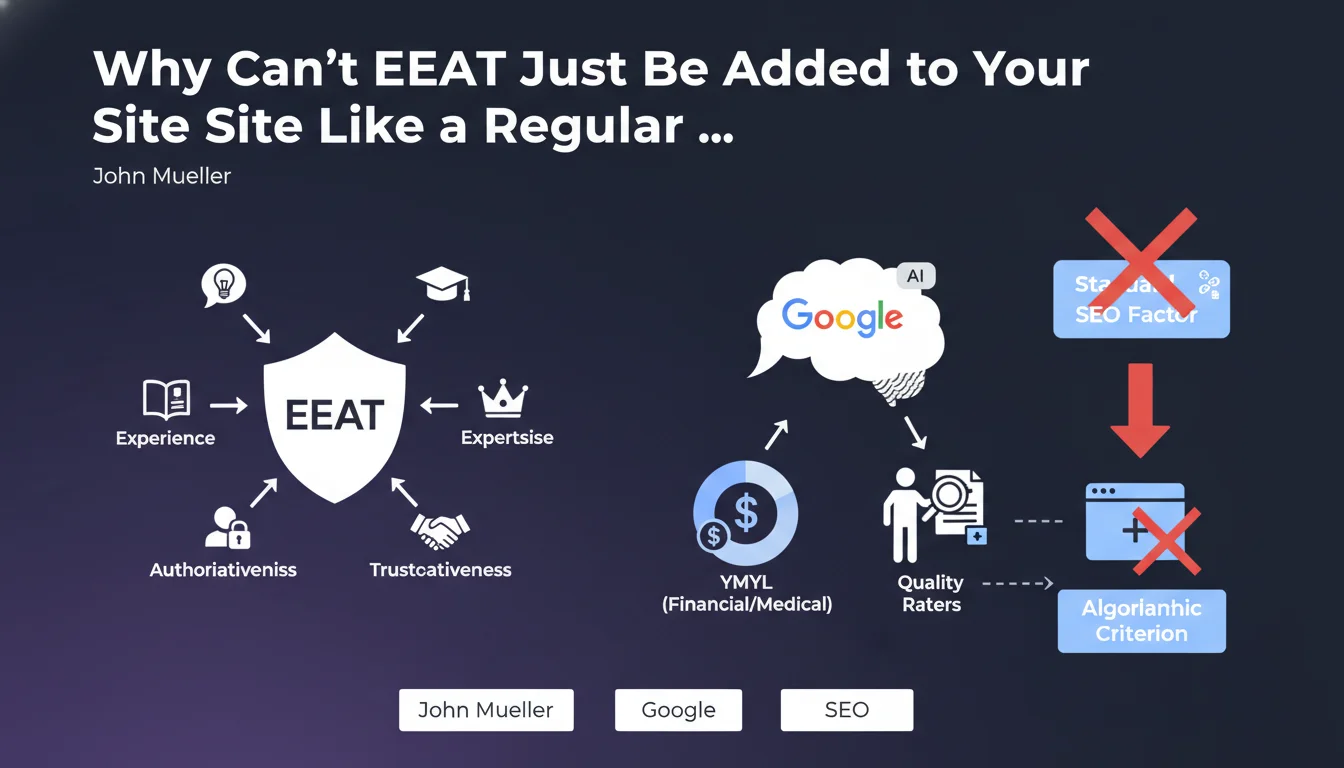
John Mueller has just clarified a major misconception about EEAT (Experience, Expertise, Authoritativeness, and Trustworthiness). Contrary to what many believe, it is not an SEO criterion that can be checked off like a list of technical tasks.
EEAT is primarily an evaluation framework used by Quality Raters, those human evaluators who judge the quality of search results. These evaluations are then used to train and refine Google's algorithms.
The important revelation: EEAT has variable algorithmic weight depending on the type of content. It is particularly critical for YMYL (Your Money Your Life) topics such as finance or health, where incorrect information can have serious consequences. For general-interest sites like recipe blogs, its direct algorithmic impact is much lower.
- EEAT is not a direct ranking factor that can be technically "optimized"
- It primarily applies algorithmically to sensitive YMYL content
- It's a set of indirect signals that Google detects through various site elements
- Raters look for evidence of legitimacy rather than an EEAT checklist
SEO Expert opinion
This clarification from Mueller is perfectly consistent with what we observe in the field. Sites that attempt to "add EEAT" superficially (formatted biographies, badges, mentions) without real substance rarely see significant improvement. What works is the authentic building of a reputation.
However, we need to nuance the YMYL/non-YMYL distinction. In practice, we find that even "general-interest" sites benefit from solid EEAT signals, particularly in competitive sectors. A culinary blog with a recognized chef, media appearances, and external citations will perform better than an anonymous blog, even if the impact is less pronounced than for a medical site.
The mistake would be to think "my site isn't YMYL, so EEAT doesn't matter." The correct interpretation: the intensity of the impact varies, but working on your legitimacy remains relevant for all serious sites.
Practical impact and recommendations
- For YMYL sites: Invest heavily in real credibility (qualified authors, verifiable references, total transparency on sources)
- For all sites: Don't neglect your external reputation (mentions, citations, natural editorial backlinks)
- Avoid superficial tactics: Simply adding detailed "About" pages or biographies without real substance will have only a marginal impact
- Prioritize authenticity: Build genuine expertise rather than simulating EEAT signals
- Document your qualifications: If you have legitimate expertise, ensure it's visible and verifiable (degrees, experience, achievements)
- Work on your brand building: Brand mentions and industry recognition are indirect but powerful EEAT signals
- Audit your positioning: Identify whether your content touches on YMYL or sensitive topics to prioritize your efforts
Implementing a coherent and authentic EEAT strategy often requires a comprehensive view of your digital positioning, industry reputation, and content architecture. This holistic approach, which combines technical SEO expertise and brand strategy, represents a considerable investment in time and multidisciplinary skills. For companies operating in YMYL or highly competitive sectors, surrounding yourself with specialized SEO experts can prove decisive in developing a tailored strategy and avoiding the pitfalls of an overly superficial approach.
💬 Comments (0)
Be the first to comment.