
Official statement
What you need to understand
Google confirms a frequently observed practice: adding content on a new theme does not result in a direct penalty on your site. This statement reassures publishers who wish to diversify their content.
However, the reality is more nuanced. Google analyzes how this new content articulates with your site's existing ecosystem. The search engine will look for thematic links and assess overall coherence.
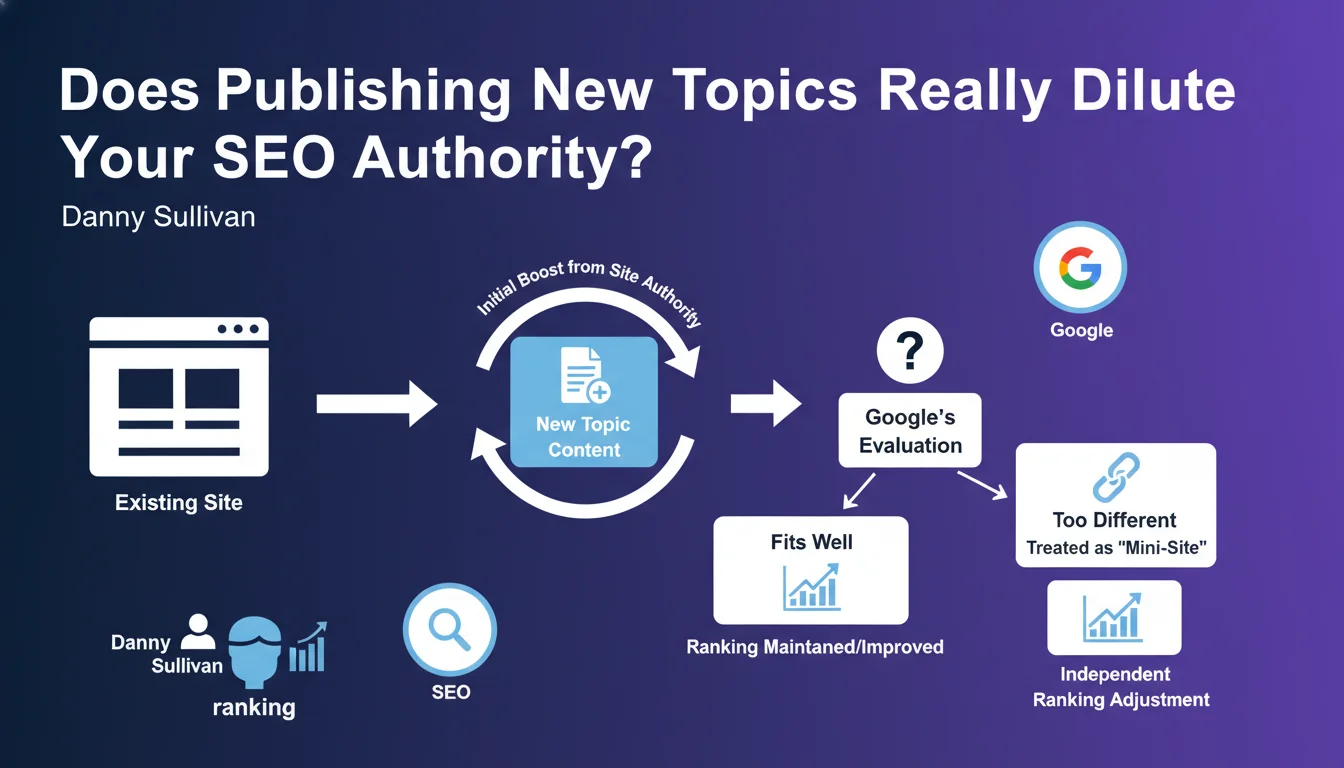
The mechanism works in two stages: an inheritance phase followed by a readjustment. Initially, your new content benefits from the domain's overall authority. But if Google deems it too distant from your main theme, it may treat it as a distinct entity.
- No direct penalty for publishing on a new topic
- Initial inheritance of the main domain's authority
- Possible readjustment if the content is deemed too different
- Concept of internal mini-sites with their own reputation
- Evaluation of thematic coherence by algorithms
SEO Expert opinion
This statement confirms what we have been observing for several years: Google has considerably refined its understanding of topicality. Historical generalist sites (press, major media) retain their ability to rank on varied topics, while more recent sites are evaluated with greater rigor.
The notion of "mini-sites" is particularly revealing. It explains why certain sections of a site perform differently from the rest. Google can isolate a section and evaluate it according to its own metrics: specific backlinks, engagement rates, demonstrated expertise on that precise segment.
In practice, architecture and internal linking become crucial. You must demonstrate to Google how this new topic fits into your overall strategy, even if it represents an extension of your main theme.
Practical impact and recommendations
- Audit your current thematic coherence: identify your core expertise recognized by Google before expanding
- Prepare a dedicated architecture: create clear silos for new topics with their own navigation structure
- Document the thematic connection: write bridge content that explains the link between your historical topics and the new ones
- Invest in strategic internal linking: intelligently link new content to old to create semantic coherence
- Obtain targeted backlinks: for new sections, seek external links that reinforce your legitimacy on these themes
- Measure performance separately: create segments in your analytics tools to track the evolution of each "mini-site"
- Be patient and progressive: expand your thematic scope gradually rather than abruptly
- Strengthen E-E-A-T signals: demonstrate expertise and authority on new topics (qualified authors, sources, case studies)
In summary: you can diversify your content without fearing penalties, but carefully prepare this expansion. Google is watching and will judge the relevance of this diversification over the long term.
Implementing these recommendations requires a deep understanding of semantic architecture, crawl budget, and thematic relevance signals. Since these optimizations are often complex and time-consuming, particularly when assessing Google's perceived coherence and effectively structuring new content silos, the support of a specialized SEO agency can prove invaluable to secure your thematic expansion strategy and maximize your chances of success from the start.
💬 Comments (0)
Be the first to comment.