
Official statement
Other statements from this video 19 ▾
- □ Does Google really index all languages the same way?
- □ Are nofollow links and noindex tags actually hurting your SEO?
- □ Do 404 errors really hurt your site's search rankings?
- □ Should you really redirect all 404 pages to improve your SEO?
- □ Can you really reset Search Console data when you take over a website?
- □ Are regional subdomains enough to target a specific geographic market?
- □ Why are your rich results displaying the wrong currency and what's the fix?
- □ Does Google really penalize you for publishing video transcriptions as text on your website?
- □ Why does Google reject aggregated reviews in product structured data?
- □ Does Google really crawl URL variations that have no internal links or backlinks pointing to them?
- □ Why does Googlebot keep crawling 404 pages long after they've been deleted?
- □ Is the text-to-code ratio really a Google ranking factor?
- □ Do UTM parameters with medium=referral really kill the SEO value of a backlink?
- □ Do you really need to reply to every blog comment to boost your SEO?
- □ Should you worry when robots.txt shows up as a soft 404 in Search Console?
- □ Do you really need to worry about missing X-Robots-Tag and meta robots tags?
- □ Are your automatic Geo IP redirects killing your international SEO performance?
- □ Can modifying your title tags and meta descriptions really shift your Google rankings?
- □ Can poor quality links or traffic harm your site's reputation?
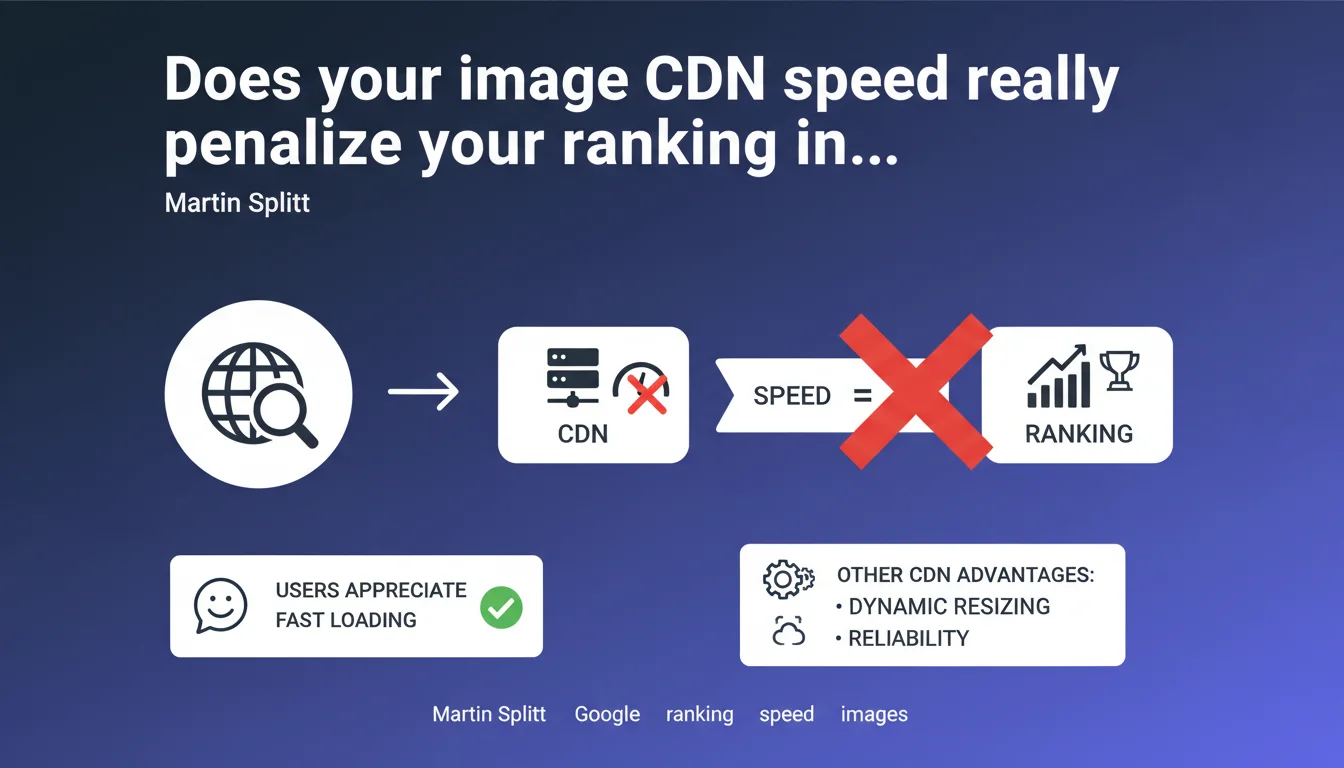
Google claims that the response speed of a CDN serving images does not directly impact their appearance in image search results. Only user experience — and therefore potentially engagement — could play an indirect role. CDNs remain useful for other reasons (resizing, availability), but not for immediate SEO boost.
What you need to understand
Does Google really separate technical criteria from user experience?
Martin Splitt clearly distinguishes two things: on one hand, indexing and ranking criteria in Google Images, on the other, user experience on your site. The loading speed of images from a CDN does not fall into the first category, according to him.
In other words, a CDN that takes 200 ms instead of 50 ms to serve an image will not make that image disappear from the SERPs. Google collects the image, indexes it, and makes it eligible for results — regardless of the CDN latency at the time of crawl.
Why this statement now?
Probably to dispel a misconception: that Core Web Vitals or server speed impact all aspects of SEO in the same way. Google repeatedly states that each type of content (HTML page, image, video) has its own criteria.
For Google Images, priority signals remain: image quality, metadata, page context, relevance of surrounding content. CDN network latency is not on this list.
What are the real benefits of a CDN for images?
Splitt clarifies that CDNs bring other concrete benefits: dynamic resizing, format optimization (WebP, AVIF), geographic availability, server load reduction. These elements improve UX and, indirectly, can influence engagement metrics — bounce rate, time on page.
- CDN response speed does not affect indexation or direct ranking in Google Images
- Users appreciate images that load quickly — indirect impact via engagement and behavioral signals
- CDNs remain useful for technical optimization (responsive formats, compression, geolocation)
- Google Images criteria are: quality, metadata, page context, relevance — not network latency
SEO Expert opinion
Is this statement consistent with what we observe in the field?
Yes, generally. Sites using slow CDNs (or no CDN at all) are not systematically absent from Google Images. We regularly see images hosted on underperforming servers appear without issue in results — as long as the image itself is relevant and properly contextualized.
However, [To verify]: Google does not detail what happens if the CDN is so slow that Googlebot times out or abandons image crawling. In that case, the image will never be indexed — which is different from saying « it is indexed but poorly ranked ». Splitt remains vague on the latency threshold that would trigger a crawl failure.
What nuances should we add to this statement?
Image loading speed influences Core Web Vitals (LCP in particular), which themselves impact ranking of HTML pages in regular search. So if your CDN is slow and your LCP images are heavy, you risk a penalty on page positioning — even if the image itself remains indexed in Google Images.
Another point: engagement signals are difficult to measure, but a user who clicks on an image in Google Images, arrives on your site and leaves instantly because nothing loads… that sends a negative signal. Indirect, but real.
In what cases does this rule not apply?
If your CDN is so slow that Googlebot never manages to retrieve the image (timeout after X seconds), then obviously the image won't be indexed. Splitt doesn't specify this threshold. [To verify] on extreme cases (CDN with latency >5 seconds, for example).
Another edge case: if the CDN delivers unstable HTTP codes (intermittent 502, 503), Google may eventually deprioritize crawling of these resources. Again, we're stepping outside the strict « speed » framework, but in practice it's related.
Practical impact and recommendations
What should you do concretely if you use a CDN for your images?
Keep using a CDN — but focus on the right metrics. Rather than absolute latency, monitor: availability (uptime), compression quality, modern formats (WebP, AVIF), automatic resizing according to viewport.
Make sure the CDN never blocks Googlebot. Verify in Search Console that image resources are properly crawlable, and that you don't have spikes of 5xx errors or timeouts. That's more important than saving 20 ms on TTFB.
What mistakes should you avoid to stay aligned with this recommendation?
Don't over-optimize network latency at the expense of image quality or its HTML context. A blurry image that loads in 10 ms will never rank better than a sharp image that takes 200 ms. Prioritize metadata first (alt, title, caption, structured data ImageObject).
Avoid free or unstable CDNs with poor availability rates. A CDN that goes down 5% of the time causes more problems than a slightly slow but reliable CDN. Google may interpret instability as a negative signal — even if Splitt didn't say it explicitly.
How to verify that your CDN configuration is not penalizing your image SEO?
- Check in Google Search Console > Coverage that no crawl errors appear on your image URLs
- Test accessibility of your CDN images with the URL Inspection tool in GSC
- Monitor Core Web Vitals of your main pages — especially LCP if an image is the largest contentful element
- Ensure the CDN serves modern formats (WebP, AVIF) to compatible browsers
- Verify that all your images have relevant alt attributes and rich HTML context (headings, captions, surrounding paragraphs)
- Enable lazy loading for off-viewport images — except for the LCP image
In summary: your CDN speed does not directly impact your presence in Google Images, but a quality CDN improves user experience and can indirectly influence your engagement signals. Focus on availability, image quality and metadata rather than milliseconds of latency.
If you manage an e-commerce site, media outlet or gallery with thousands of images, these optimizations — CDN, responsive formats, structured metadata — quickly become complex to orchestrate alone. Support from an SEO-specialized agency can help you prioritize the right levers and avoid costly mistakes in your image infrastructure.
❓ Frequently Asked Questions
Un CDN lent peut-il empêcher mes images d'être indexées par Google ?
Les Core Web Vitals comptent-ils pour le référencement dans Google Images ?
Faut-il quand même optimiser la vitesse de chargement des images ?
Quels critères Google utilise-t-il pour classer les images ?
Un CDN gratuit ou instable pose-t-il des risques SEO ?
🎥 From the same video 19
Other SEO insights extracted from this same Google Search Central video · published on 21/08/2024
🎥 Watch the full video on YouTube →
💬 Comments (0)
Be the first to comment.