
Official statement
Other statements from this video 20 ▾
- □ Should you really block AI-generated automatic translations from your site with noindex?
- □ Are site: searches polluting your Search Console data?
- □ Why Is Google Telling You to Ignore Your PageSpeed Insights Scores?
- □ Should you really stop obsessing over Core Web Vitals optimization?
- □ Should you really worry about buying an expired domain?
- □ Can AI Really Produce SEO-Quality Content with Just Human Proofreading?
- □ Can poor machine translation really tank your SEO rankings?
- □ Do affiliate links actually hurt your page's search rankings?
- □ Should you really fix every single broken backlink pointing to your site?
- □ Does Next.js really require specific SEO best practices from the start?
- □ Can you safely canonicalize pages that are 93% identical without damaging your SEO?
- □ Should you redirect or completely disable an unused subdomain for SEO?
- □ Should you really worry about toxic backlinks pointing to your site?
- □ Should you really match your page title and H1 tag?
- □ Why does Google discourage using site: queries to verify indexation?
- □ Why does a high ranking not guarantee strong CTR on Google?
- □ Do JavaScript console errors really hurt your site's search rankings?
- □ Could showing all product variants to Googlebot alone be quietly destroying your search visibility?
- □ Do you really need a dedicated page per video to rank in rich video results?
- □ Is content syndication really worth the risk to your organic visibility?
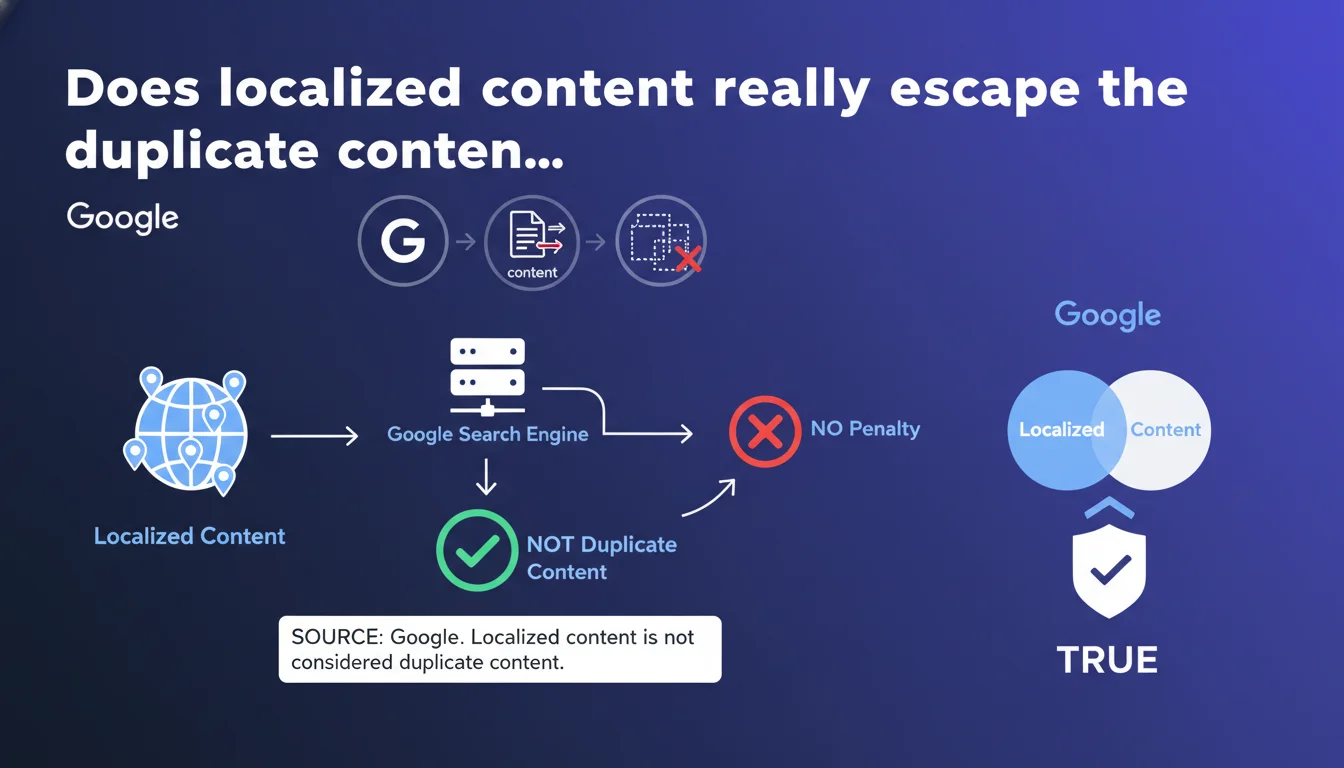
Google states it does not penalize duplicate content on localized websites. In other words, translating or adapting your pages for different markets would not trigger a duplication filter. This clarification removes major uncertainty for international sites that hesitated to deploy language versions for fear of duplicate content.
What you need to understand
What exactly does "localized content" mean to Google?
Google is talking about language or regional versions of the same content. A French site that offers its pages in English, German, Spanish — or an e-commerce that duplicates its product sheets across .fr, .be, .ch with minor adaptations (currencies, legal notices, contact information).
The nuance is important: this is not about publishing the exact same text across multiple URLs without reason. It's about adapting content for a different audience, even if the structure and substance remain similar.
Why is this statement coming out now?
Because fear of duplicate content has long hindered international SEO strategies. Some SEO professionals worried that an English version nearly identical to the French version would be seen as duplication.
Google clarifies: no, this is not considered spam. Algorithms understand that the same company can legitimately serve the same message in multiple languages.
Does this mean we can duplicate without limits?
No. The statement targets legitimate localized content, not mass spam. If you create 50 subdomains with the same text just to occupy the SERP, that's still spam.
Localization implies a clear intent to serve a distinct audience — different language, different market, different cultural context. Not just duplicating for the sake of it.
- Google does not penalize language or regional versions of the same content
- Localization assumes adaptation for a specific audience (language, currency, context)
- This does not give a free pass to duplicate content without strategic reason
- hreflang tags remain essential for indicating relationships between versions
SEO Expert opinion
Is this statement consistent with what we observe in practice?
Yes and no. In most cases, well-structured multilingual sites (correct hreflang, clearly distinct versions) effectively do not suffer visible penalties. Large brand international sites prove this: same content translated across 20 language versions, no filter applied.
But — and this is where it gets tricky — Google says nothing about edge cases. What about sites that duplicate content to target French-speaking regions with different URLs but strictly identical text? Or e-commerce sites that artificially inflate their presence with "localized" subdomains that differ by only three words?
[To verify] The boundary between legitimate localization and manipulation remains fuzzy. Google talks about "localized content" without defining clear criteria — how many textual differences are needed? Does automatic translation suffice?
Should we conclude that hreflang is no longer important?
Absolutely not. Hreflang remains essential for indicating to Google which version to serve to which user. Without hreflang, you risk cannibalization: multiple versions of the same content fighting for the same keyword in the same SERP.
Google does not penalize duplication between localized versions, but you still need to explicitly signal the relationships between these versions. Otherwise, the algorithm may choose the wrong page for the wrong audience.
In what cases might this rule not apply?
If your "localization" is limited to changing a header and three words in the footer, it's hard to speak of distinct content. Google might then consider you're trying to manipulate the index with near-duplicates with no added value.
Another case: sites that create "regional" versions purely for technical reasons (fr-fr, fr-be, fr-ch) with strictly identical content, without real adaptation. Here, no automatic penalty, but a risk of signal dilution: Google no longer knows which version to favor.
Practical impact and recommendations
What should you concretely do to benefit from this clarification?
First, audit your localized versions. Verify that each language or regional version adds real value: quality translation, cultural adaptation, currencies, local legal notices, relevant contact information.
Next, properly implement hreflang tags. Each version should point to its equivalents in other languages. Without it, Google won't know these contents are legitimate variants and not accidental duplicates.
Finally, don't multiply versions without strategic reason. If you're targeting three French-speaking countries with the same text, ask yourself if three distinct URLs are truly necessary — or if a single version with Search Console geographic targeting suffices.
What mistakes should you absolutely avoid?
Don't create "localized" versions just to occupy more SERP real estate. Google might interpret this as doorway spam, especially if the pages are nearly identical and provide no added value to the local user.
Also avoid raw automatic translation. An English version generated by a tool and published without review or editorial adaptation is not localization — it's just duplicate with different vocabulary.
And above all, don't neglect unique content per market. Even though Google tolerates duplication between localized versions, pages that add specific content (local case studies, regional customer testimonials, cultural context) always perform better.
- Audit each localized version: qualitative translation, real cultural adaptations
- Properly implement hreflang on all versions (bidirectional)
- Verify that each version brings specific value to its target audience
- Don't multiply URLs without clear geographic or language targeting strategy
- Avoid automatic translation without editorial review
- Prioritize adding unique content per market whenever possible
❓ Frequently Asked Questions
Dois-je quand même utiliser hreflang si Google ne pénalise pas le contenu localisé ?
Est-ce que traduire automatiquement mes pages avec un outil suffit pour être considéré comme du contenu localisé ?
Puis-je créer plusieurs versions régionales en français (fr-FR, fr-BE, fr-CH) avec le même contenu ?
Cette déclaration s'applique-t-elle au contenu syndiqué ou republié ?
Combien de différences textuelles faut-il entre deux versions pour que Google considère ça comme de la localisation ?
🎥 From the same video 20
Other SEO insights extracted from this same Google Search Central video · published on 13/06/2024
🎥 Watch the full video on YouTube →
💬 Comments (0)
Be the first to comment.