
Official statement
Other statements from this video 20 ▾
- □ Faut-il vraiment bloquer les traductions automatiques par IA de votre site en noindex ?
- □ Les recherches site: polluent-elles vos données Search Console ?
- □ Pourquoi Google vous demande d'ignorer les scores de PageSpeed Insights ?
- □ Faut-il vraiment arrêter d'optimiser les Core Web Vitals à tout prix ?
- □ Faut-il se méfier d'un domaine expiré racheté ?
- □ L'IA peut-elle vraiment produire du contenu SEO de qualité avec une simple relecture humaine ?
- □ La traduction automatique peut-elle vraiment pénaliser votre classement SEO ?
- □ Les liens d'affiliation pénalisent-ils vraiment le référencement de vos pages ?
- □ NextJS impose-t-il vraiment des bonnes pratiques SEO spécifiques ?
- □ Peut-on canonicaliser des pages à 93% identiques sans risque pour son SEO ?
- □ Faut-il rediriger ou désactiver un sous-domaine SEO non utilisé ?
- □ Faut-il encore s'inquiéter des liens toxiques pointant vers votre site ?
- □ Faut-il vraiment faire correspondre le titre et le H1 d'une page ?
- □ Le contenu localisé échappe-t-il vraiment à la pénalité pour duplicate content ?
- □ Pourquoi Google déconseille-t-il d'utiliser les requêtes site: pour vérifier l'indexation ?
- □ Pourquoi un bon classement ne garantit-il pas un CTR élevé sur Google ?
- □ Les erreurs JavaScript dans la console impactent-elles vraiment le référencement de votre site ?
- □ Pourquoi afficher toutes les variantes produits à Googlebot peut-il détruire votre indexation ?
- □ Faut-il vraiment une page dédiée par vidéo pour ranker dans les résultats enrichis ?
- □ La syndication de contenu est-elle un pari risqué pour votre visibilité organique ?
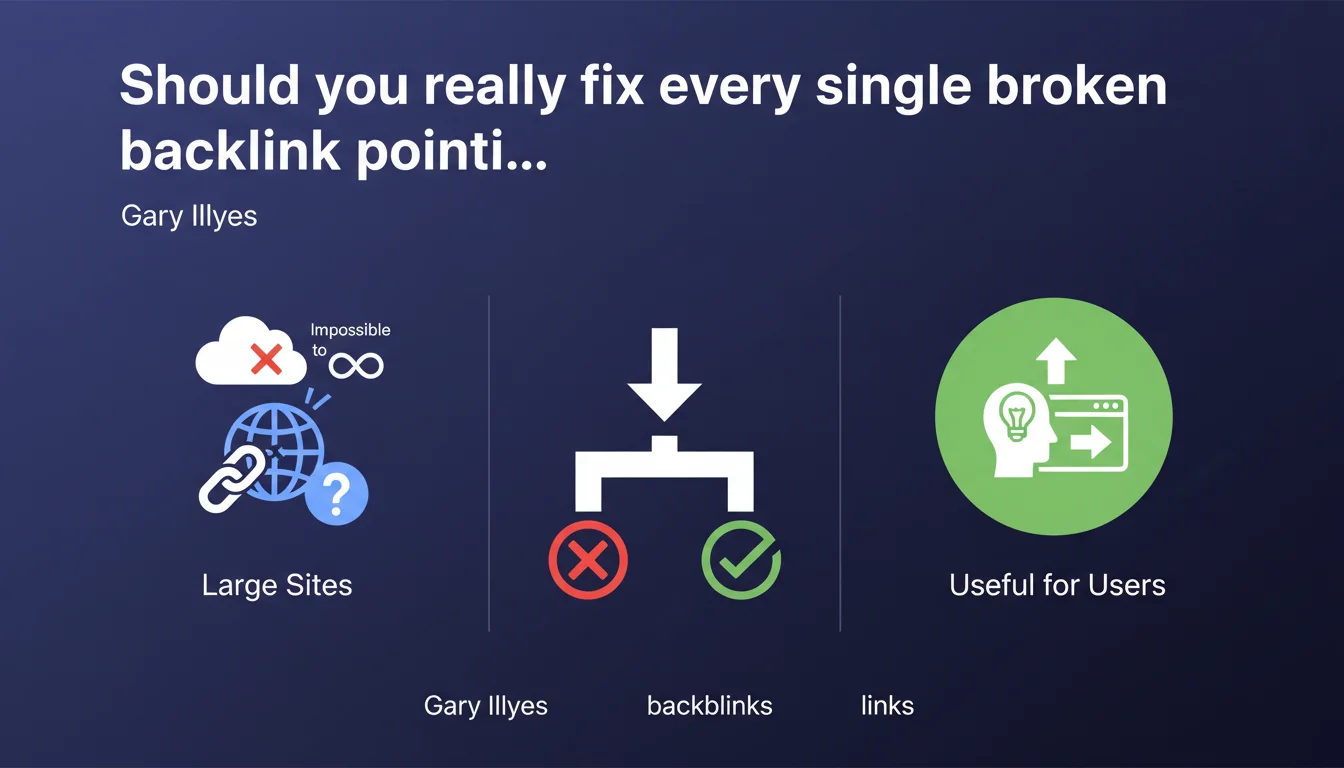
Google recommends fixing broken backlinks that provide real value to users, not all of them. For large-scale sites, aiming for completeness is unrealistic and counterproductive. Prioritize based on actual utility and link equity.
What you need to understand
What does Google actually mean by "broken backlinks" in this statement?
We're talking about external links pointing to pages that no longer exist on your site — typically 404 errors. These backlinks, often acquired naturally, lose their value if the destination page has disappeared due to a redesign, migration, or content deletion.
Google clarifies that you shouldn't fix all of these links, but rather those that would be useful for users. This distinction is critical: the criterion isn't the volume of broken links, but their potential relevance.
Why does Google emphasize utility for users?
Because not all backlinks are created equal. A broken link from an obsolete directory has no interest in being recovered. However, a link from a reputable media outlet to a technical guide that was deleted represents a net loss — both for PageRank and for qualified traffic.
Google's approach remains consistent with its philosophy: optimize for the user, not for the bot. If a visitor clicks on that external link and lands on a 404, the experience is degraded. Fixing the link via a 301 redirect restores that utility.
Why acknowledge that you can't fix them all?
It's a rare moment of official pragmatism. On a mature site with thousands of pages and years of history, broken backlinks often number in the hundreds, even thousands. Auditing and treating each case individually quickly becomes unmanageable.
Google recognizes this reality and implicitly validates a prioritization approach: focus on links that have real impact, ignore the rest. It's a form of permission to not aim for exhaustive perfection.
- Broken backlinks: external links pointing to 404 pages on your site
- Sorting criterion: utility for the user, not raw volume
- Acknowledged pragmatism: impossible to handle all of them on large sites
- Recommended focus: fix links from quality sources with potential traffic
SEO Expert opinion
Is this statement consistent with practices observed in the field?
Yes, and it's actually one of the rare cases where Google explicitly validates what SEOs are already doing. Standard practice consists of prioritizing broken backlinks according to their authority (DR, TF), thematic relevance, and traffic potential. You don't waste time on zombie links from abandoned sites.
What's interesting is that Google doesn't say "fix all backlinks to maximize your PageRank". It frames the approach within an UX and relevance logic. This confirms that chasing raw volume of fixed links makes no sense — 10 strategic redirects are better than 100 pointless corrections.
What nuances should be added to this recommendation?
First point: Google provides no quantitative threshold. How many broken backlinks can remain without penalty? No answer. [To verify] whether a massive volume of external 404s has negative indirect impact, for example through crawl budget degradation or a "poorly maintained site" signal.
Second nuance: the notion of "useful for users" remains vague and subjective. Is a backlink from a niche forum with 50 visits/month useful? Depending on context, yes or no. Google lets the SEO judge — but this lack of clear framework opens the door to interpretation.
Finally, this statement only addresses broken external backlinks, not dead internal links. Yet the latter often pose more serious crawl and architecture problems. Don't mix these two issues.
What are the risks if you completely ignore broken backlinks?
Concretely? You lose qualified traffic and PageRank. A backlink from a high-authority site pointing to a 404 is a flow of link juice that disappears into the void. If that link was on a strategic page, the loss is measurable.
On the UX side, each visitor landing on a 404 via an external link is a potential friction point. Google probably doesn't directly penalize external 404s, but the accumulation of negative signals (high bounce rate, short session duration) can have indirect repercussions.
Practical impact and recommendations
How do you identify priority broken backlinks to fix?
Start by extracting the complete list of backlinks pointing to 404s via Google Search Console ("Pages" tab, filter for 404s, then cross-reference with "Links"). Next, export the backlinks list from a third-party tool (Ahrefs, Majestic, SEMrush) to enrich the data with authority metrics.
Then prioritize based on three criteria: the authority of the referring domain (DR > 40), thematic relevance (does the link come from a site in your sector?), and estimated traffic (a link from a high-traffic page is valuable). Ignore links from poor directories, abandoned sites, or pages without traffic.
What's the best method for fixing a broken backlink?
Standard solution: 301 redirect to the most relevant page. If the old URL covered a specific topic, redirect to the new equivalent page. If no equivalent page exists, redirect to the parent category or related resource — never to the homepage except in extreme cases.
Viable alternative: recreate a lightweight page on the old URL with minimal content and a link to the updated resource. This approach works if the backlink is very powerful and the redirect would break thematic consistency.
Avoid redirect chains (301 → 301 → 200) that dilute PageRank and slow crawling. A redirect should point directly to the final destination.
Should you contact referring sites to ask them to fix the link?
Ideally, yes — but in practice, it's rarely effective. Most webmasters don't respond or don't bother updating a link. Reserve this approach for very high-value backlinks (press, major authority sites) where the effort is worthwhile.
For everything else, manage it server-side with 301 redirects. It's faster, more reliable, and you keep full control. If the referring site updates the link on its own later, great — but don't count on it.
- Extract the list of backlinks to 404s from Google Search Console and a third-party SEO tool
- Prioritize based on referring domain authority, thematic relevance, and estimated traffic
- Implement 301 redirects to the most relevant pages (never default to homepage)
- Verify there are no redirect chains (301 → 301 → 200)
- Ignore low-quality backlinks (obsolete directories, abandoned sites)
- Contact referring sites only for very high-value backlinks
- Document created redirects for easier future maintenance
❓ Frequently Asked Questions
Google pénalise-t-il un site qui a beaucoup de backlinks cassés ?
Combien de backlinks cassés faut-il réparer en priorité ?
Vaut-il mieux rediriger vers la home ou vers une catégorie parente ?
Les redirections 301 transmettent-elles 100 % du PageRank ?
Faut-il réparer les backlinks depuis des sites de faible autorité ?
🎥 From the same video 20
Other SEO insights extracted from this same Google Search Central video · published on 13/06/2024
🎥 Watch the full video on YouTube →
💬 Comments (0)
Be the first to comment.