
Official statement
Other statements from this video 20 ▾
- □ Should you really block AI-generated automatic translations from your site with noindex?
- □ Are site: searches polluting your Search Console data?
- □ Why Is Google Telling You to Ignore Your PageSpeed Insights Scores?
- □ Should you really stop obsessing over Core Web Vitals optimization?
- □ Should you really worry about buying an expired domain?
- □ Can poor machine translation really tank your SEO rankings?
- □ Do affiliate links actually hurt your page's search rankings?
- □ Should you really fix every single broken backlink pointing to your site?
- □ Does Next.js really require specific SEO best practices from the start?
- □ Can you safely canonicalize pages that are 93% identical without damaging your SEO?
- □ Should you redirect or completely disable an unused subdomain for SEO?
- □ Should you really worry about toxic backlinks pointing to your site?
- □ Should you really match your page title and H1 tag?
- □ Does localized content really escape the duplicate content penalty?
- □ Why does Google discourage using site: queries to verify indexation?
- □ Why does a high ranking not guarantee strong CTR on Google?
- □ Do JavaScript console errors really hurt your site's search rankings?
- □ Could showing all product variants to Googlebot alone be quietly destroying your search visibility?
- □ Do you really need a dedicated page per video to rank in rich video results?
- □ Is content syndication really worth the risk to your organic visibility?
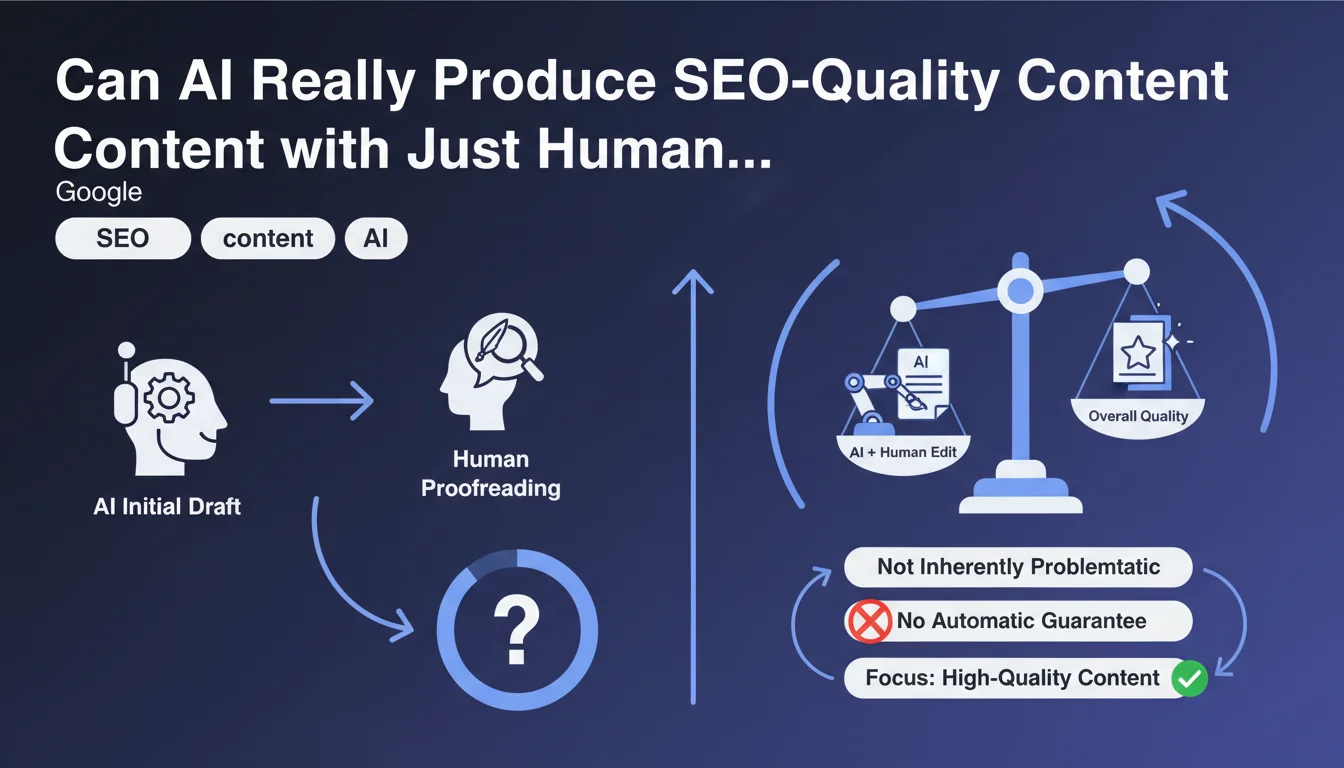
Google claims that the final quality of content takes priority over the production method. Using AI to generate drafts and then having humans review them is not penalized, but it absolutely doesn't guarantee content that will satisfy search engines. The result is what counts, not the process.
What you need to understand
Google is attempting to clarify its position on AI-generated content, a topic that has stirred up the SEO sphere since the explosion of generative tools. The message is simple on the surface: no matter how you produce your content, only the final result will be evaluated.
This statement addresses a recurring concern: is using AI to write automatically penalized? The answer is no. But be careful — this is not a blank check.
Why does Google insist on final quality rather than the method?
Because the search engine has always had the same objective: satisfying the user's search intent. Whether your content is written by a freelance writer, an intern, an LLM, or a mix of all three, Google doesn't care.
What interests it is knowing whether your page provides a complete, credible answer that is better structured than the competition. If your AI draft plus human review produces generic text that looks like 50 other pages, you're going nowhere.
Is human proofreading enough to transform an AI draft into high-performing content?
No. And that's where the statement becomes interesting. Google explicitly states that having a human review it guarantees nothing. It's an indirect jab at everyone who thinks a quick grammar pass is enough to "humanize" a ChatGPT output.
Effective proofreading means restructuring, enriching with exclusive data, verifying consistency with your industry expertise. If your editor just corrects commas, you stay in the generic lane.
- The AI plus human workflow is not penalized by Google in itself
- Final quality takes priority: originality, depth, expertise, usefulness
- Simple proofreading is not enough to guarantee high-performing content
- Google evaluates the result, not the production method
SEO Expert opinion
Is this statement consistent with what we observe in the field?
Yes and no. In principle, it's consistent: Google has always said it seeks to reward useful content, regardless of its origin. Historically, it actually took years before the engine could effectively detect spun or automatically translated content.
But the reality is that since the Helpful Content updates, we've observed increased volatility on sites that massively published generic AI content, even with human review. Coincidence? Not sure. [To verify]: Google has never published internal data on the correlation between intensive AI use and visibility drops.
What nuances should be added to this claim?
First, the notion of "quality" remains fuzzy. Google gives no threshold, no objective criteria. We're always dealing with subjective evaluation via Quality Raters Guidelines and behavioral signals (pogo-sticking, time on page, bounce rate).
Second, "having human editors review" can mean many things. Between quick proofreading and complete rewriting with added sources, examples from the field, and personal perspective, there's a world of difference. Google doesn't clarify — and that's intentional.
In what cases does this rule not really apply?
For YMYL sectors (Your Money Your Life), the bar is set much higher. A health article generated by AI and reviewed by a non-specialist will never pass Google's filters, even if it's grammatically flawless.
Similarly, on highly competitive queries where demonstrated expertise makes the difference (finance, legal, complex B2B), standard AI content has no chance against a competitor publishing original analysis, case studies, and exclusive data.
Practical impact and recommendations
What should you concretely do if you use AI to produce content?
First, never publish an AI draft as-is. Even if you think it "reads well," it will always lack the differentiating angle that makes a page stand out.
Next, establish a structured revision process: fact-checking, adding proprietary data (your figures, customer feedback, internal benchmarks), rewording to match your brand voice, technical SEO optimization (semantic markup, internal linking, media).
What mistakes should you absolutely avoid?
Don't fall into the volume-for-volume trap. Publishing 50 AI articles per week with cosmetic proofreading is the best way to dilute your authority and tank your Core Web Vitals if your CMS isn't optimized.
Another mistake: believing that because Google "allows" AI, it will reward mediocre content. The search engine doesn't penalize AI as such, but it gives no favors to mediocre content, regardless of its source.
- Use AI as a research assistant or to structure an outline, not as a final writer
- Have content reviewed by someone who masters the subject, not just a general proofreader
- Add exclusive elements: internal data, real-world examples, personal perspective
- Ensure each page brings real added value versus the competition
- Don't multiply AI pages on similar queries (risk of cannibalization)
- Track behavioral metrics: time on page, bounce rate, scroll depth
Google doesn't penalize AI use, but gives no bonus either. If you want AI content to perform, it must be enriched, verified, personalized — and that takes time, industry expertise, and a real editorial strategy.
Setting up this type of hybrid AI plus human workflow can prove complex: defining good prompts, structuring review processes, training teams, measuring performance. For many companies, relying on an SEO agency that masters these issues allows you to accelerate implementation while avoiding costly visibility mistakes.
❓ Frequently Asked Questions
Google peut-il techniquement détecter qu'un contenu a été généré par IA ?
Faut-il mentionner qu'un contenu a été assisté par IA ?
Un concurrent qui publie massivement du contenu IA sans relecture sera-t-il pénalisé ?
La relecture humaine doit-elle être faite par un expert du sujet ?
Peut-on utiliser l'IA pour réécrire du contenu existant sans risque de duplicate content ?
🎥 From the same video 20
Other SEO insights extracted from this same Google Search Central video · published on 13/06/2024
🎥 Watch the full video on YouTube →
💬 Comments (0)
Be the first to comment.