
Official statement
Other statements from this video 20 ▾
- □ Should you really block AI-generated automatic translations from your site with noindex?
- □ Are site: searches polluting your Search Console data?
- □ Why Is Google Telling You to Ignore Your PageSpeed Insights Scores?
- □ Should you really stop obsessing over Core Web Vitals optimization?
- □ Should you really worry about buying an expired domain?
- □ Can AI Really Produce SEO-Quality Content with Just Human Proofreading?
- □ Can poor machine translation really tank your SEO rankings?
- □ Do affiliate links actually hurt your page's search rankings?
- □ Should you really fix every single broken backlink pointing to your site?
- □ Does Next.js really require specific SEO best practices from the start?
- □ Can you safely canonicalize pages that are 93% identical without damaging your SEO?
- □ Should you redirect or completely disable an unused subdomain for SEO?
- □ Should you really worry about toxic backlinks pointing to your site?
- □ Should you really match your page title and H1 tag?
- □ Does localized content really escape the duplicate content penalty?
- □ Why does Google discourage using site: queries to verify indexation?
- □ Why does a high ranking not guarantee strong CTR on Google?
- □ Do JavaScript console errors really hurt your site's search rankings?
- □ Do you really need a dedicated page per video to rank in rich video results?
- □ Is content syndication really worth the risk to your organic visibility?
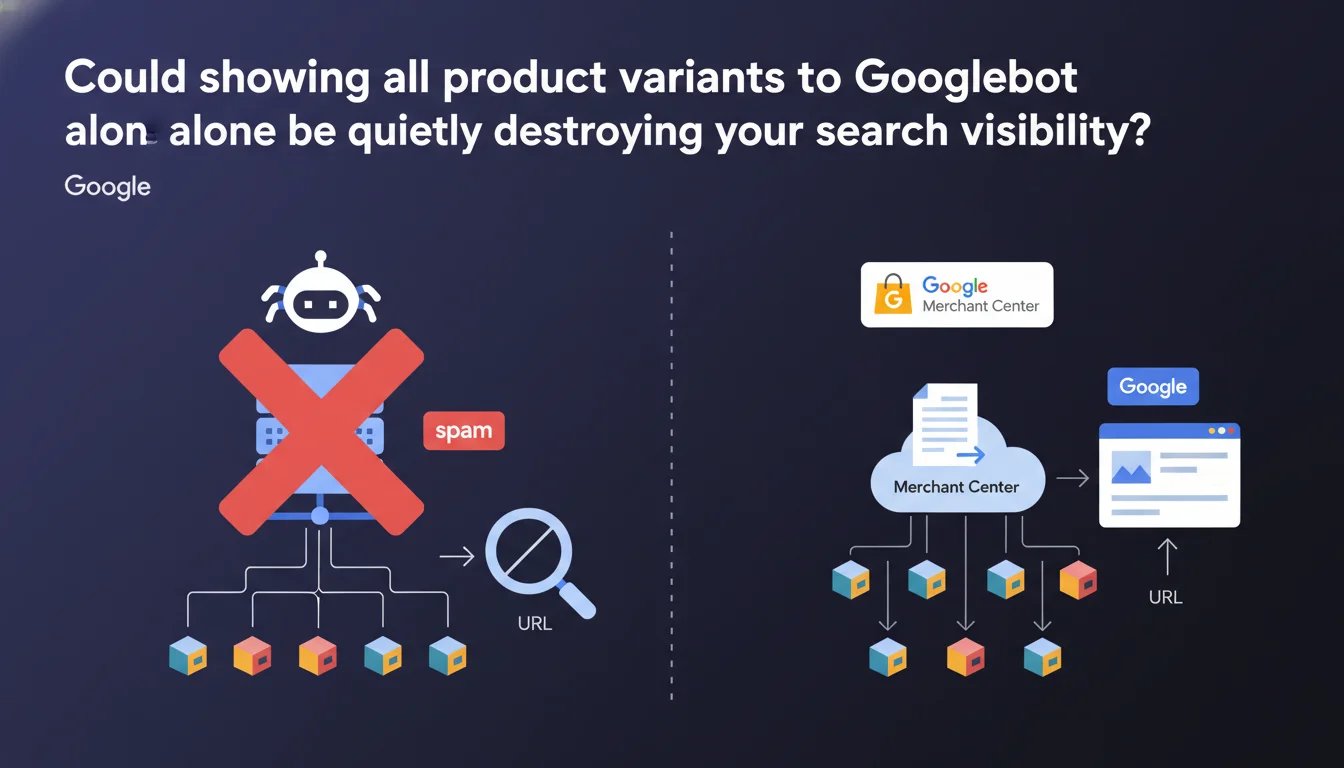
Displaying all product variants exclusively to Googlebot (but not to users) is considered cloaking and violates Google's anti-spam policies. The official solution? Use Merchant Center to submit these variants — they'll appear in Shopping results even if the URLs aren't indexed in regular search. Two-speed e-commerce is now the standard.
What you need to understand
What exactly is product variant cloaking?
Cloaking, in its classic definition, means serving different content to Googlebot and to users. Google is clarifying a specific case here: creating pages that list all variants of a product (colors, sizes, materials) only for the bot, while the human user sees only a reduced version or a dynamic selector.
This practice is tempting — you multiply indexable pages, you capture more long-tail traffic. Except that for Google, it's a blatant manipulation of the index. The intention is clear: artificially inflate the crawl surface without offering the same experience to the end user.
Why is Google cracking down on this approach now?
E-commerce sites have long juggled this gray area. Technically, showing all product combinations to Googlebot made it possible to improve organic visibility on ultra-specific queries. But Google has hardened its stance: this practice dilutes index quality and creates massive duplications.
The official position is unambiguous — if the user cannot naturally access this page, Googlebot should not see it either. This is a strict redefinition of the fairness principle between bot and human. No special treatment, even for "technically" legitimate content.
Merchant Center, the imposed alternative — but is it really enough?
Google is explicitly pushing Merchant Center as the workaround solution. By submitting your variants through this structured feed, they appear in Google Shopping and rich results, without requiring indexing in classic web search.
Let's be honest: it's a transfer of power. You abandon control of classic organic indexing to depend on a proprietary Google feed. Merchant Center becomes the mandatory gateway for any serious e-commerce strategy — and that's a structural shift.
- Product variant cloaking (content visible only to Googlebot) is a violation of anti-spam rules
- Merchant Center becomes the recommended tool for submitting variants without classic web indexing
- Variants submitted via Merchant Center appear in Shopping and rich results
- This approach marks a shift toward structured feeds rather than traditional HTML indexing
- The bot/human distinction is now a non-negotiable red line for Google
SEO Expert opinion
Is this rule really new or just a clarification?
The principle of cloaking is as old as SEO itself. What's changing here is the clarification of a specific case: e-commerce product variants. Google isn't inventing anything, it's closing a door that some had left slightly ajar.
In practice, many sites have already taken manual penalties for this type of manipulation — but without a clear message on the "why". This official declaration formalizes what savvy SEOs already knew: if Googlebot sees 50 URLs where the user sees 5, you're playing with fire. [To verify]: does Google systematically detect this type of cloaking, or only during manual audits? Field feedback suggests automatic detection remains uneven across sectors.
Merchant Center, a solution or a hidden dependency?
Google sells Merchant Center as the clean alternative. In reality, it's a strategic lock. You outsource your product data to a proprietary system, you lose control of classic organic indexing, and you enter a feed logic where Google decides what bubbles up or not.
The problem? Merchant Center is demanding. A poorly structured feed, incomplete data, inconsistencies between your site and the feed — and your variants disappear. Unlike an HTML page you index and control, here you're entirely dependent on Google's validation. It's a trade-off you need to embrace with eyes wide open.
[To verify]: do variants submitted via Merchant Center get the same SEO weight as classic organic pages? Observations show they do not — Shopping display doesn't equal a top 3 organic position. It's second-tier visibility.
In what cases does this rule create a real dilemma?
Imagine a site with thousands of variants (textiles, made-to-order furniture). Creating one HTML page per combination would be suicidal in terms of crawl budget and cannibalization. But not doing it means giving up capturing ultra-specific queries like "floral dress size 42 long sleeves".
The Merchant Center solution only partially resolves this dilemma — it captures Shopping traffic, but abandons classic organic search. For sites that live on SEO long-tail, it's a sacrifice. There's no miracle solution here, just an arbitrage between compliance and performance.
Practical impact and recommendations
What should you do concretely if you're affected?
First, audit your site. Compare what Googlebot sees (via Search Console or a crawler configured with Google user-agent) and what a real user sees. If you detect pages or content accessible only to the bot, you're in violation.
Next, switch to Merchant Center if you haven't already. Set up a clean product feed with all variants, including those that don't have a dedicated URL. Use structured attributes (color, size, material) so Google understands the relationships between variants.
Finally, remove or consolidate "ghost" pages created for Googlebot. If a variant doesn't have a viable user page, it shouldn't be indexed — period. Properly redirect to the parent page or to a variant selection page.
What mistakes should you absolutely avoid?
Don't gamble by subtly masking content through conditional JavaScript or user-agent detection. Google has the tools to detect these sophisticated cloaking patterns, and penalties fall without warning.
Also avoid neglecting Merchant Center under the pretext that "it doesn't replace organic". That's true, but it's become the only officially supported path for managing variants without risk of penalty. A poorly managed or abandoned feed is a flat loss of Shopping visibility.
Be wary of unintentional duplications as well. If you keep variant URLs indexed while also submitting them via Merchant Center, you create conflicts. Google doesn't know which version to display, and you dilute your authority. Choose a strategy and stick with it.
How do you verify that your site is compliant?
Use Search Console's URL Inspection tool to compare the raw HTML render and the render "as seen by Google". If entire blocks of variants appear only in the latter, that's a warning sign.
Run a crawl with Screaming Frog or equivalent in Googlebot mode, then do it again in classic browser mode. Export both URL lists and compare them. Any URL present only in the bot crawl is potentially problematic.
Also check Search Console's coverage reports. Pages indexed but not accessible via classic user navigation (no internal links, not in HTML sitemap) are indicators of unintentional cloaking. Google indexes them because they're in the XML sitemap, but no user can naturally reach them — that's exactly what you need to fix.
- Audit the difference between content seen by Googlebot and content seen by real users
- Configure and optimize a Merchant Center feed with all product variants
- Remove or redirect "ghost" pages created only for robots
- Avoid any user-agent detection to display differentiated content
- Compare Googlebot vs browser crawls to identify gaps
- Verify consistency between Search Console indexing and user navigation
- Choose one unique strategy: either classic indexed URLs or Merchant Center feed — not both
❓ Frequently Asked Questions
Puis-je créer des pages de variantes si elles sont accessibles aux utilisateurs ?
Merchant Center remplace-t-il complètement l'indexation organique pour les variantes ?
Comment Google détecte-t-il le cloaking de variantes produits ?
Que faire si mon site a déjà des milliers de variantes indexées ?
Est-ce que l'utilisation de JavaScript pour afficher les variantes est autorisée ?
🎥 From the same video 20
Other SEO insights extracted from this same Google Search Central video · published on 13/06/2024
🎥 Watch the full video on YouTube →
💬 Comments (0)
Be the first to comment.