
Official statement
Other statements from this video 20 ▾
- □ Should you really block AI-generated automatic translations from your site with noindex?
- □ Are site: searches polluting your Search Console data?
- □ Why Is Google Telling You to Ignore Your PageSpeed Insights Scores?
- □ Should you really stop obsessing over Core Web Vitals optimization?
- □ Should you really worry about buying an expired domain?
- □ Can AI Really Produce SEO-Quality Content with Just Human Proofreading?
- □ Can poor machine translation really tank your SEO rankings?
- □ Do affiliate links actually hurt your page's search rankings?
- □ Should you really fix every single broken backlink pointing to your site?
- □ Does Next.js really require specific SEO best practices from the start?
- □ Can you safely canonicalize pages that are 93% identical without damaging your SEO?
- □ Should you redirect or completely disable an unused subdomain for SEO?
- □ Should you really worry about toxic backlinks pointing to your site?
- □ Does localized content really escape the duplicate content penalty?
- □ Why does Google discourage using site: queries to verify indexation?
- □ Why does a high ranking not guarantee strong CTR on Google?
- □ Do JavaScript console errors really hurt your site's search rankings?
- □ Could showing all product variants to Googlebot alone be quietly destroying your search visibility?
- □ Do you really need a dedicated page per video to rank in rich video results?
- □ Is content syndication really worth the risk to your organic visibility?
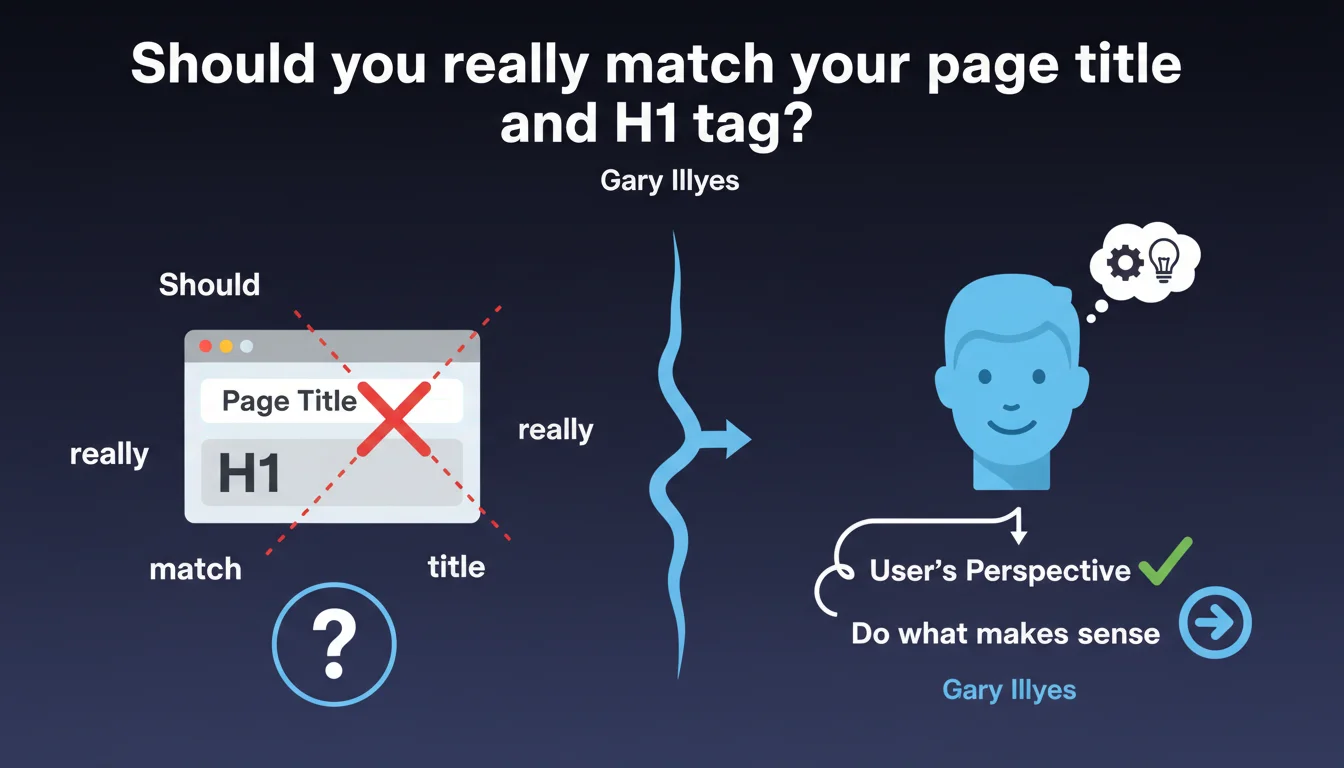
Google confirms that matching between the title tag and H1 is not a ranking factor. Gary Illyes recommends prioritizing user consistency rather than strict matching between these two elements. This statement frees SEO practitioners from a technical constraint often perceived as mandatory.
What you need to understand
This statement debunks a persistent misconception in the SEO community. For years, exact matching between title and H1 has been presented as a best practice, even a golden rule.
Gary Illyes sets a clear framework here: what matters is relevance for the user, not technical uniformity.
Why has this confusion persisted for so long?
Because semantic consistency between title and H1 has always made sense from a UX perspective. A user who clicks a search result expects to find the same message on the destination page.
The problem is that this UX principle has been transformed into a rigid technical rule. Result: websites with title and H1 that are identical word-for-word, sometimes at the expense of editorial clarity.
What does "doing what makes sense" really mean?
Google doesn't ask for strict textual matching. It asks for logical continuity between what is promised in the SERPs and what is delivered on the page.
The title can be optimized for clicks and search context. The H1 can be more explicit, longer, or phrased differently to serve immediate comprehension once on the page.
What's the difference between title and H1 in information architecture?
The title tag appears in SERPs, browser tabs, and social shares. It's an external contextual element outside the page.
The H1 structures visible content. It's an internal editorial landmark that hierarchizes information for readers and crawlers.
- Strict title/H1 matching is not a ranking factor
- Google favors semantic consistency over textual identity
- The title should serve the SERP context, the H1 comprehension on the page
- A divergence between the two is acceptable if it improves user experience
SEO Expert opinion
Is this statement consistent with field observations?
Yes, and it's reassuring. I've analyzed hundreds of well-ranked pages with different titles and H1s. No negative correlation has ever been observed.
What works: a title optimized for SERP CTR (short, punchy, with the main keyword) and a more explicit H1 that sets the context for the reader once on the page.
Where do the limits of this relaxed rule appear?
Let's be clear: Google says matching isn't mandatory, not that it's useless. If your title promises "Complete Backlinks Guide" and your H1 says "Advanced Netlinking Strategies," you create cognitive friction.
The freedom given here doesn't exempt you from thematic consistency. Too large a gap between title and H1 can harm bounce rate and engagement, which indirectly impacts SEO.
Should you abandon any matching altogether?
No. For transactional pages or simple informational articles, keeping title and H1 aligned often remains the most effective solution. It's direct, it's clear, it works.
Where divergence makes sense is on complex pages, multi-intent landings, or long editorial content where the H1 can provide more context than a 60-character title allows.
Practical impact and recommendations
What should you concretely do on your existing pages?
Nothing systematic. Start by auditing strategic pages: those generating traffic, those converting, those ranking in positions 5-15 that could climb higher.
Ask yourself: does my title and H1 serve the same objective or complementary objectives? If the title is optimized for clicks and the H1 for comprehension, you're on the right track.
What mistakes should you avoid when optimizing?
Don't succumb to the temptation of differentiated keyword stuffing. Some create different titles and H1s solely to place more keywords. It doesn't work, and it creates a wobbly user experience.
Also avoid factual contradictions. If your title announces "2025" and your H1 "2024," or if the promised angle differs from the angle covered, you lose credibility.
How do you verify that your titles and H1s are well-calibrated?
Test the perceived consistency. Display your title as it appears in SERPs, then your H1. Is the transition from one to the other smooth or disorienting?
Look at your behavioral metrics: bounce rate, time spent, scroll depth. A problematic gap between title and H1 often translates to quick bounces.
- Verify thematic consistency between title and H1, not necessarily textual
- Optimize the title for SERP CTR, the H1 for editorial clarity
- Test pages with significant gaps: analyze user behavior
- Never create a promise break between what's announced and what's delivered
- Prioritize high-value pages for adjustments
This statement frees you from technical constraints but reinforces the demand for strategic consistency. You can now leverage title and H1 to serve different but complementary objectives: the first to capture attention in SERPs, the second to structure and contextualize content.
Fine-tuning these elements requires deep analysis of your content architecture and conversion goals. If you manage a complex site with many page types, working with a specialized SEO agency can help you fully exploit this flexibility without sacrificing overall coherence.
❓ Frequently Asked Questions
Est-ce que Google pénalise les sites où title et H1 sont identiques ?
Peut-on avoir plusieurs H1 sur une même page ?
Le H1 est-il plus important que le title pour le SEO ?
Faut-il mettre le mot-clé principal dans le title ET le H1 ?
Google réécrit-il automatiquement le title si celui-ci diffère du H1 ?
🎥 From the same video 20
Other SEO insights extracted from this same Google Search Central video · published on 13/06/2024
🎥 Watch the full video on YouTube →
💬 Comments (0)
Be the first to comment.