
Official statement
Other statements from this video 20 ▾
- □ Faut-il vraiment bloquer les traductions automatiques par IA de votre site en noindex ?
- □ Les recherches site: polluent-elles vos données Search Console ?
- □ Pourquoi Google vous demande d'ignorer les scores de PageSpeed Insights ?
- □ Faut-il vraiment arrêter d'optimiser les Core Web Vitals à tout prix ?
- □ Faut-il se méfier d'un domaine expiré racheté ?
- □ L'IA peut-elle vraiment produire du contenu SEO de qualité avec une simple relecture humaine ?
- □ La traduction automatique peut-elle vraiment pénaliser votre classement SEO ?
- □ Les liens d'affiliation pénalisent-ils vraiment le référencement de vos pages ?
- □ Faut-il vraiment réparer tous les backlinks cassés pointant vers votre site ?
- □ NextJS impose-t-il vraiment des bonnes pratiques SEO spécifiques ?
- □ Peut-on canonicaliser des pages à 93% identiques sans risque pour son SEO ?
- □ Faut-il rediriger ou désactiver un sous-domaine SEO non utilisé ?
- □ Faut-il encore s'inquiéter des liens toxiques pointant vers votre site ?
- □ Faut-il vraiment faire correspondre le titre et le H1 d'une page ?
- □ Le contenu localisé échappe-t-il vraiment à la pénalité pour duplicate content ?
- □ Pourquoi Google déconseille-t-il d'utiliser les requêtes site: pour vérifier l'indexation ?
- □ Pourquoi un bon classement ne garantit-il pas un CTR élevé sur Google ?
- □ Les erreurs JavaScript dans la console impactent-elles vraiment le référencement de votre site ?
- □ Pourquoi afficher toutes les variantes produits à Googlebot peut-il détruire votre indexation ?
- □ La syndication de contenu est-elle un pari risqué pour votre visibilité organique ?
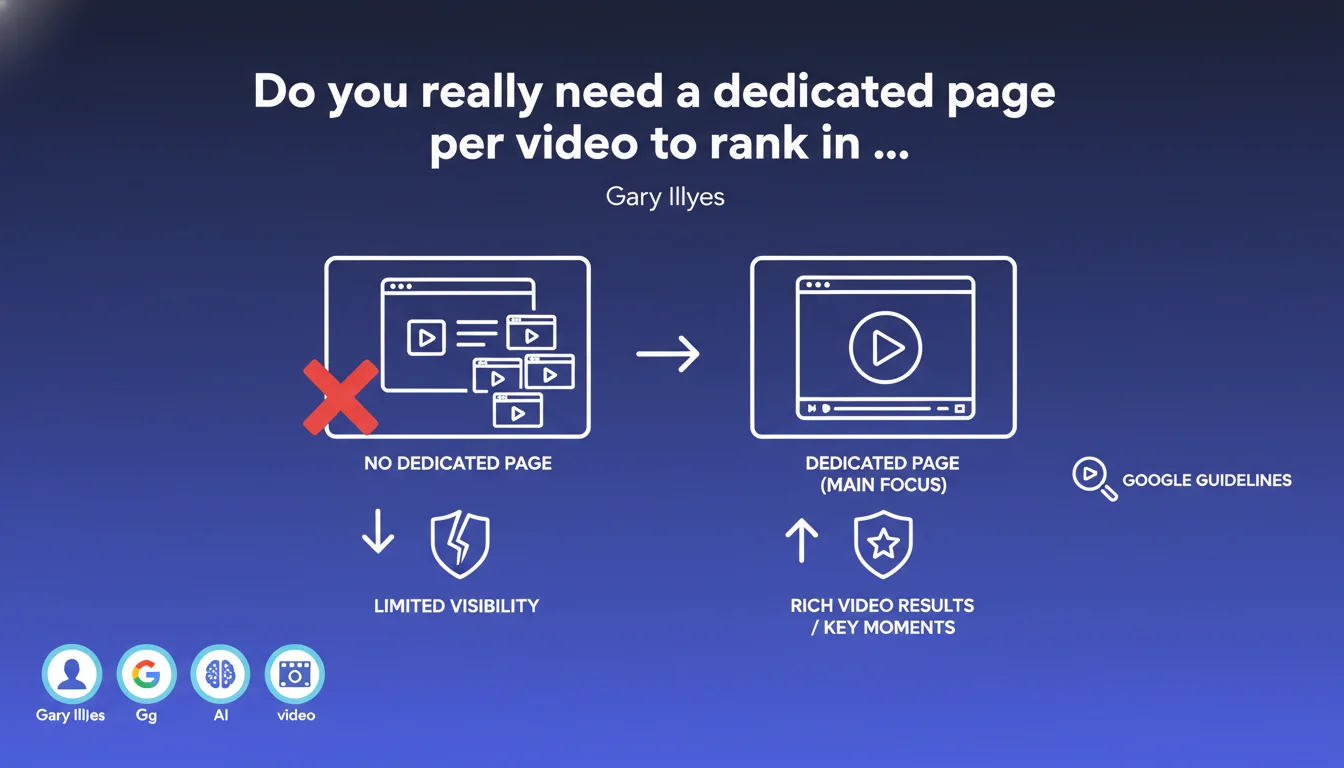
Google requires a dedicated page per video to get rich video results with key moments. The video must be the main focus of the page — not just a supplement buried in a long article. Without this structure, you lose access to advanced features in the SERP.
What you need to understand
This statement from Gary Illyes sets a precise technical rule: to access rich video results with features like key moments, each video must have its own URL where it constitutes the main content.
This is not a simple recommendation — it's a structural prerequisite. Without a dedicated page, Google cannot activate rich features, even if your schema.org VideoObject markup is perfect.
Why does Google impose this constraint?
The logic is twofold. First, Google wants to guarantee that the URL returned in results actually corresponds to the promised experience: if a user clicks on a key moment at 3:42, they must land on a page where the video is immediately visible, not buried after 800 words of text.
Second, this allows Google to understand the semantic context of each video individually. A page with 5 embedded videos? Impossible for the engine to determine which one is the main subject — so no rich processing.
What exactly is a "dedicated page"?
It's not enough to have a unique URL. The page must structurally demonstrate that the video is the main focus: player visible above the fold, title and description consistent with video content, correct VideoObject markup.
Accompanying text is allowed — a complete transcript, for example, poses no problem. What blocks it is when the video becomes a simple illustrative complement to dominant text content.
- A unique URL per video is mandatory for rich results
- The video must be the main content visible immediately
- Schema.org markup alone is not enough without this structure
- Multi-video pages are excluded from rich processing
- This rule applies specifically to key moments and advanced features
Does this rule apply to all video formats?
The statement explicitly targets rich video results with advanced features. For basic display in Google's "Videos" tab, criteria are less strict.
But if your goal is to get key moments, clickable chapters, or live/premiere badges — this architecture becomes non-negotiable. It's the entry ticket for features that actually generate click-through rates.
SEO Expert opinion
Is this rule really enforced in practice?
Yes — and it's verifiable. Sites that get key moments in SERPs systematically respect this architecture. YouTube, obviously, but also media outlets that structure their video section with one page per content piece.
However, the boundary between "main focus" and "illustrative supplement" remains fuzzy. I've seen pages with 40% text get rich results, and others with 20% get ignored. The player position, video length, and probably behavioral signals play a role. [To verify]: Google has never given a precise text/video ratio.
What risks if you try to work around this rule?
Some attempt to create "shell" pages — dedicated URL but with minimal text content, just to check the box. Result: pages rank poorly because they lack semantic depth.
The equation is delicate. Too much text? The video is no longer the focus. Not enough? The page lacks context to rank on informational queries. You need to find the balance — structured transcript, summary at page top, rich metadata — without drowning the player.
Is this architecture compatible with classic editorial strategy?
That's where it gets stuck for many publishers. Historically, video was meant to enrich an article — not replace it. Moving to a "one page per video" logic means rethinking your entire content structure.
Two approaches coexist: either you create a separate video hub (like /videos/video-title/), or you partially duplicate content in text and video versions with distinct URLs. Neither is perfect — the first isolates your video content, the second creates cannibalization risks.
My observation after 15 years: sites that treat video as a standalone content format — not as a supplement — are the ones dominating rich results. It's a cultural shift as much as a technical one.
Practical impact and recommendations
How to concretely structure a compliant video page?
First rule: the player must be visible without scrolling on desktop and mobile. If users have to scroll down to see the video, Google will consider it not the main focus.
Then build around it: H1 title consistent with video title, short description (150-200 words) before the player, then complete transcript structured in sections if the video is over 5 minutes long. The VideoObject markup must point to this unique URL — not to a parent page or playlist.
What errors systematically block rich results?
Embedding multiple videos on the same page is the classic trap. Even if you mark each with its schema.org, Google won't know which to prioritize — result: none gets key moments.
Another error: create a dedicated page but with the video at the bottom, after 1000 words of content. Position matters as much as the URL. And watch out for aggressive lazy-loading that hides the player from crawling — verify in Search Console that Google sees your video.
- Create a unique URL per video (structure /videos/slug/ recommended)
- Position the player above the fold on all devices
- Limit text content before the player to maximum 150-200 words
- Add a structured transcript after the player to enrich context
- Implement VideoObject markup with all required fields (uploadDate, duration, thumbnailUrl, contentUrl)
- Specify timestamps for key moments via hasPart or Clip property
- Verify in the Search Console "Enhancements" report that videos are properly detected
- Test display in the rich results testing tool
- Avoid lazy-loading on the main player to guarantee detection on crawl
- Monitor Core Web Vitals — heavy players can degrade LCP
Should you migrate all your videos to this architecture?
No. Prioritize videos that target queries with strong informational intent and measurable search volume. A 10-minute tutorial on "how to install X"? Yes, dedicated page. A 30-second video illustrating a point in an article? Not necessary.
Audit your existing videos: identify those already generating organic traffic (even modest), those ranking in the Videos tab, and those matching "how to" or "tutorial" queries. These are your priority candidates for migration.
❓ Frequently Asked Questions
Peut-on avoir plusieurs vidéos sur une même page et obtenir quand même les résultats enrichis ?
Quelle quantité de texte peut-on ajouter sans que la vidéo perde son statut de « contenu principal » ?
Les vidéos YouTube embarquées peuvent-elles obtenir les résultats enrichis sur mon site ?
Le balisage schema.org suffit-il pour obtenir les moments clés ?
Faut-il créer des pages dédiées pour toutes les vidéos de mon site ?
🎥 From the same video 20
Other SEO insights extracted from this same Google Search Central video · published on 13/06/2024
🎥 Watch the full video on YouTube →
💬 Comments (0)
Be the first to comment.