
Official statement
Other statements from this video 11 ▾
- □ Why should photographers invest in their own website instead of relying solely on Instagram?
- □ Is it really a mistake to use generic keywords as your business name for SEO?
- □ Is Google Search Console really essential for your photography website?
- □ Why does Google index photo galleries with descriptive text better than isolated images?
- □ Can social media really coexist with your website in Google Images results?
- □ Does publishing your images first guarantee canonicalization on Google?
- □ Should you really stop watermarking your images for SEO?
- □ Should you really create a dedicated page for every image on your website?
- □ Are URL fragments (#) killing your image visibility in Google search results?
- □ Are responsive images really enough to boost your Google rankings?
- □ JPEG, WebP, AVIF: Which image format should you choose for SEO in 2025?
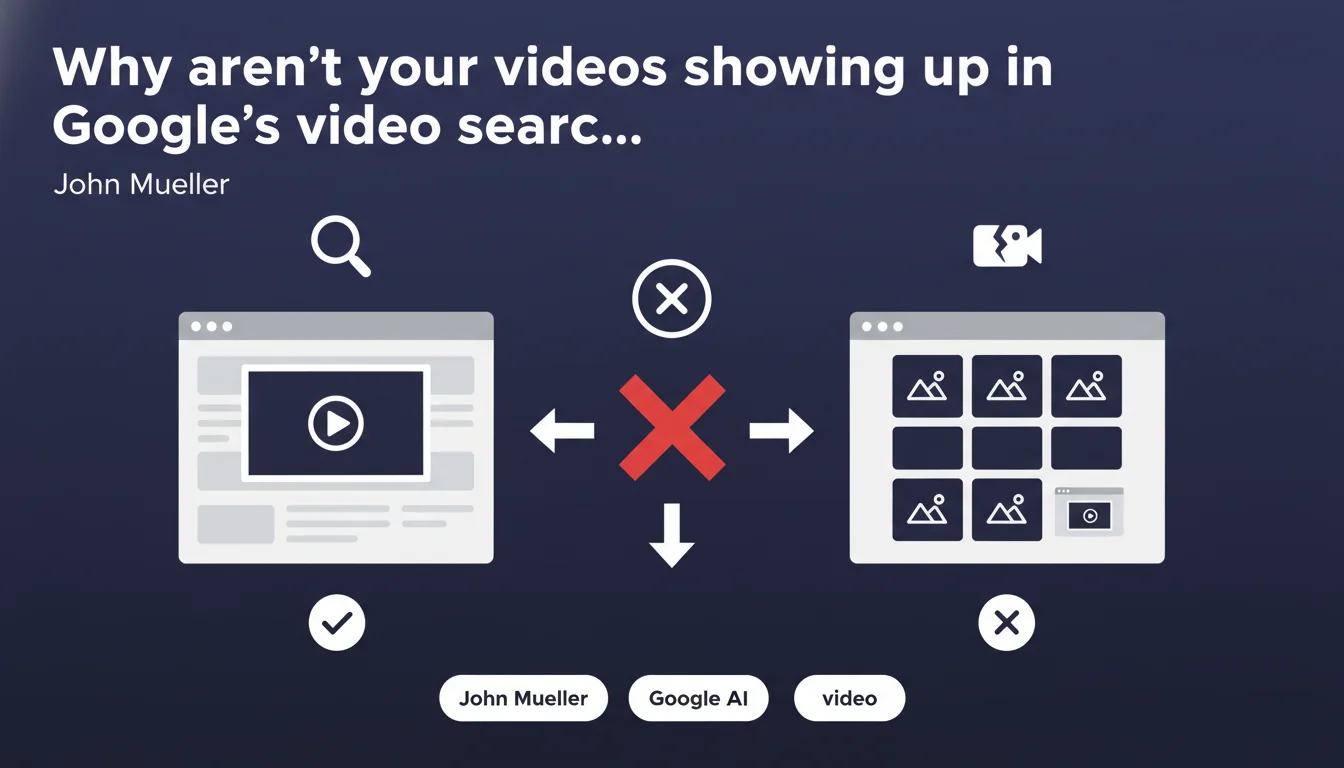
Google requires the video to be the main element of the page to appear in video search results. If a user clicks on a thumbnail, they should land on a page centered around that video — not a photo gallery with a video buried somewhere. User intent comes first: click on video = video experience.
What you need to understand
What does Google mean by the "main element"?
Mueller leaves no room for ambiguity. The main element is what dominates visually and structurally on the page. If a user lands on a gallery of 50 photos with a video buried at the bottom, Google considers the video is not the central element.
In concrete terms? The video must be visible above the fold, occupy significant space, and surrounding content should serve it — not dilute it. Transcript, description, related links: everything should revolve around the video.
Why does Google enforce this constraint?
Because user intent is everything. Someone clicking on a video thumbnail in the SERPs expects an immediate video experience. Not a long article with an accessory video.
If Google massively indexes pages where the video is just a gadget, it betrays its contract with users. And that's something Mueller makes crystal clear: the alignment between intent and results is non-negotiable.
Does this rule apply to all types of searches?
Yes, as soon as we're talking about dedicated video search results — not video carousels inserted in regular results, an important distinction. If you're targeting the "Videos" tab or video rich snippets, this requirement is a prerequisite.
For mixed pages (article + video), you can still rank in regular web search, but you won't appear in dedicated video SERPs.
- The video must be visually dominant on the page
- Users should land directly on the video after clicking
- Supporting content must serve the video, not compete with it
- This rule applies to dedicated video search results, not necessarily embedded carousels
- Google verifies alignment between user intent and actual experience
SEO Expert opinion
Is this statement consistent with what we observe in the field?
Absolutely. For years, tests have shown that Google prioritizes dedicated pages for video SERPs. Sites that try to "sprinkle" videos into long articles without clear structure are systematically outranked.
What's interesting — and Mueller doesn't say it explicitly — is that Google likely measures scroll depth and video viewing time after a click. A page where the video isn't found quickly generates pogo-sticking, a toxic signal.
What nuances should be added to this rule?
First point: Mueller talks about "video search results", not all video appearances in Google. A blog article with a complementary video can rank well in regular search and even get a video rich snippet without being the "main element".
Second nuance — and this is crucial: the notion of "main element" remains vague. What percentage of the screen? What exact position? Google doesn't give percentages. What matters is the perceived experience, not pixel-by-pixel calculation.
In what cases can this rule be circumvented?
It can't really be "circumvented", but gray areas exist. For example, an e-commerce product page with a demo video at the top could theoretically be eligible if the video is sufficiently prominent.
But let's be honest: if your main goal is to appear in video SERPs, creating a dedicated page per video remains the safest strategy. Trying to kill two birds with one stone (article + video) rarely works for pure video results.
Practical impact and recommendations
What should you do concretely to comply with this rule?
First, audit your existing video pages. Load each page and ask yourself: "If I click on a video thumbnail in Google, do I land directly on the video?" If the answer is no, restructure.
Next, adopt a dedicated architecture: one URL per video, with the video at the top, an explicit title, a transcript if relevant, and clean schema.org VideoObject markup. No mixed galleries, no photo carousel that buries the video.
What mistakes should you absolutely avoid?
Mistake number one: embedding a video "for looks" in a long article without making it central. Google won't bite.
Second common mistake: using poorly structured video players (YouTube embed without markup, silent autoplay video hidden away). Google must be able to clearly identify that there's a video, its content, its duration.
Third trap: creating "catch-all" pages with multiple videos without clear hierarchy. Google won't know which one to index for which query.
How do you verify that your site is compliant?
Use Google's rich results testing tool to validate your VideoObject markup. Verify that the thumbnail, duration, and description are properly detected.
Next, run a basic user test: ask someone unfamiliar with your page to click and time how long it takes them to find and play the video. If it's more than 3 seconds, you have a problem.
Finally, monitor your positions in Google's Videos tab and compare with your regular search positions. If you rank well in web but not in videos, it's likely a page structure issue.
- Create a dedicated page per video with unique URL
- Place the video above the fold, visually dominant
- Implement complete and valid schema.org VideoObject markup
- Avoid mixed galleries (photos + videos) on the same page
- Provide rich transcription or textual description
- Test mobile display: the video must remain central
- Check Search Console for video search impressions
- Measure view rate and adjust page layout if necessary
🎥 From the same video 11
Other SEO insights extracted from this same Google Search Central video · published on 07/08/2025
🎥 Watch the full video on YouTube →
💬 Comments (0)
Be the first to comment.