
Official statement
Other statements from this video 11 ▾
- □ Faut-il vraiment éviter les noms de marque génériques pour son SEO ?
- □ Search Console est-elle vraiment indispensable pour un site de photographie ?
- □ Pourquoi Google indexe-t-il mieux les galeries photo avec du texte descriptif qu'une image isolée ?
- □ Les réseaux sociaux peuvent-ils vraiment coexister avec votre site dans les résultats Google Images ?
- □ Publier ses images en premier garantit-il la canonicalisation sur Google ?
- □ Faut-il vraiment arrêter de filigraner vos images pour le SEO ?
- □ Faut-il vraiment créer une page dédiée pour chaque image de votre site ?
- □ Pourquoi les fragments d'URL (#) tuent-ils la visibilité de vos images dans Google ?
- □ Les images responsives suffisent-elles vraiment à améliorer votre ranking sur Google ?
- □ JPEG, WebP, AVIF : quel format d'image choisir pour le SEO en 2025 ?
- □ Pourquoi vos vidéos n'apparaissent-elles pas dans les résultats de recherche vidéo ?
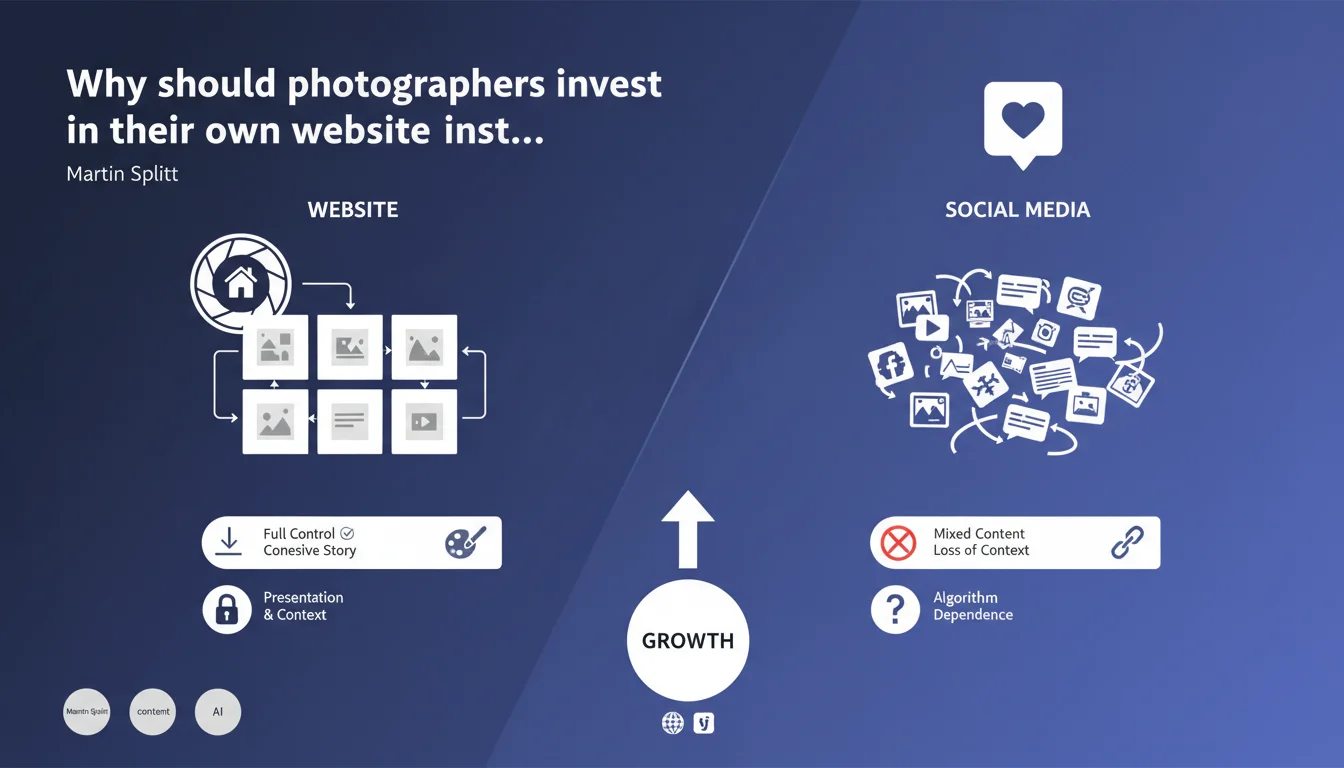
Google emphasizes that photographers need a website to complement their social media presence. The reason: complete control over image presentation and context, which is impossible on social platforms where content gets lost in the feed. From an SEO perspective, owning your channel remains crucial for building a sustainable digital presence.
What you need to understand
Why does Google emphasize this distinction between owning a website and relying on social media?
Splitt's statement highlights a structural problem: on social networks, you control nothing. The algorithm decides the display order, context, and reach. Your art photograph ends up squeezed between a sneaker ad and your cousin's selfie.
A website is your territory. You decide the layout, user journey, and visual storytelling. For a photographer selling art or premium services, this control changes everything — and Google knows it.
Does this statement only apply to photographers?
No. Splitt uses photography as an example because it's visual and compelling, but the principle applies to all content creators. Writers, designers, consultants, craftspeople: whenever your business depends on quality presentation and context, a clean website remains essential.
Social networks provide visibility and immediate traffic. A website builds a lasting asset that no one can take away from you overnight.
What's the real SEO value behind this recommendation?
Google rewards websites that offer a coherent and controlled experience. An Instagram profile has no exploitable semantic structure, no clear hierarchy, no structured data. A well-built website does.
Let's be honest: Google benefits when quality content remains indexable and crawlable. If everything migrates to closed silos (Instagram, TikTok), its search engine loses relevance.
- Complete control over content presentation and context
- Channel ownership: no dependency on third-party algorithms
- Ability to tell a coherent story, essential for art and premium services
- Semantic structure exploitable by search engines
- Complementarity between website (lasting asset) and social media (immediate visibility)
SEO Expert opinion
Is this recommendation really new?
Not at all. Google has been repeating this for years in various forms. What's changing is the context: with TikTok and Instagram rising as preferred discovery channels, many creators wonder if a website still matters.
Splitt's answer is clear: yes, but not for the same reasons as in 2010. Back then, your website was the entry point. Today, it's your anchor point — where you convert attention captured elsewhere.
Are there cases where this rule doesn't apply?
Practically speaking? If your business model relies solely on virality and volume (memes, highly ephemeral content), a website adds little value. You live in the moment, not in duration.
But the moment you sell something — a service, product, or expertise — or build a lasting personal brand, your website becomes central again. That's where many creators struggle: they confuse temporary visibility with long-term authority.
What's the real difference between social visibility and organic SEO?
Social networks give you traffic as long as you feed the machine. Stop posting for three weeks and you disappear. Organic SEO, meanwhile, compounds over time: quality content that's well-optimized continues ranking and driving traffic months after publication.
For a professional photographer, this means their portfolio can generate leads with minimal active effort — but only if it's optimized for the right keywords and technically sound.
Practical impact and recommendations
What concrete steps should a photographer implement?
First, a website with clear architecture: thematic galleries, service pages, a solid about section. Not a dumping ground of 300 random photos. Each series should tell a story and be semantically optimized.
Next, structured data. Schema.org offers specific tags for photographers, portfolios, and artwork. Google can then understand what you do and display relevant rich snippets.
Finally, technical performance: images must be compressed without perceptible quality loss, your site must load fast even with heavy visuals. A portfolio taking 8 seconds to load is dead on arrival.
What critical mistakes should you avoid?
First mistake: build a website then abandon it. If your last update was in 2019 and you're posting to Instagram daily, Google understands where your real center of gravity is. You don't need daily posts, but your site must be alive.
Second mistake: mindlessly duplicate Instagram content on your website. That adds nothing. Your site must offer different value: deeper context, complete series, narratives, detailed case studies.
Third mistake: neglecting internal linking. Your galleries should connect with each other, creating thematic journeys. A visitor coming for wedding portraits should easily discover your event coverage without searching.
How do you measure if your web strategy actually works?
Look at conversion rate, not just traffic. A site attracting 50 qualified visitors monthly that generates 5 quote requests beats a site with 500 visitors and zero conversions.
Also analyze session duration and pages per visit. If people spend 3 minutes on your site and browse multiple galleries, that's a good sign. If everyone bounces in 10 seconds, you have a relevance or UX problem.
- Create a website with clear architecture and well-organized thematic galleries
- Implement Schema.org structured data tailored to photographic content
- Optimize technical performance: image compression, lazy loading, CDN
- Keep your website regularly updated with fresh content
- Differentiate website content from social media posts
- Build coherent internal linking between different galleries
- Set up precise conversion tracking (quote requests, contact inquiries)
- Create SEO-optimized service pages for commercial search queries
- Ensure perfect mobile compatibility for your portfolio
🎥 From the same video 11
Other SEO insights extracted from this same Google Search Central video · published on 07/08/2025
🎥 Watch the full video on YouTube →
💬 Comments (0)
Be the first to comment.