
Official statement
Other statements from this video 11 ▾
- □ Why should photographers invest in their own website instead of relying solely on Instagram?
- □ Is Google Search Console really essential for your photography website?
- □ Why does Google index photo galleries with descriptive text better than isolated images?
- □ Can social media really coexist with your website in Google Images results?
- □ Does publishing your images first guarantee canonicalization on Google?
- □ Should you really stop watermarking your images for SEO?
- □ Should you really create a dedicated page for every image on your website?
- □ Are URL fragments (#) killing your image visibility in Google search results?
- □ Are responsive images really enough to boost your Google rankings?
- □ JPEG, WebP, AVIF: Which image format should you choose for SEO in 2025?
- □ Why aren't your videos showing up in Google's video search results?
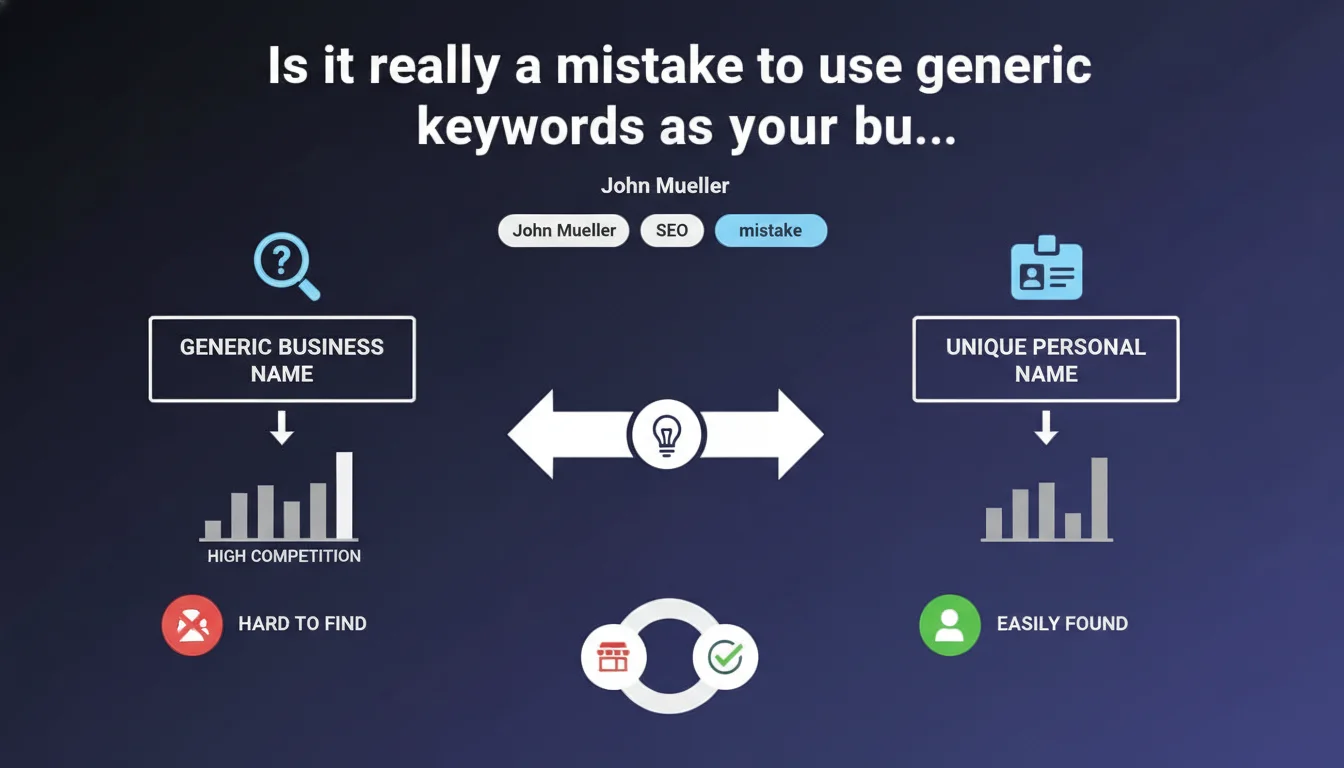
Mueller asserts that small businesses (photographers, craftspeople) shoot themselves in the foot by choosing a generic name like "Wedding Photographer Paris". His advice: prioritize a distinctive personal name or brand. Why? Zero chance of ranking on ultra-competitive terms, whereas a unique name creates a captive audience able to find you directly.
What you need to understand
Why does Google insist on this distinction between proprietary brand vs generic term?
The problem is structural. When a business calls itself "Plumber Paris 15th" or "Wedding Photography Studio", it tries to rank directly on search intent rather than build an identity.
Except Google has evolved. Generic queries are now locked down by dominant players, directories, review platforms. A freelancer betting everything on this is chasing a ghost — and in the process loses the ability to create brand equity recoverable through branded searches.
What concretely happens when you use a personal name as a brand?
You create a semantic monopoly. Someone searches "John Smith photographer" or "Studio Light"? That's you, and only you, who shows up. No competition, no battle of AdWords bids at €15 per click.
It also changes the relational dynamic. Satisfied clients can recommend your name easily, not "um, you know, that photographer guy who does vintage stuff". A personal name is memorable, shareable, searchable.
Does this logic apply to all types of websites?
No, and this is where Mueller remains vague. He speaks of small businesses and photographers — professions where the client relationship is personal, where word-of-mouth matters.
For an e-commerce selling socks, nobody will search "Deluxe Socks" if the brand is unknown. In that case, the domain name can integrate a strategic keyword without being a handicap — provided the content strategy compensates.
- Distinctive brand: creates a monopoly on branded searches, facilitates word-of-mouth
- Generic name: lost in the crowd, impossible to remember, no SEO differentiation
- Exception: transactional sites where traffic relies on categorical SEO, not brand awareness
- Side effect: a personal name makes natural backlinks and local citations more credible
SEO Expert opinion
Is this statement consistent with what we observe in the field?
Yes, but with brutal nuances. Small businesses choosing a generic name indeed end up invisible, except in rare hyper-niche local scenarios. However, Mueller's argument rests on a fragile hypothesis: that people will search for your name.
For a personal name to be a lever, people must first know it. That requires word-of-mouth, social networks, press mentions, Google Business Profile reviews. Without this upstream work, having a unique name changes nothing — you remain invisible, just with a different name.
In what cases does a generic name remain relevant?
When the business model relies on immediate transactional traffic, not customer retention. Typically: comparison sites, affiliate sites, certain online services where the user seeks a solution, not a brand.
Concrete example: a site called "Free-Plumber-Quote.com" can capture SEO traffic if the content strategy is solid. But it will never create brand equity, and the day Google adjusts its algorithm or a competitor arrives, it's over. Conversely, "Smith Plumbing" can survive 20 years if word-of-mouth works.
Why is this mistake so common among small businesses?
Because the idea seems logical on the surface: "If I call myself Wedding Photographer Lyon, people searching for that will find me." Except Google doesn't work that way anymore since at least 2015.
Current algorithms favor authority, editorial relevance, user signals. Having a keyword in your name no longer compensates for an empty site, absent backlinks, a poorly optimized Google Business profile. And especially, it locks you into a short-term strategy where everything depends on one keyword instead of building a lasting asset.
Practical impact and recommendations
What should you do if your current brand is a generic term?
Two options. First: complete rebrand to a personal name. It's radical, but sometimes necessary — especially if the current site isn't taking off. That means properly redirecting the old domain, updating all social profiles, notifying customers.
Second option: build a layer of brand awareness without changing the name. You keep "Wedding Photographer Lyon" but create content around your approach, style, projects. You work on customer reviews, local publications, collaborations. The goal? Make people search for your name, even if it's generic.
How do you structure a personal branding strategy for a freelancer?
Start by clarifying your positioning. What differentiates you? What visual, editorial, conceptual universe represents you? A personal name without identity is worth nothing.
Then work on brand signals: flawless Google Business profile, presence on platforms where your audience hangs out (Instagram for photographers, Houzz for architects…), client testimonials mentioning your name.
Finally, ensure your site ranks for your personal name. It seems obvious, but verify: when someone types your name, do you show up first? Not a namesake, not an orphaned LinkedIn profile, not an old Facebook page.
- Verify that your brand name is available on major platforms (domain, social networks, Google Business)
- Audit semantic competition: are there other players with a similar or identical name?
- Optimize title/meta tags to systematically include your brand name, not just generic keywords
- Create an editorial content strategy that showcases your expertise under your name
- Work on contextual backlinks with brand anchor text, not just keyword anchors
- Track branded search volume monthly via Google Search Console and Google Trends
- Implement a review collection system with explicit mention of your name
🎥 From the same video 11
Other SEO insights extracted from this same Google Search Central video · published on 07/08/2025
🎥 Watch the full video on YouTube →
💬 Comments (0)
Be the first to comment.