
Official statement
Other statements from this video 11 ▾
- □ Pourquoi un photographe devrait-il investir dans un site web plutôt que miser uniquement sur Instagram ?
- □ Faut-il vraiment éviter les noms de marque génériques pour son SEO ?
- □ Search Console est-elle vraiment indispensable pour un site de photographie ?
- □ Pourquoi Google indexe-t-il mieux les galeries photo avec du texte descriptif qu'une image isolée ?
- □ Publier ses images en premier garantit-il la canonicalisation sur Google ?
- □ Faut-il vraiment arrêter de filigraner vos images pour le SEO ?
- □ Faut-il vraiment créer une page dédiée pour chaque image de votre site ?
- □ Pourquoi les fragments d'URL (#) tuent-ils la visibilité de vos images dans Google ?
- □ Les images responsives suffisent-elles vraiment à améliorer votre ranking sur Google ?
- □ JPEG, WebP, AVIF : quel format d'image choisir pour le SEO en 2025 ?
- □ Pourquoi vos vidéos n'apparaissent-elles pas dans les résultats de recherche vidéo ?
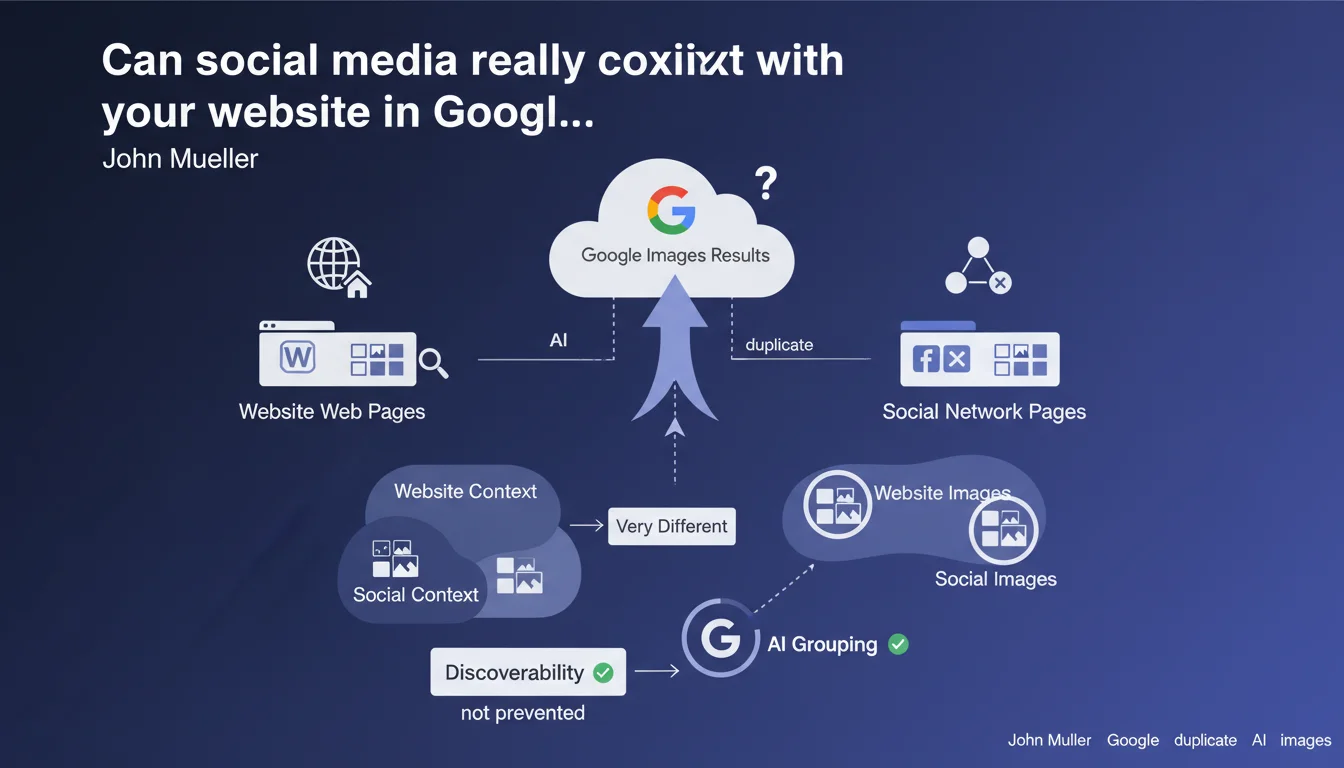
Google states that web pages and social media pages containing the same image can coexist in web search results thanks to different contexts. In image search, duplicates may be grouped, but this doesn't affect discoverability. For SEO practitioners, this means that publishing your visuals on Instagram or Pinterest doesn't necessarily cannibalize your web ranking.
What you need to understand
Why does Google differentiate between web results and image results?
Mueller makes an important distinction between classic web search and image search. In web results, the algorithm evaluates the overall context of the page: textual content, structure, links, domain authority.
A product photo on your e-commerce listing and that same photo posted on Instagram live in radically different contexts. Google therefore doesn't consider them direct competitors in traditional SERPs — they answer distinct search intents.
How does Google handle duplicate images in Google Images?
In image search specifically, Google can detect duplicates and group them. Concretely, if your image appears on 15 different sites, Google won't display 15 identical thumbnails.
But — and this is the crucial point — this grouping doesn't prevent discovery. Users can access different sources through the image search interface. Your site therefore remains accessible even if the image is duplicated elsewhere.
What does this statement reveal about search intent?
What Mueller implicitly confirms is that Google analyzes the intent behind the query. Someone searching for "gray convertible sofa" probably doesn't have the same expectations as someone browsing Pinterest.
Web results prioritize rich commercial or informational pages, while social networks can appear for more exploratory or inspirational queries. Context makes all the difference.
- Web pages and social media with the same image aren't in direct competition in classic web results
- Google can group duplicates in Google Images, but this doesn't block access to different sources
- The context of the page (text, structure, authority) takes priority over simply having an identical image
- Search intent determines what types of results Google displays
SEO Expert opinion
Does this statement match what we observe in the field?
Overall, yes. We regularly observe that the same image can appear both on an e-commerce site and on the brand's Instagram account without one cannibalizing the other in web search results.
However — and this is where it gets complicated — in Google Images, the situation is more murky. Duplicate grouping works... sometimes. I've observed cases where Pinterest or Instagram literally outranks the original source in image results, especially when these platforms have perceived higher authority or superior social engagement.
What nuances should be added to this claim?
Mueller oversimplifies a bit. Saying that "context is different so they coexist" masks a reality: certain social platforms benefit from preferential treatment in Google Images, not necessarily through algorithmic favoritism, but through volume of signals (shares, clicks, time spent).
If your image goes viral on Pinterest with 10,000 repins, and remains unknown on your site with 3 backlinks, guess which one Google will feature in image results? Context doesn't always compensate for a massive imbalance in authority and engagement.
In what cases doesn't this rule apply?
First case: branded queries. If someone searches "Nike Air Max red", Google will prioritize Nike.com even if the image circulates everywhere. Strong branding provides protection.
Second case: unique images without controlled distribution. If you publish an exclusive photo on your blog and it's reused without credit by 50 aggregators, you can lose authorship in Google Images, especially if those sites have more authority. Context alone isn't always enough to restore order.
Practical impact and recommendations
Should you duplicate your images on social media or keep them exclusive?
Let's be honest: keeping your images exclusive to "protect your SEO" is a losing strategy in 2025. Multi-channel distribution remains essential for visibility, indirect traffic, and social signals.
What Mueller's statement confirms is that posting on Instagram or Pinterest doesn't automatically penalize you in web results. So yes, distribute widely — but with a few precautions.
How to optimize so your site remains prioritized in Google Images?
First, optimize the context around the image on your site: precise alt text, descriptive caption, rich editorial content around the visual. Google must understand that your page provides more value than a simple social post.
Next, leverage structured metadata (Schema.org for products, recipes, articles). This strengthens context and helps Google differentiate your page from a simple social share.
Finally, monitor your domain authority. If your images are consistently outranked by Pinterest in Google Images, it's often a symptom of a broader backlinks or traffic issue.
What mistakes should you avoid to not lose the image battle?
Mistake number one: publishing your images in high resolution on social networks before indexing them on your site. Let Google discover your version first, then distribute elsewhere a few days later.
Mistake number two: failing to watermark or sign your strategic visuals. If an image goes viral without attribution, you lose credit — and Google might consider other sources as original.
Mistake number three: neglecting internal linking to your pages containing key images. An isolated page, even with good context, will struggle to compete with a 100K-follower Instagram profile.
- Distribute your images on social media without fear of web cannibalization
- Optimize the context around each image: alt text, caption, rich editorial content
- Use structured data (Schema.org) to strengthen the relevance signal
- Publish first on your site, then on social networks a few days later to let Google index your version as priority
- Add a watermark or discreet signature to your strategic visuals
- Strengthen internal linking to your pages containing important images
- Regularly monitor your Google Images ranking with specialized tracking tools
🎥 From the same video 11
Other SEO insights extracted from this same Google Search Central video · published on 07/08/2025
🎥 Watch the full video on YouTube →
💬 Comments (0)
Be the first to comment.