
Official statement
Other statements from this video 20 ▾
- □ Should you really block AI-generated automatic translations from your site with noindex?
- □ Are site: searches polluting your Search Console data?
- □ Why Is Google Telling You to Ignore Your PageSpeed Insights Scores?
- □ Should you really worry about buying an expired domain?
- □ Can AI Really Produce SEO-Quality Content with Just Human Proofreading?
- □ Can poor machine translation really tank your SEO rankings?
- □ Do affiliate links actually hurt your page's search rankings?
- □ Should you really fix every single broken backlink pointing to your site?
- □ Does Next.js really require specific SEO best practices from the start?
- □ Can you safely canonicalize pages that are 93% identical without damaging your SEO?
- □ Should you redirect or completely disable an unused subdomain for SEO?
- □ Should you really worry about toxic backlinks pointing to your site?
- □ Should you really match your page title and H1 tag?
- □ Does localized content really escape the duplicate content penalty?
- □ Why does Google discourage using site: queries to verify indexation?
- □ Why does a high ranking not guarantee strong CTR on Google?
- □ Do JavaScript console errors really hurt your site's search rankings?
- □ Could showing all product variants to Googlebot alone be quietly destroying your search visibility?
- □ Do you really need a dedicated page per video to rank in rich video results?
- □ Is content syndication really worth the risk to your organic visibility?
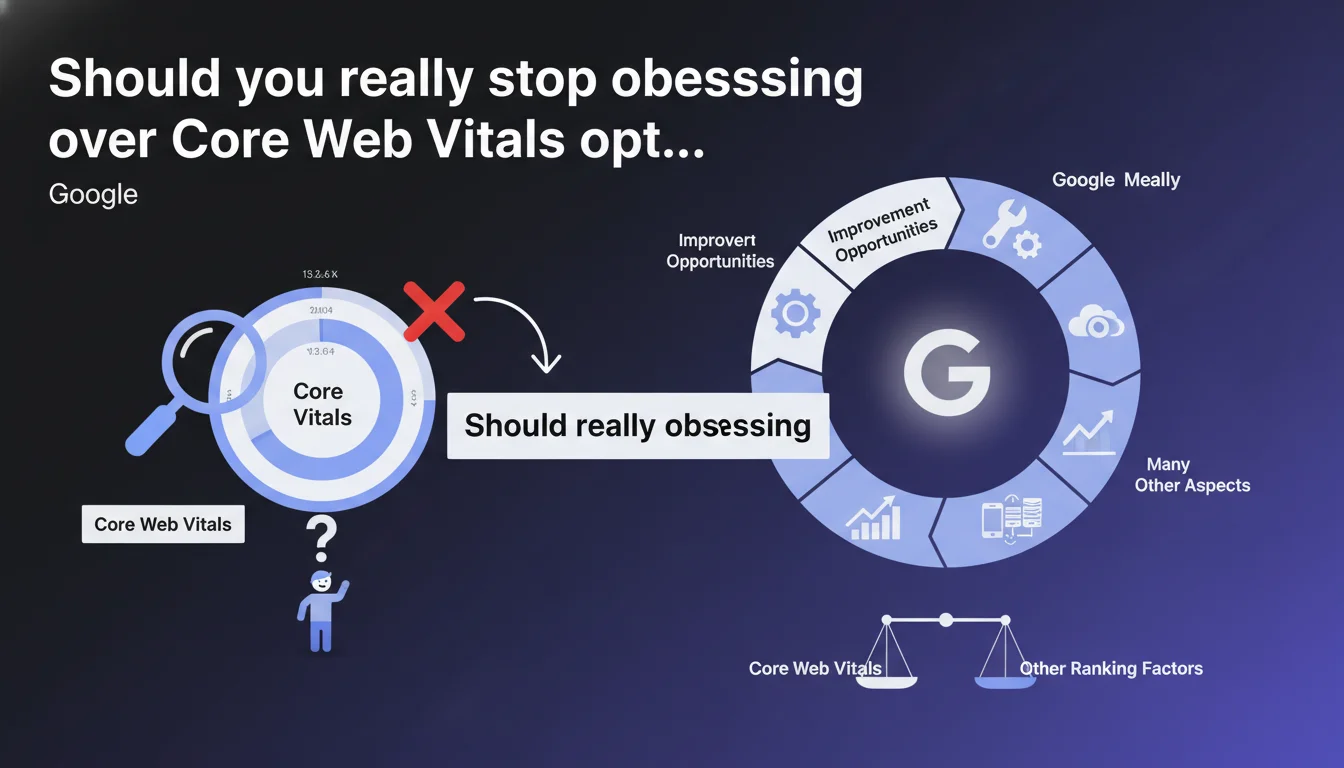
Google emphasizes that Core Web Vitals are just one ranking factor among many, and that chasing micro-optimizations of these metrics is counterproductive. The recommended approach: use these indicators to detect significant issues and regressions, not to fine-tune every millisecond. The message is clear—invest your time where real user impact matters.
What you need to understand
Are Core Web Vitals really secondary in Google's algorithm?
Google clarifies that Core Web Vitals are part of page experience, but they don't carry much weight compared to relevant content and other quality signals. A site with excellent technical metrics but mediocre content will never outrank a competitor offering genuine added value.
This positioning isn't new, but Google regularly emphasizes it to temper obsessive behaviors. In practical terms, a PageSpeed score improving from 85 to 92 will probably change nothing about your organic visibility.
What does "avoid over-optimization" actually mean?
Google discourages spending weeks squeezing out 50 ms on Largest Contentful Paint when your content doesn't properly address search intent. Over-optimization also means implementing complex technical solutions that destabilize your infrastructure for marginal gains.
The goal of CWV was to push publishers to fix genuinely degraded experiences—not to create a race toward 100/100 on every measurement tool. The "Good" thresholds defined by Google are already more than sufficient for most sites.
How can you use these metrics without falling into excess?
Google suggests treating them as monitoring indicators rather than absolute targets. If your CWV metrics degrade sharply, that's a warning signal about a real technical issue worth investigating.
On the other hand, improving LCP from 2.2s to 1.8s when the "Good" threshold is 2.5s will deliver no measurable SEO benefit. Spend that time improving your content, internal linking, or building your backlink strategy instead.
- CWV are one factor among hundreds in the ranking algorithm
- Google recommends fixing significant issues, not micro-optimizing
- Use CWV to detect regressions and obvious improvement opportunities
- A good CWV score never compensates for poor or irrelevant content
- The "Good" thresholds defined by Google are already reasonable targets
SEO Expert opinion
Is this statement consistent with what we observe in the real world?
Absolutely. Large-scale A/B testing shows that the SEO impact of CWV is modest compared to other levers. Sites with mediocre metrics but excellent content regularly dominate technically flawless competitors.
Let's be honest—the correlation between a perfect PageSpeed score and high organic rankings is weak. What really matters: content relevance, domain authority, information freshness, and semantic structure.
What are the limitations of this official stance?
Google remains vague about the exact thresholds that trigger a page experience penalty. We know that scoring in the red zone on all CWV degrades rankings, but by how much? No precise public data. [Needs verification]
Additionally, this statement applies to most sites, but certain ultra-competitive sectors (high-end e-commerce, finance, healthcare) may see positioning differences tied to CWV when all other factors are equal.
And that's where it gets tricky: Google says "don't over-optimize," but in an environment where 10 competitors have exactly the same content level, CWV can become the decisive tie-breaker.
When should you still prioritize CWV?
If your metrics are truly in the red (LCP > 4s, CLS > 0.25, FID > 300ms), fixing these issues remains a priority. A catastrophic user experience directly impacts engagement metrics—and those influence SEO.
For e-commerce sites, improving CWV can reduce bounce rate and increase conversions, which has an indirect but real impact on rankings. SEO isn't just about algorithmic placement.
Practical impact and recommendations
What should you actually do with Core Web Vitals?
Adopt a pragmatic and proportional approach. Start by identifying strategic pages (SEO landing pages, product sheets, pillar content) and check their CWV in Search Console via the "Core Web Vitals" report.
If these pages are in the green zone ("Good"), move on to something else. Invest your time in content production, semantic optimization, or link strategy. If they're orange or red, prioritize fixes that offer the best impact-to-effort ratio.
What mistakes should you absolutely avoid?
Never sacrifice functionality or content for metrics. Removing images, videos, or useful features to artificially improve LCP or CLS defeats the purpose of actual user experience.
Also avoid fixating on synthetic lab tool scores. A site can show 95/100 on PageSpeed Insights and still be red in actual CrUX data if your audience primarily uses slow connections or low-end devices.
And that's where it gets tricky: some third-party vendors sell "magic" CWV solutions that introduce failure points or disproportionate recurring costs compared to expected SEO gains.
How can you monitor these metrics without becoming obsessive?
Set up monthly monitoring via Search Console and CrUX. If a sharp decline appears, investigate—it's often a symptom of real technical regression (new plugin, hosting change, misconfigured third-party script).
For everything else, focus on fundamentals: acceptable server response time (< 600ms), optimized and lazy-loaded images, critical CSS inlined, deferred scripts. These best practices naturally improve CWV without falling into hyper-optimization.
- Check CWV of strategic pages in Search Console (actual CrUX data)
- Fix only orange/red pages with high organic traffic
- Prioritize high-impact optimizations: hosting, caching, images, third-party scripts
- Never degrade functionality or content to artificially improve scores
- Set up monthly CrUX monitoring to catch regressions
- Ignore synthetic lab tool scores if real-world data looks good
- Invest first in content, semantics, and link building
❓ Frequently Asked Questions
Les Core Web Vitals sont-ils vraiment un facteur de classement Google ?
Quel est le seuil minimum de CWV à viser pour le SEO ?
Faut-il se fier aux scores PageSpeed Insights ou aux données CrUX ?
Peut-on ignorer complètement les CWV si on a un excellent contenu ?
Les CWV ont-ils plus d'impact sur mobile que sur desktop ?
🎥 From the same video 20
Other SEO insights extracted from this same Google Search Central video · published on 13/06/2024
🎥 Watch the full video on YouTube →
💬 Comments (0)
Be the first to comment.