
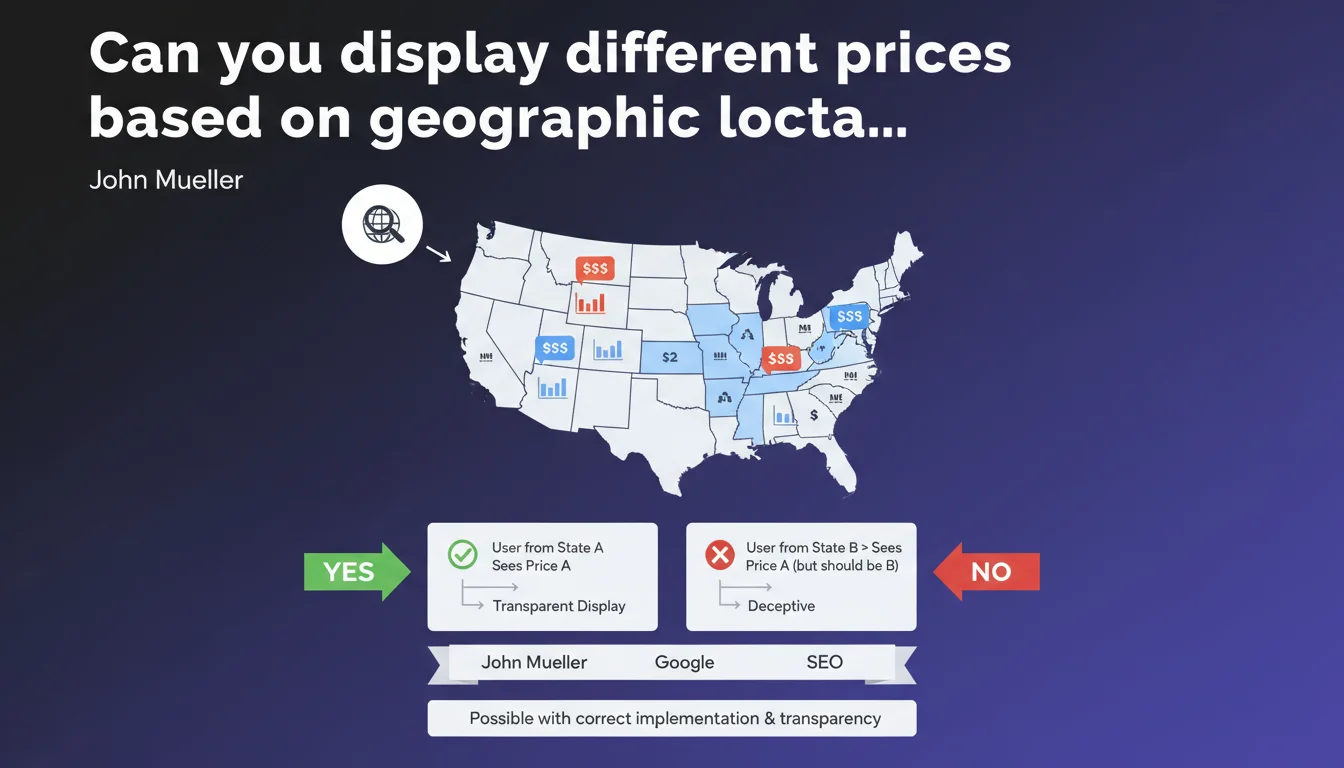
Official statement
Google officially accepts displaying different prices based on geographic location (US states in this case), provided the implementation is technically correct and transparent to users. This statement opens the door to geo-targeted pricing strategies without penalty risk, but raises technical questions about managing structured data.
What you need to understand
Why is Google addressing this question now?
US e-commerce sites often apply different prices depending on the state — local taxes, shipping fees, specific regulations. Until now, a gray area existed regarding the compatibility of this practice with product rich snippets.
Mueller's statement clarifies that this pricing differentiation is not considered cloaking or manipulation, provided there is transparency. Google can technically handle multiple prices in its enriched results.
What does Google mean by "correct implementation"?
The term is intentionally vague. We can reasonably infer that Google expects consistency between the price displayed in SERPs and the one visible on the destination page — based on the user's geolocation.
Implementation should probably rely on adapted Product structured data, with documented price variations. The technical question: should there be a separate URL per state or a single URL with JS detecting the location? Mueller doesn't clarify.
What are the implications for international sites?
Although the statement concerns US states, the principle theoretically applies to multi-country or multi-region sites. A European site displaying prices in EUR, GBP, CHF based on location could follow the same logic.
Be careful though — legal constraints vary enormously. The EU imposes strict rules on price transparency and geo-blocking that may conflict with certain implementations.
- Google explicitly authorizes variable prices based on geolocation
- The sine qua non condition: user transparency and price consistency between SERP and page
- No mention of penalties if the implementation is clean
- Uncertainty remains about implementation technical details (URL structure, schema markup)
- Probable extension of the principle to international sites, but legal framework must be verified
SEO Expert opinion
Is this statement consistent with real-world practices?
Yes and no. Major e-commerce sites have already implemented this differentiation for years without visible ranking issues. But standard Product structured data (schema.org) only provides a single price and priceCurrency field.
We therefore observe diverse implementations: some sites generate markup dynamically server-side based on IP, others inject the price via JS after loading. Google claims to be able to "handle" these variations, but the question of the price indexed in rich snippets remains undocumented. [To verify]: which price does Google prioritize when crawling from its California datacenters?
What risks does this approach carry despite the statement?
The main risk: a perceived inconsistency between SERP and landing page. If a user sees price X in Google results and discovers price Y on the site (even if justified by location), the bounce rate explodes — a negative signal for Google.
Second pitfall: Search Console validation. A dynamically changing price can generate structured data errors if the Google crawler doesn't always detect the same markup. Third-party validation tools can also flag inconsistencies.
In which cases might this rule not apply?
If price differentiation is used solely for conversion optimization via A/B testing or dynamic pricing (user A sees €99, user B sees €119 for the same product, same location), we're outside the framework described by Mueller. That remains potential cloaking.
Same if the price displayed in structured data never matches the actual price — for example, systematically displaying the lowest price to attract clicks when 90% of users see a higher rate. Google could consider this rich snippet manipulation.
Practical impact and recommendations
How to technically implement this price variation?
Two main approaches emerge. First: separate URLs per region with hreflang or URL parameters (?state=CA, ?state=NY). Each URL generates its own schema.org markup with the corresponding price. Clean, but heavy to maintain.
Second: single URL with server-side IP detection and injection of the correct price into rendered HTML. More elegant, but requires that Googlebot sees a consistent price — ideally the default region price or median price. Client-side JavaScript can then dynamically adjust.
In all cases, ensure that the price in structured data matches the visible price for the same geolocation. Use Google's structured data testing tools to validate rendering.
What critical errors must you absolutely avoid?
Never display a "bait" price in the schema markup that corresponds to no actual user reality. If your product costs between €50 and €80 depending on regions, don't put €50 in the markup if only 5% of visitors will actually see it.
Also avoid inconsistencies between markup and visual display. If the JSON-LD indicates €100 but the DOM displays €120 (even temporarily before JS injection), Google can detect a mismatch and invalidate your rich snippets.
Last point: don't rely solely on JavaScript to generate the price. Googlebot executes JS but with limitations. The price must be present in server-rendered HTML or rendered server-side from the first paint.
How to verify my implementation's compliance?
- Test your URLs with the Search Console URL inspection tool — verify the detected price in the rendering
- Simulate multiple locations (VPN, proxy) and compare generated markup vs displayed price
- Monitor structured data errors in Search Console — any warning on Product.price is critical
- Clearly document for the user why the price varies ("Price incl. tax for [State/Country]")
- If you use Merchant Center, ensure your product feed reflects the same pricing logic
- Measure bounce rate from rich snippets — a sudden increase may indicate SERP/page price inconsistency
💬 Comments (0)
Be the first to comment.