
Official statement
What you need to understand
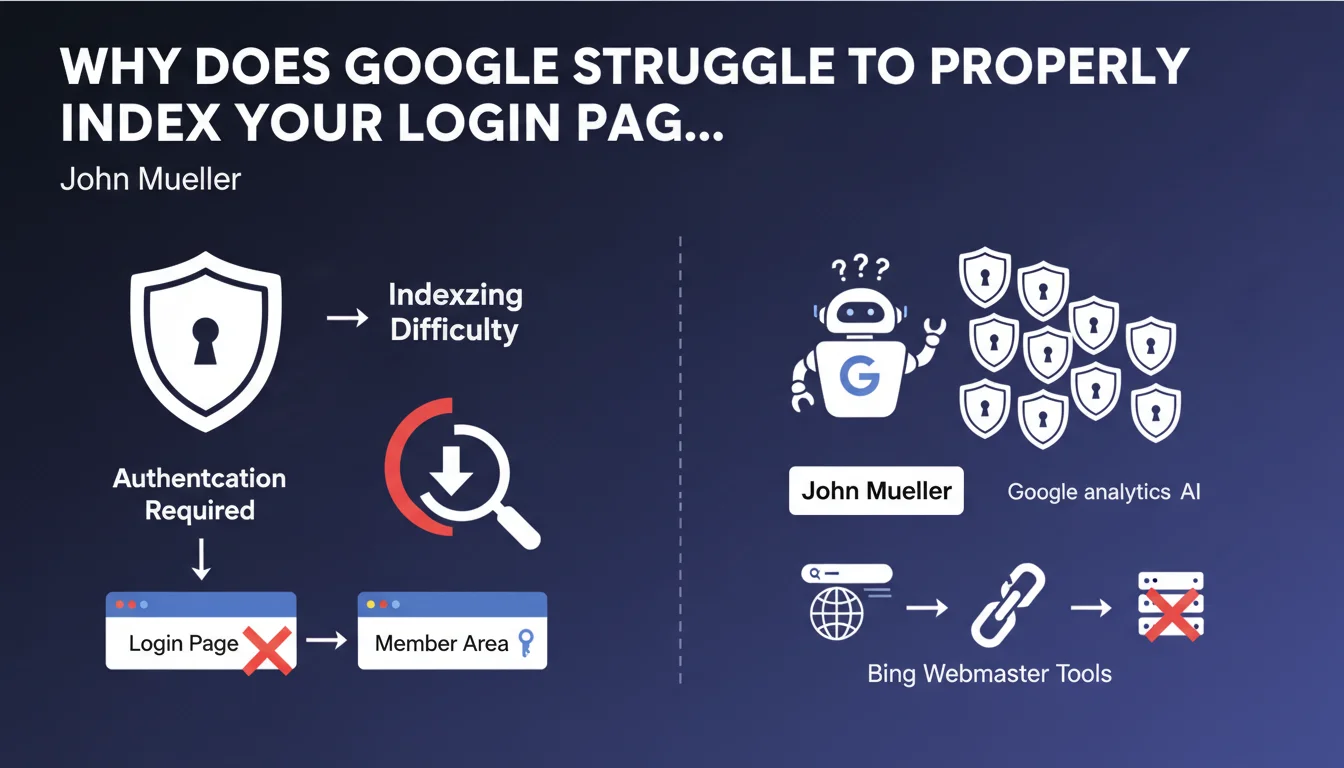
Authentication-protected pages represent a major technical challenge for search engines. John Mueller reveals that even Google encounters indexing difficulties with its own interfaces like Search Console.
The problem mainly concerns login pages, admin interfaces, member areas, and dashboards requiring identification. Search engine crawlers cannot get past these authentication barriers, which creates a blind spot in their indexing capability.
This technical limitation affects both Google and Bing. The example cited shows that the Bing Webmaster Tools login page does not appear correctly in Google results, a problem that Google itself has experienced with Search Console.
- Pages requiring authentication are difficult to index for all search engines
- Google acknowledges encountering this problem on its own services
- Crawlers cannot get past login barriers
- This technical topic will be explored further in a future podcast with Martin Splitt
SEO Expert opinion
This statement confirms what experienced SEO practitioners have long observed in the field. Protected pages do indeed create a gray area where indexing becomes random or even impossible.
However, we need to add nuance: Google can sometimes index the login page itself (the identification form), but not the content located behind that barrier. This is why some companies see their "/login" or "/sign-in" page appear in results, without it being really useful for the user.
Google's admission regarding its own services shows the extent of the technical challenge. If the search engine struggles to optimize Search Console indexing, imagine the complexity for third-party sites with varied architectures.
Practical impact and recommendations
- Don't expect your protected pages to be well indexed: accept this structural technical limitation
- Create alternative public pages to present your services, tools, or interfaces before the login barrier
- Optimize your login page with a clear title and meta description if you want it to appear for brand queries
- Implement public landing pages describing the features accessible after authentication
- Use public documentation pages to showcase your tools' capabilities without requiring login
- Avoid placing strategic SEO content behind authentication walls if you're targeting organic traffic
- Create a separate sitemap for your public pages and exclude protected areas via robots.txt if necessary
- Monitor in Search Console indexing attempts of your protected pages to identify potential leaks
In summary: Accept that content behind authentication is not indexable and adapt your strategy accordingly. Prioritize an architecture where strategic SEO content remains public.
Restructuring your architecture to intelligently separate public content and protected areas requires in-depth technical expertise and a comprehensive strategic vision. These structural optimizations often touch the core of your platform and involve complex architectural decisions. To avoid costly mistakes and benefit from a personalized diagnosis adapted to your specific context, support from a specialized SEO agency can prove invaluable for maximizing your visibility while preserving the security of your member spaces.
💬 Comments (0)
Be the first to comment.