
Official statement
What you need to understand
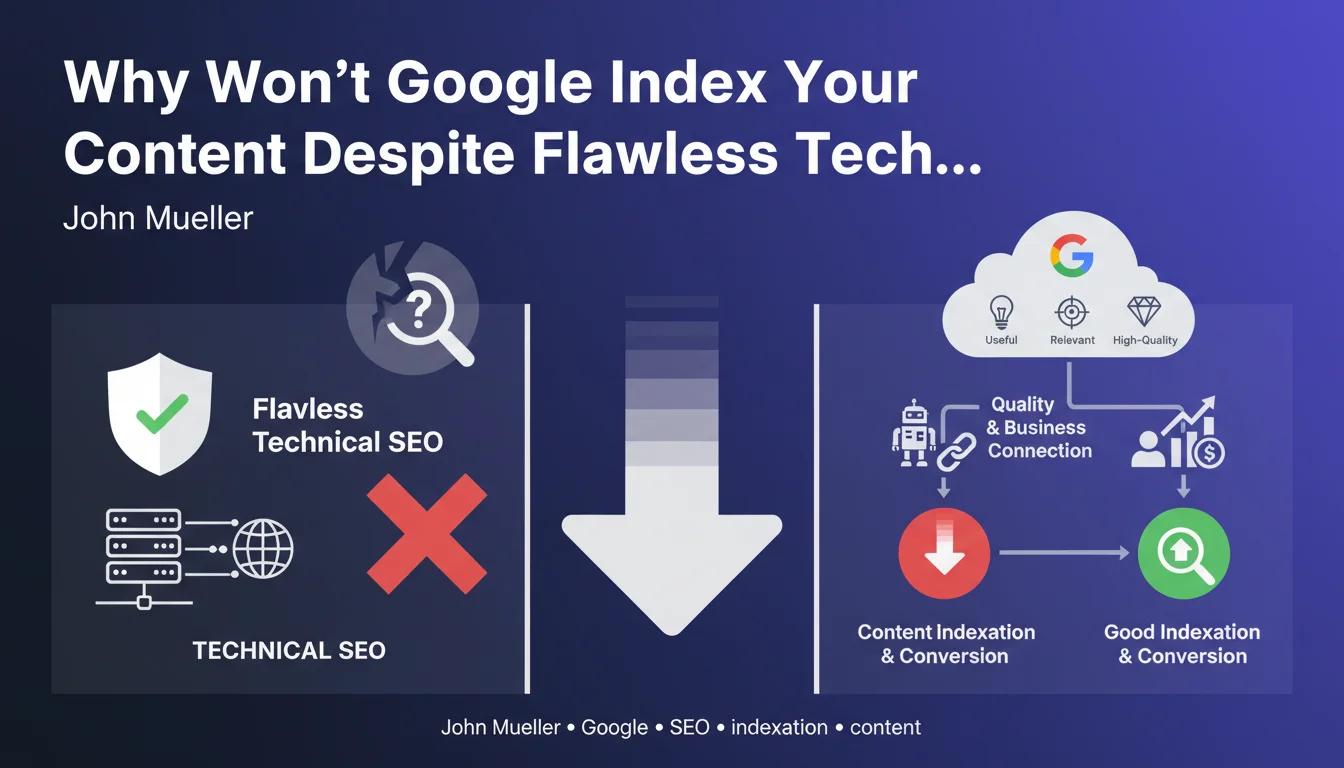
This statement from John Mueller highlights a frequent paradox: a technically perfect site can nevertheless suffer from partial or non-existent indexation. The reason? Google is no longer satisfied with evaluating technical compliance, it primarily judges the actual relevance of the content offered.
Concretely, this means that Google performs a selective sorting of pages to index. The search engine does not index the entire web, but only what it considers useful and quality for its users. Technically optimized content that is deemed irrelevant will simply be excluded from the index.
Mueller also raises a crucial point: producing content disconnected from your actual business solely for the purpose of ranking on keywords no longer works. This approach harms both indexation and conversions, as Google detects the inconsistency between content and offering.
- Technical excellence does not guarantee indexation if content quality is insufficient
- Google operates a qualitative selection of pages to index
- Content must be aligned with your actual business and business objectives
- Relevance for the user takes precedence over pure SEO optimization
SEO Expert opinion
This statement is perfectly consistent with the evolution observed over recent years. In practice, we indeed see that sites with Lighthouse scores of 100/100 and perfect crawlability can have 30 to 40% of their pages not indexed. Google now applies a quality filter upstream of indexation.
However, we must nuance: the notion of "relevance" remains subjective and contextual. Content deemed irrelevant by Google may nevertheless answer specific niche queries. The problem lies in the fact that Google measures relevance through indirect signals: engagement rates, visit duration, natural links, domain topical authority.
In certain cases, particularly for e-commerce sites with thousands of similar product pages or news sites producing mass content, this sorting can seem arbitrary. The key is to prove to Google that each page brings real differentiating value.
Practical impact and recommendations
- Audit your existing content: identify non-indexed pages and honestly evaluate their real added value for users
- Eliminate superficial content: delete or drastically improve pages created solely to rank without providing value
- Strengthen topical alignment: ensure that each piece of content is directly related to your expertise and commercial offering
- Develop depth: transform superficial content into comprehensive resources that differentiate from the competition
- Integrate proof of expertise: add case studies, proprietary data, concrete experience feedback that demonstrates your legitimacy
- Optimize engagement signals: work on UX to increase time spent and reduce bounce rate, quality signals for Google
- Prioritize conversion: content that converts is generally relevant content, align your SEO and business objectives
- Monitor the index: regularly use Search Console to monitor which pages are actually indexed and look for patterns
Implementing this strategy focused on quality and real relevance requires in-depth expertise and the ability to conduct fine analysis of your digital ecosystem. These optimizations simultaneously affect content, architecture, user experience and your brand's strategic positioning. For personalized support that transforms these recommendations into a concrete action plan adapted to your sector, engaging a specialized SEO agency can prove valuable, especially if your internal resources are limited or if you want to accelerate results.
💬 Comments (0)
Be the first to comment.