
Official statement
Other statements from this video 20 ▾
- □ Should you really block AI-generated automatic translations from your site with noindex?
- □ Are site: searches polluting your Search Console data?
- □ Why Is Google Telling You to Ignore Your PageSpeed Insights Scores?
- □ Should you really stop obsessing over Core Web Vitals optimization?
- □ Should you really worry about buying an expired domain?
- □ Can AI Really Produce SEO-Quality Content with Just Human Proofreading?
- □ Can poor machine translation really tank your SEO rankings?
- □ Do affiliate links actually hurt your page's search rankings?
- □ Should you really fix every single broken backlink pointing to your site?
- □ Does Next.js really require specific SEO best practices from the start?
- □ Can you safely canonicalize pages that are 93% identical without damaging your SEO?
- □ Should you redirect or completely disable an unused subdomain for SEO?
- □ Should you really worry about toxic backlinks pointing to your site?
- □ Should you really match your page title and H1 tag?
- □ Does localized content really escape the duplicate content penalty?
- □ Why does Google discourage using site: queries to verify indexation?
- □ Do JavaScript console errors really hurt your site's search rankings?
- □ Could showing all product variants to Googlebot alone be quietly destroying your search visibility?
- □ Do you really need a dedicated page per video to rank in rich video results?
- □ Is content syndication really worth the risk to your organic visibility?
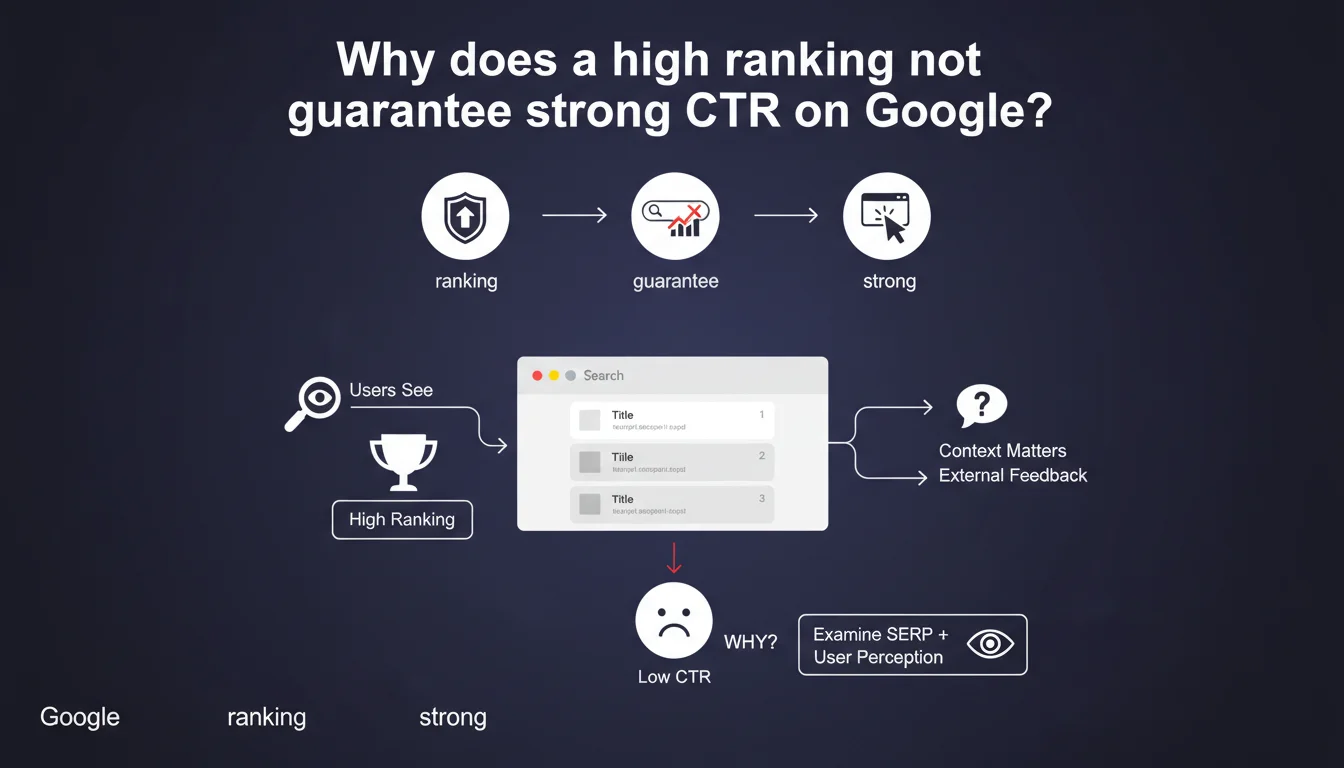
Google reminds us that good positioning alone isn't enough to drive clicks. You need to analyze actual SERPs, observe what users see, and understand the complete context of the search results page. Metrics alone don't tell the whole story.
What you need to understand
Google highlights a blind spot that's all too common among SEOs: focusing solely on rankings without looking at what's actually happening in the SERP. A site can be in 3rd position and have a disastrous CTR simply because featured snippets, People Also Ask blocks, or ads are capturing all the attention.
What does "examining actual search results" really mean?
Concretely, Google is telling you: step away from your console and open a browser. Position data from Search Console doesn't reflect the visual reality of the SERP. A result in position 4 might visually appear at the bottom of the page if three rich snippets precede it.
The algorithm doesn't manage user experience alone. The composition of the SERP — videos, images, Knowledge Graph, local pack — massively influences click behavior. Your meta description might be perfect, but if it's buried under Google features, it becomes invisible.
Why does Google insist on "external feedback"?
Because you're biased. You know your brand, your offer, your jargon. An average user scans in 2 seconds and picks the result that visually matches their intent.
Asking someone external to look at your result in the SERP is about testing whether your title and description are truly differentiated in their context. Not in a spreadsheet — in the visual noise of a Google search page.
What is the "complete context" of the SERP?
It's the sum of all elements surrounding your result. Google features (People Also Ask, featured snippets, videos), direct competitors, ads. Everything that diverts attention or cannibalizes your clicks.
A low CTR can signal that Google has decided to satisfy the intent directly within the SERP, without requiring a click. Or that your competitors have more compelling titles. Or that your URL inspires less trust. Context determines performance.
- Analyze the actual SERP, not just position metrics
- Observe what users see: Google features, competitors, ads
- Test with an external perspective to eliminate perception bias
- Understand that CTR depends on complete visual context, not ranking alone
- Good positioning in a SERP saturated with features = low effective visibility
SEO Expert opinion
Is this recommendation truly scalable?
Let's be honest: Google provides no tools to automate this analysis. Asking an SEO to manually check SERPs for hundreds or thousands of keywords is unrealistic. Third-party tools exist (SEMrush, Ahrefs), but they don't always accurately capture localized or personalized features.
The advice is relevant for identifying trends on your top keywords, but becomes impractical for a complete audit. Google knows this. The statement remains vague on the operational "how." [To verify]: is there a Search Console metric that will better reflect real visibility than simple ranking position?
Is external feedback really reliable?
Asking a colleague for their opinion on your title is useful. But it doesn't replace A/B testing in real conditions. Perceptions vary by profile, device, search context. Subjective feedback remains... subjective.
What's missing here: Google doesn't discuss testing different headlines through title and meta tag modifications. That's measurable. A junior employee's opinion on your meta description is far less so. The recommendation is somewhat weak on methodology.
What is the limitation of this approach when facing Google features?
If Google decides to place a featured snippet, Knowledge Panel, or local pack above you, you can't do much about it — or nearly nothing. Optimizing your title won't help if the problem stems from the SERP's structure itself.
Google tells you "analyze the context," but gives you no leverage to modify that context. It's like telling someone "observe why you're losing" without giving them the means to win. The real lever is targeting featured snippets or reformulating your keyword strategy to avoid saturated SERPs.
Practical impact and recommendations
How do you concretely analyze your SERPs to understand low CTR?
Start by identifying your pages with an abnormal position/CTR gap in Search Console. Filter queries where you rank 1-5 with CTR below 10%. These are your priority case studies.
Next, open a browser in private navigation (to limit personalization) and search for each term. Note what precedes your result: featured snippet? People Also Ask? Videos? Ads? Take screenshots — you'll need to document these SERPs to track their evolution.
Repeat the process on mobile and desktop. SERPs often differ radically between devices. A featured snippet can take up the entire mobile screen and push your result below the fold.
What actions should you take once you've diagnosed the problem?
If your CTR is hampered by Google features, you have two options: either optimize to capture those features (structure your content for the featured snippet, for example), or retarget your keywords toward less cluttered queries.
If the issue stems from your title and meta tags — they're bland, generic, or poorly differentiated — test more compelling variations. Use numbers, questions, clear benefits. And above all, compare with your direct competitors: what makes their result more clickable?
Finally, test with real users. Show them the SERP (without indicating your result) and ask which result they'd click on spontaneously. Their answers will provide insights that metrics alone cannot reveal.
What mistakes should you avoid in this process?
Don't settle for analyzing a single frozen SERP. Google constantly adjusts the features displayed based on timing, location, device. Document multiple views to get a representative picture.
Avoid confusing average position with actual position. Search Console gives you an average — but if you fluctuate between position 3 and 15, your CTR will be erratic. Look at the distribution of positions, not just the average.
Don't underestimate the impact of your URL and breadcrumb displayed in the SERP. A long, incomprehensible, or untrustworthy URL can kill your CTR even with an excellent title.
- Filter pages with abnormal position/CTR gap in Search Console
- Analyze actual SERPs in private navigation, on desktop and mobile
- Document Google features that precede your result (screenshots)
- Compare your title and meta tags with those of your direct competitors
- Test your results with external users to eliminate bias
- Optimize to capture featured snippets if possible
- Reconsider your target keywords if SERPs are too saturated with features
- Track SERP evolution over time — they're never static
Analyzing low CTR isn't just about checking your rankings. You need to observe actual SERPs, understand how Google features redistribute attention, and test your results with external eyes. Metrics tools are useful, but they don't replace contextual visual analysis.
These optimizations require time, methodological rigor, and the ability to blend quantitative data with qualitative insights. If this approach seems complex to pilot alone or scale across your site, support from a specialized SEO agency can help you systematize this analysis while maintaining the precision each SERP context demands.
❓ Frequently Asked Questions
Un bon classement dans la Search Console garantit-il un CTR élevé ?
Comment savoir si mon CTR est anormalement faible pour ma position ?
Les outils SEO montrent-ils fidèlement les SERP réelles ?
Que faire si mon CTR est plombé par un featured snippet concurrent ?
Les avis externes sur mes balises title/meta sont-ils vraiment utiles ?
🎥 From the same video 20
Other SEO insights extracted from this same Google Search Central video · published on 13/06/2024
🎥 Watch the full video on YouTube →
💬 Comments (0)
Be the first to comment.