
Official statement
Other statements from this video 20 ▾
- □ Faut-il vraiment bloquer les traductions automatiques par IA de votre site en noindex ?
- □ Pourquoi Google vous demande d'ignorer les scores de PageSpeed Insights ?
- □ Faut-il vraiment arrêter d'optimiser les Core Web Vitals à tout prix ?
- □ Faut-il se méfier d'un domaine expiré racheté ?
- □ L'IA peut-elle vraiment produire du contenu SEO de qualité avec une simple relecture humaine ?
- □ La traduction automatique peut-elle vraiment pénaliser votre classement SEO ?
- □ Les liens d'affiliation pénalisent-ils vraiment le référencement de vos pages ?
- □ Faut-il vraiment réparer tous les backlinks cassés pointant vers votre site ?
- □ NextJS impose-t-il vraiment des bonnes pratiques SEO spécifiques ?
- □ Peut-on canonicaliser des pages à 93% identiques sans risque pour son SEO ?
- □ Faut-il rediriger ou désactiver un sous-domaine SEO non utilisé ?
- □ Faut-il encore s'inquiéter des liens toxiques pointant vers votre site ?
- □ Faut-il vraiment faire correspondre le titre et le H1 d'une page ?
- □ Le contenu localisé échappe-t-il vraiment à la pénalité pour duplicate content ?
- □ Pourquoi Google déconseille-t-il d'utiliser les requêtes site: pour vérifier l'indexation ?
- □ Pourquoi un bon classement ne garantit-il pas un CTR élevé sur Google ?
- □ Les erreurs JavaScript dans la console impactent-elles vraiment le référencement de votre site ?
- □ Pourquoi afficher toutes les variantes produits à Googlebot peut-il détruire votre indexation ?
- □ Faut-il vraiment une page dédiée par vidéo pour ranker dans les résultats enrichis ?
- □ La syndication de contenu est-elle un pari risqué pour votre visibilité organique ?
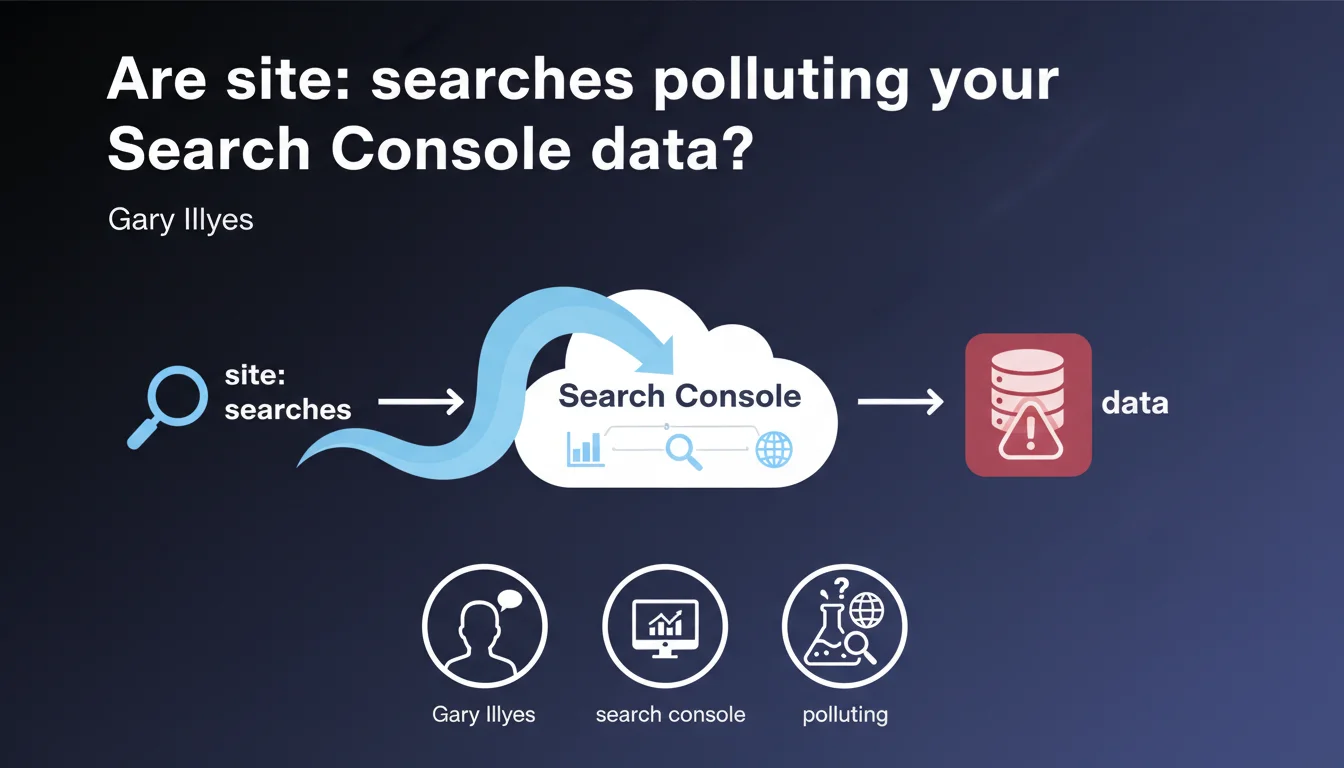
Google confirms that queries performed with the site: operator are counted in Search Console data. These diagnostic searches, often conducted by SEO professionals themselves or automated tools, add to genuine organic user searches. The impact remains marginal for most sites, but can distort interpretation on low traffic volumes.
What you need to understand
What exactly do these site: searches represent in your reports?
The site: operator is used daily by SEO professionals to verify the indexation of a domain or specific page. When you type site:mydomain.com in Google, you trigger a query that generates impressions and potentially clicks — exactly like a standard search.
Gary Illyes' statement confirms that these queries feed the performance metrics in Search Console. Concretely, if you check your site's indexation 10 times a day, those 10 impressions add to your statistics. The problem? This data doesn't reflect real user behavior but a technical diagnostic action.
Why does Google include these "parasitic" data?
Google treats the site: operator as a standard search from its infrastructure perspective. The engine processes the query, generates a SERP, records the impression. Technically, there's no fundamental distinction between a standard search and a search with advanced operator in the processing pipeline.
Excluding these queries would require specific filtering, probably deemed unnecessary by Google. For a site with thousands of organic visits per day, a few site: searches change nothing in the trends. But for a low-traffic site or in launch phase, these diagnostic queries can represent a non-negligible share of displayed impressions.
Which other search operators are affected?
The statement explicitly mentions site:, but raises the question of other advanced operators: intitle:, inurl:, filetype:, cache:, related:, etc. Gary Illyes doesn't specify whether these queries are also counted, which leaves significant uncertainty.
The most likely hypothesis: all operators that generate a standard SERP with organic results feed Search Console. Purely informational operators like cache: or info: could be excluded, but nothing is officially confirmed. This is the kind of detail Google doesn't thoroughly document.
- Site: searches are counted as standard impressions and clicks in Search Console
- This data doesn't reflect real user behavior but technical verifications
- The impact is proportional to traffic volume: negligible on a large site, potentially significant on a small one
- The status of other advanced operators remains officially undocumented
- Google offers no native filter to exclude these queries from reports
SEO Expert opinion
Is this statement really a breakthrough?
Let's be honest: this behavior was already known empirically by most practitioners. Many of us had noticed suspicious queries in performance reports, especially on low-traffic sites where every impression counts. The real novelty is Google's official confirmation.
What's troubling is that this data "pollution" has existed since the beginning of Search Console without Google ever proposing a solution. No dedicated filter, no automatic segmentation, not even a line in the official documentation before this statement. For a tool supposed to provide actionable data, it's a surprisingly persistent blind spot.
What's the real impact on your analysis?
For an e-commerce site with 50,000 monthly impressions, 20 site: searches will change absolutely nothing in your curves. The noise is statistically negligible. However, for a niche site with 200 monthly impressions, 15 indexation verifications represent 7.5% of total volume. That starts to seriously distort trends.
The real trap concerns small launch sites or low-exposure sections of a large site. When you're tracking the evolution of a new category with 10 daily impressions, your own verifications can create artificial spikes that you might interpret as positive signals. [To verify]: the impact on average CTR metrics remains unclear — does a click on a site: result count the same as a standard organic click?
Which third-party tools amplify this problem?
SEO crawlers and automated monitoring tools massively use the site: operator to verify indexation. If you've configured a tool to daily check your 500 main pages via site:mydomain.com/page-X queries, you could be injecting potentially 15,000 parasitic impressions per month.
Some indexation monitoring scripts run continuously, generating hundreds of weekly queries. And there, even on a medium-traffic site, the impact becomes measurable. The problem? You can't easily identify these queries in Search Console because they appear as standard impressions, mixed with the rest.
Practical impact and recommendations
How to identify these parasitic queries in your data?
Search Console offers no native filter to isolate operator searches. However, you can spot suspicious patterns: queries containing your exact domain name, unique impressions with abnormally high CTR, unexplained spikes on low-exposure pages.
The most reliable method remains to cross-reference sources: compare your Search Console data with Google Analytics by filtering by landing page. If Search Console shows 50 impressions on a URL but Analytics only reports 5 Google organic visits, there are likely site: queries in the mix. It's not an exact science, but it gives an indication.
Should you modify your indexation verification practices?
The question is legitimate: should you continue using site: knowing it pollutes your data? The answer depends on your traffic volume. On a large site, the impact is so marginal that it's not worth changing your habits. Keep verifying indexation as usual.
For small sites or low-visibility sections, favor alternative methods: URL inspection directly in Search Console, use of the Indexing API, verification via third-party tools that don't use the site: operator. If you absolutely must use site:, do it from a private session or different browser — even though technically, it changes nothing regarding recorded impressions.
What to do if your data is already distorted?
Unfortunately, you can't retroactively clean Search Console data. Google offers no filtering or manual exclusion option. Your only choice: accept this limitation and account for it in your future analyses.
For client reports or dashboards, add an explanatory note about this margin of error. If you're presenting data on a small site with low traffic, clarify that impressions potentially include technical verifications. It's transparent and prevents misinterpretations.
- Systematically compare Search Console and Analytics to identify suspicious discrepancies
- Limit the use of automated tools that generate hundreds of site: queries per day
- On small sites, prefer URL inspection in Search Console rather than site:
- Document this limitation in your client reports to avoid misunderstandings
- Don't try to "correct" past data — it's impossible
- Focus on relative trends rather than absolute figures if your traffic is low
This statement confirms a reality already observed in the field: site: searches slightly pollute your Search Console data. The impact remains negligible for the majority of sites, but can significantly distort analysis on low volumes. Adjust your verification practices if necessary, and above all, integrate this variable into your data interpretations.
These methodological adjustments — source cross-referencing, pattern identification, bias documentation — require fine tool mastery and deep understanding of metrics. For sites where every impression counts or where data reliability conditions strategic decisions, working with a specialized SEO agency can prove valuable in implementing robust analysis processes and avoiding interpretation pitfalls.
❓ Frequently Asked Questions
Les recherches site: consomment-elles du crawl budget ?
Peut-on exclure ces recherches des rapports Search Console ?
Un clic sur un résultat site: compte-t-il dans le CTR ?
Les autres opérateurs comme intitle: ou inurl: sont-ils aussi comptabilisés ?
Faut-il arrêter d'utiliser l'opérateur site: pour vérifier l'indexation ?
🎥 From the same video 20
Other SEO insights extracted from this same Google Search Central video · published on 13/06/2024
🎥 Watch the full video on YouTube →
💬 Comments (0)
Be the first to comment.