
Official statement
Other statements from this video 20 ▾
- □ Faut-il vraiment bloquer les traductions automatiques par IA de votre site en noindex ?
- □ Les recherches site: polluent-elles vos données Search Console ?
- □ Pourquoi Google vous demande d'ignorer les scores de PageSpeed Insights ?
- □ Faut-il vraiment arrêter d'optimiser les Core Web Vitals à tout prix ?
- □ Faut-il se méfier d'un domaine expiré racheté ?
- □ L'IA peut-elle vraiment produire du contenu SEO de qualité avec une simple relecture humaine ?
- □ Les liens d'affiliation pénalisent-ils vraiment le référencement de vos pages ?
- □ Faut-il vraiment réparer tous les backlinks cassés pointant vers votre site ?
- □ NextJS impose-t-il vraiment des bonnes pratiques SEO spécifiques ?
- □ Peut-on canonicaliser des pages à 93% identiques sans risque pour son SEO ?
- □ Faut-il rediriger ou désactiver un sous-domaine SEO non utilisé ?
- □ Faut-il encore s'inquiéter des liens toxiques pointant vers votre site ?
- □ Faut-il vraiment faire correspondre le titre et le H1 d'une page ?
- □ Le contenu localisé échappe-t-il vraiment à la pénalité pour duplicate content ?
- □ Pourquoi Google déconseille-t-il d'utiliser les requêtes site: pour vérifier l'indexation ?
- □ Pourquoi un bon classement ne garantit-il pas un CTR élevé sur Google ?
- □ Les erreurs JavaScript dans la console impactent-elles vraiment le référencement de votre site ?
- □ Pourquoi afficher toutes les variantes produits à Googlebot peut-il détruire votre indexation ?
- □ Faut-il vraiment une page dédiée par vidéo pour ranker dans les résultats enrichis ?
- □ La syndication de contenu est-elle un pari risqué pour votre visibilité organique ?
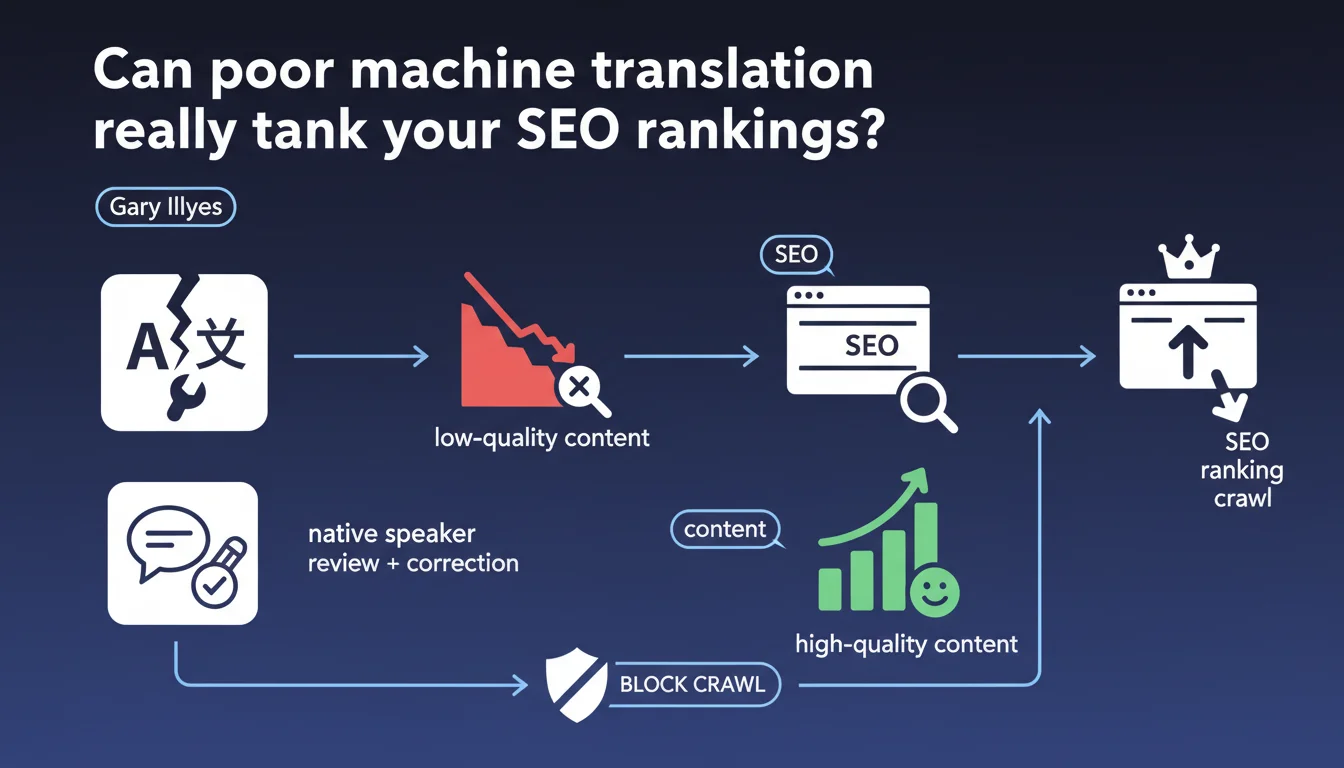
Google confirms that low-quality automatic translation negatively impacts rankings. The solution? Systematically have a native speaker review it or block crawling of automatically translated versions. No gray area: either you ensure quality, or you hide the content from Google.
What you need to understand
Why does Google specifically penalize machine-translated content?
The answer boils down to one word: usefulness. An approximate translation creates a poor user experience — awkward sentences, mistranslations, clumsy phrasing. Google detects these signals through behavioral metrics and semantic analysis.
Here's the catch: the engine no longer distinguishes between poorly written content and sloppy translation. Both produce the same symptoms: high bounce rate, low dwell time, lack of engagement. For the algorithm, it's low-quality content, period.
What exactly does Google mean by "poor-quality translation"?
The statement is deliberately vague. We're talking about translations that sound robotic, with recurring grammatical errors, idioms rendered incorrectly, or vocabulary mismatched to cultural context.
Concretely? A text that makes a native reader wince in the first few lines. No need to be a linguist — if it reads like raw Google Translate, it's failed. Google never specifies a tolerance threshold, but field observation shows that multilingual sites with unreviewed translations consistently lose visibility on their international versions.
Is blocking crawl really the only alternative to hiring reviewers?
Gary Illyes presents two options: either guarantee quality through native review, or block Googlebot access outright. It's a fairly radical binary choice.
In practice, this second option amounts to abandoning international SEO for those pages. Only useful if these translated versions serve a non-SEO purpose (internal customer support, limited technical documentation). For 99% of e-commerce or editorial sites, it's not an option — it's an admission of defeat.
- Unreviewed machine translation = algorithmic penalty risk
- Native speaker review = only quality guarantee Google recognizes
- Block crawl = giving up on international SEO for those pages
- No tolerance or minimum quality threshold officially communicated
- Behavioral signals likely play a role in detection
SEO Expert opinion
Does this statement actually match what we observe in the field?
Yes, but with caveats. Sites that deploy automatically translated content without review consistently see chronic underperformance on their international versions. Lower rankings, mediocre CTR, anemic organic traffic.
What's less clear is the exact mechanism. Google claims to evaluate linguistic quality, but in practice, it's mostly engagement metrics that expose poorly translated content. A Spanish visitor who bounces immediately because the text is incomprehensible sends an unambiguous signal. [To verify]: Does Google actually have a sophisticated enough linguistic analysis system to detect poor translation independently of behavioral signals? Nothing in this statement proves it.
Are all sectors treated equally?
No, and that's a blind spot in this statement. An e-commerce site with formulaic product sheets and repetitive structures better withstands approximate translation than a editorial blog or B2B site where writing quality determines credibility.
Similarly, some language pairs are riskier than others. Translating English to French or German with DeepL or Google Translate yields exploitable results with light review. Moving from Japanese to Portuguese? It's a gamble. Gary Illyes ignores these nuances — he speaks as if all machine translations were equivalent.
Is the advice to block crawl actually relevant?
Honestly? It's a strategic nonsense for 95% of use cases. If you invested in a multilingual version of your site, it's specifically to capture international traffic. Blocking Googlebot defeats that entire purpose.
The only scenario where it makes sense: you accidentally published automatically translated content, lack resources to fix it short-term, and prefer to avoid a temporary penalty. That's damage control, not strategy. The real advice should be: never publish unreviewed machine translation in production.
Practical impact and recommendations
How do you audit the quality of existing translations on your site?
First step: identify automatically translated pages. If you use a plugin or automatic translation system, list all affected URLs. Cross-reference with Search Console data to spot language versions that underperform abnormally (low impressions, poor CTR, mediocre positions).
Next, manually test with native speakers. No need to audit 10,000 pages — take a representative sample (homepage, main category pages, 5-10 articles or product sheets). If these key pages sound off, the rest of the site is probably compromised. Ask testers to rate fluidity, clarity, and credibility on a 5-point scale.
What mistakes must you absolutely avoid in a translation workflow?
Mistake #1: publishing raw output from a machine translation tool directly. Even DeepL, though excellent, produces sentences needing adjustments. Idioms, wordplay, cultural references — machines miss all of that.
Mistake #2: trusting review to a non-native speaker "who's pretty good" at the target language. A Frenchman fluent in Spanish won't catch the subtle nuances a Madrilenian or Mexican spots instantly. Google might miss them too, but your visitors won't — their behavior will reveal the deception.
Mistake #3: ignoring cultural context. A technically correct translation can be culturally inappropriate. A direct call-to-action works in English US, far less in Japanese. These misalignments kill conversion and degrade engagement metrics.
What if you've already published automatically translated content?
Three options, in priority order. Option 1: immediate review and correction by native speakers, at least on high-traffic-potential pages. Prioritize landing pages, main categories, articles already ranking somewhat. Abandon zombie pages with no potential.
Option 2: if budget is tight, temporarily unpublish problematic language versions (via noindex or crawl block) while you fix them. Better 3 solid languages than 10 mediocre ones. Communicate clearly to users that these versions are under maintenance.
Option 3: if truly no resources exist, permanently delete automatically translated versions and redirect to the original. You lose international SEO potential, but avoid penalty. It's surrender, not strategy — but sometimes it's the lesser evil.
- Audit all automatically translated pages, identify those underperforming in Search Console
- Manually test a representative sample with native speakers (fluidity, clarity, credibility)
- Prioritize review of high-SEO-potential pages (homepage, categories, top articles)
- Never publish machine translation without review, even a "quick" one
- Verify translators are native speakers and understand cultural context
- Temporarily unpublish (noindex) low-quality language versions if budget is insufficient
- Monitor engagement metrics by language (bounce rate, dwell time, conversions)
- Document the translation workflow to ensure quality on future content
Unreviewed machine translation is a SEO anchor for your international versions. Google doesn't forgive mediocre content, whatever the reason. Native speaker review isn't negotiable if you're serious about international rankings.
The advice to block crawl is an admission of failure — only consider it as a last resort. Investment in quality translation pays off: better positions, better conversion rates, stronger brand perception. Managing multilingual optimization can be complex alone, especially across multiple languages. Engaging an international SEO agency provides personalized guidance on translation workflow, language prioritization, and quality audits — an investment that secures your international expansion.
❓ Frequently Asked Questions
Est-ce que Google pénalise automatiquement toute page traduite par machine ?
Peut-on utiliser DeepL ou Google Translate comme base de travail ?
Si je bloque le crawl de mes pages traduites, est-ce que je perds tout référencement international ?
Comment vérifier si mes traductions actuelles posent problème ?
Une mauvaise traduction sur une langue peut-elle affecter le classement des autres versions ?
🎥 From the same video 20
Other SEO insights extracted from this same Google Search Central video · published on 13/06/2024
🎥 Watch the full video on YouTube →
💬 Comments (0)
Be the first to comment.