
Official statement
Other statements from this video 20 ▾
- □ Should you really block AI-generated automatic translations from your site with noindex?
- □ Are site: searches polluting your Search Console data?
- □ Why Is Google Telling You to Ignore Your PageSpeed Insights Scores?
- □ Should you really stop obsessing over Core Web Vitals optimization?
- □ Should you really worry about buying an expired domain?
- □ Can AI Really Produce SEO-Quality Content with Just Human Proofreading?
- □ Can poor machine translation really tank your SEO rankings?
- □ Do affiliate links actually hurt your page's search rankings?
- □ Should you really fix every single broken backlink pointing to your site?
- □ Can you safely canonicalize pages that are 93% identical without damaging your SEO?
- □ Should you redirect or completely disable an unused subdomain for SEO?
- □ Should you really worry about toxic backlinks pointing to your site?
- □ Should you really match your page title and H1 tag?
- □ Does localized content really escape the duplicate content penalty?
- □ Why does Google discourage using site: queries to verify indexation?
- □ Why does a high ranking not guarantee strong CTR on Google?
- □ Do JavaScript console errors really hurt your site's search rankings?
- □ Could showing all product variants to Googlebot alone be quietly destroying your search visibility?
- □ Do you really need a dedicated page per video to rank in rich video results?
- □ Is content syndication really worth the risk to your organic visibility?
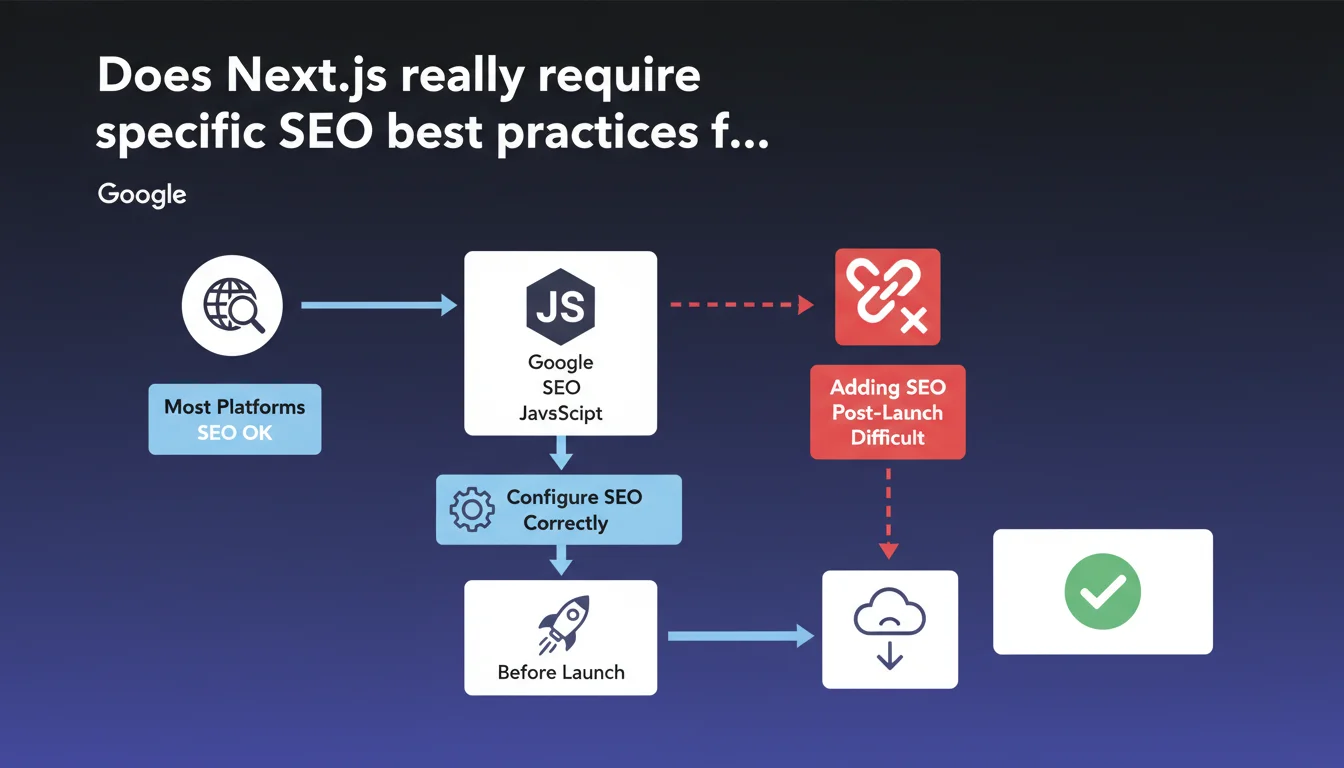
Google confirms that Next.js performs well for SEO as long as you follow JavaScript SEO best practices from the design phase. The key message: configure SEO before launch rather than trying to add it afterward, which proves far more complex. No inherent penalty with the framework, but heightened vigilance is necessary on JavaScript implementation.
What you need to understand
Why does Google insist on configuring SEO before launch?
The reason is simple: modifying a Next.js site's architecture after going live often means partially rebuilding the application. Initial choices (SSR, SSG, ISR) determine how Google crawls and indexes content.
Unlike a traditional CMS where you can add meta tags or optimize URLs without breaking everything, Next.js requires structural decisions from the start. Changing the rendering mode for an entire section may require refactoring code, with regression risks.
Is Next.js more complicated than other platforms for SEO?
Google states that "most platforms perform well" — a deliberately vague formulation. In practice, Next.js is neither better nor worse, but it requires technical understanding that WordPress or Shopify don't demand.
The framework offers granular control over rendering (SSR, SSG, CSR), which is an advantage... if the team knows how to exploit it. Misconfigured, Next.js can generate content invisible to Googlebot or create duplication problems via poorly planned dynamic routes.
What are the JavaScript SEO best practices Google mentions?
Google refers to its JavaScript SEO documentation, which covers several critical points. The first: ensure that essential content is rendered server-side or generated statically, not just client-side.
Other practices include managing lazy loading for images, optimizing initial load time, and correctly configuring meta tags via next/head. Google also emphasizes the importance of XML sitemaps and URL structure.
- Configure SEO from the design phase of the Next.js project, not afterward
- Choose the right rendering mode (SSR/SSG/ISR) based on content type
- Prioritize server-side rendering for critical content
- Correctly implement meta tags via next/head or the new Metadata API
- Verify that Googlebot accesses content without relying on client-side JavaScript
- Optimize Core Web Vitals from the development phase
SEO Expert opinion
Does this statement hide a real difficulty with Next.js?
Let's be honest: Google wouldn't need to specify "consult JavaScript SEO best practices" if everything worked perfectly by default. This recommendation implies that Next.js sites regularly cause indexing issues.
Real-world cases show that common errors include content generated only client-side, missing or duplicated metadata between pages, and catastrophic load times on mobile. Next.js lets you do everything — including break everything.
Is the distinction between frameworks really relevant?
Google says "most platforms perform well" — a statement that deserves nuance. [Needs verification] because this generalization masks enormous disparities between a well-configured static Gatsby site and a poorly designed React SPA.
The real question isn't "Is Next.js good for SEO?" but "Does the development team understand the SEO implications of each technical choice?". A misconfigured Next.js site will be worse than basic WordPress — conversely, an optimized Next.js outperforms most traditional CMS in performance.
Is the timing of SEO configuration really that critical?
Absolutely. On Next.js, fixing an architectural error after launch costs 10 times more than during development. Migrating from client-side rendering to SSR involves refactoring components, handling API calls differently, and comprehensive testing.
Unlike a CMS where installing an SEO plugin takes 5 minutes, Next.js requires code modifications that need specialized technical skills. This is why Google heavily emphasizes initial configuration — because they know post-launch corrections are rarely done correctly.
Practical impact and recommendations
What to verify before launching a Next.js site?
First reflex: test rendering with JavaScript disabled. If main content disappears, you have a problem. Googlebot executes JavaScript, but with timeout and resource limitations — best not to depend solely on that.
Next, verify metadata configuration in each template. Next.js offers several methods (next/head, Metadata API), but none are automatic. Each page must explicitly have its title, description, and Open Graph tags defined.
What errors should you avoid during initial configuration?
The most common mistake: putting everything in getServerSideProps by default thinking it's better for SEO. In reality, for static or rarely changing content, getStaticProps with revalidation (ISR) is more performant and resource-efficient.
Another classic pitfall: neglecting sitemap.xml and robots.txt. Next.js doesn't generate them automatically — you must either create them manually in the public folder or use a library like next-sitemap. Without a sitemap, Google discovers pages less efficiently.
How do you validate that SEO configuration is correct?
Use Search Console and inspect URLs as soon as possible. The "URL Inspection" tool shows exactly what Googlebot sees and indexes. If rendered HTML differs from source code, that's a red flag.
Also test Core Web Vitals with PageSpeed Insights and Lighthouse. Next.js offers automatic optimizations (Image component, font optimization), but they must be enabled and configured correctly. A Lighthouse score below 90 on mobile typically indicates a configuration issue.
- Verify that main content displays without active JavaScript
- Test each page type in the Search Console URL Inspection tool
- Configure metadata (title, description, OG tags) for all templates
- Implement a dynamic or static sitemap.xml based on site structure
- Choose the right rendering mode for each section (SSR/SSG/ISR)
- Optimize images with the next/image component and define width/height
- Test Core Web Vitals on real mobile connections
- Configure redirects and 404 error handling in next.config.js
❓ Frequently Asked Questions
NextJS est-il compatible avec le SEO par défaut ?
Faut-il toujours utiliser le rendu côté serveur avec NextJS ?
Comment Google crawle-t-il les pages NextJS ?
Peut-on ajouter le SEO sur un site NextJS déjà en production ?
Les Core Web Vitals sont-ils automatiquement optimisés avec NextJS ?
🎥 From the same video 20
Other SEO insights extracted from this same Google Search Central video · published on 13/06/2024
🎥 Watch the full video on YouTube →
💬 Comments (0)
Be the first to comment.