
Official statement
What you need to understand
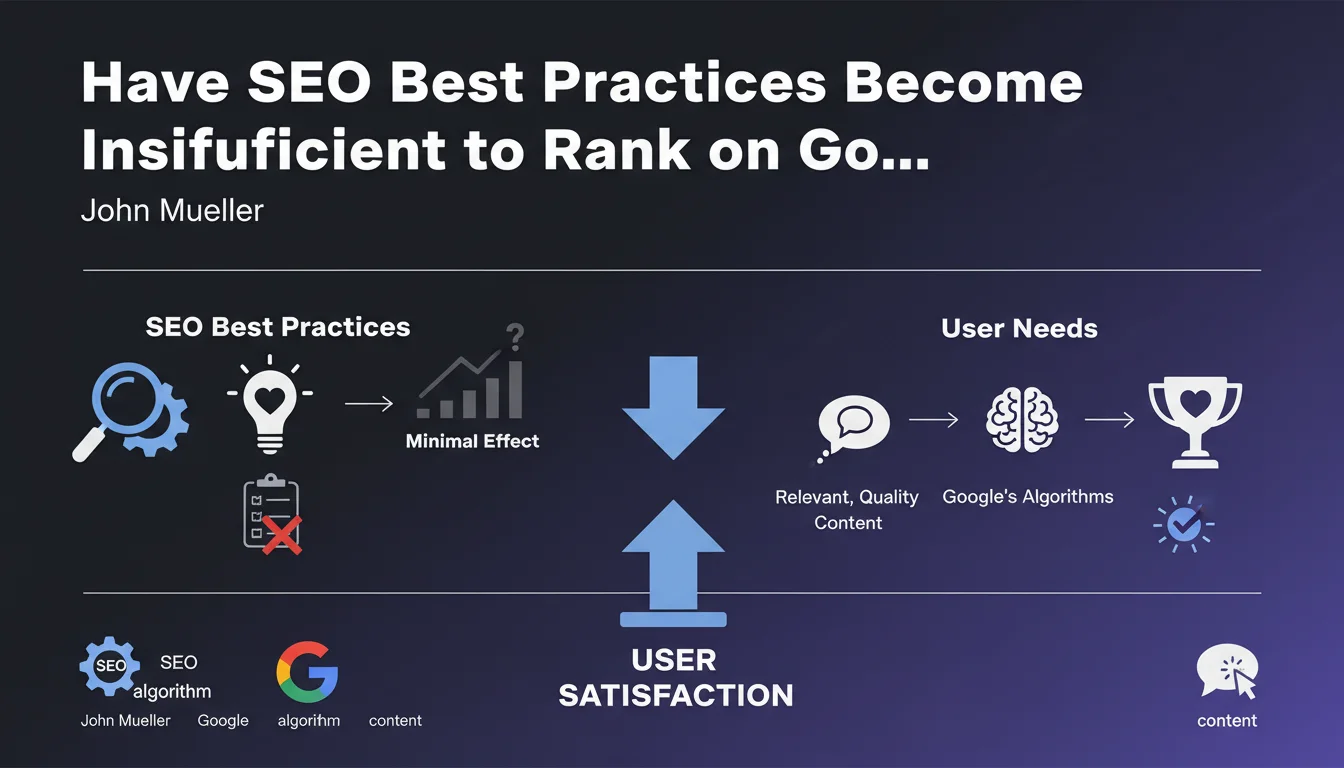
This statement from Google marks an important ideological turning point in the approach to organic search engine optimization. It emphasizes that technical optimization alone no longer guarantees success.
Concretely, this means that a site that is perfectly optimized from a technical standpoint (tags, speed, linking) but offers generic or irrelevant content will have limited performance. Google asserts that its algorithms are now capable of distinguishing truly useful content from content that is simply "well optimized."
The emphasis is placed on search intent and user satisfaction as determining criteria. Behavioral signals (bounce rate, time on page, interactions) are taking on growing importance in quality evaluation.
- Technical optimization remains necessary but is no longer sufficient
- Content must address a real and identified user need
- Relevance and usefulness take precedence over keyword density
- Algorithms now evaluate the actual satisfaction of visitors
- A balance between technical SEO and added value is essential
SEO Expert opinion
This position is completely consistent with the developments observed in recent years. The sites that are crushing it today are those that have understood that SEO is a means, not an end. Content created solely to "please Google" is gradually losing ground.
However, an important nuance must be made: technical best practices remain the essential foundation. Exceptional content on a technically deficient site (slow, non-indexable, poorly structured) will not perform either. The hierarchy is clear: solid technical foundation first, then quality content on top.
Cases where this applies less concern basic informational queries where technical aspects can still make the difference, or niche markets with little competition where minimal optimization is sufficient.
Practical impact and recommendations
- Audit your existing content: identify pages that are technically optimized but provide little added value and substantially enrich them
- Redefine your creation process: start with user needs analysis before keyword research
- Invest in user research: customer interviews, analysis of questions asked to support, specialized forums
- Measure actual satisfaction: implement engagement metrics (actual reading time, scroll depth, interactions) rather than just traffic
- Train your writers: they must understand personas and intents, not just place keywords
- Avoid "pure SEO" content: ban texts written solely to rank without providing distinctive value
- Favor depth: one comprehensive and useful guide is worth more than 10 superficial optimized articles
- Test and iterate: use user data to continuously improve relevance
Implementing this approach requires a profound cultural transformation that goes beyond simply applying technical recipes. It involves crossing skills in content strategy, behavioral analysis, UX and technical optimization.
This growing complexity of modern SEO often makes it difficult to manage in-house, particularly for smaller teams. Working with a specialized SEO agency can prove wise to benefit from personalized support combining technical expertise, editorial vision and proven methodology, while freeing up your internal resources to focus on your core business.
💬 Comments (0)
Be the first to comment.