
Official statement
What you need to understand
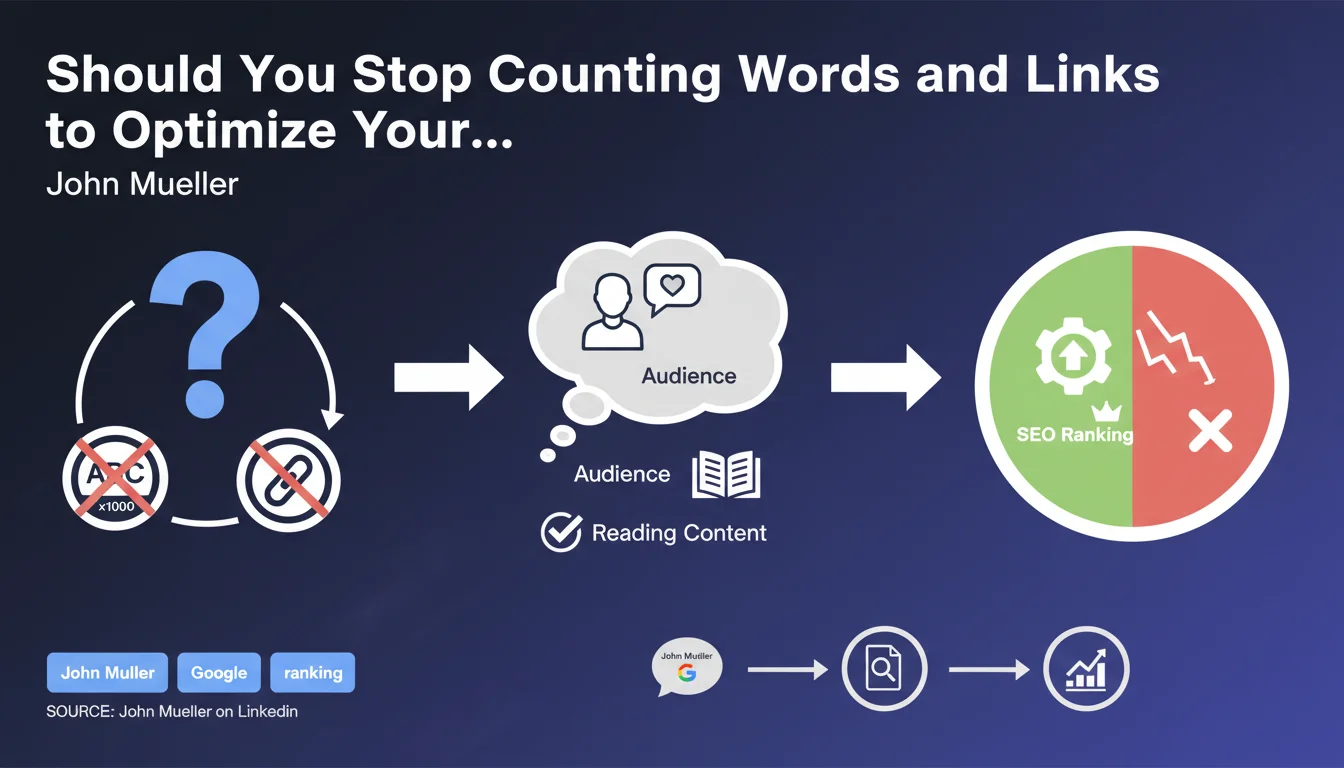
John Mueller, Google spokesperson, reminded on LinkedIn that the number of words and links on a page does not constitute a direct ranking factor. This statement aims to correct a persistent misconception in the SEO industry.
Many SEO practitioners still use arbitrary quantitative metrics as objectives: reaching a minimum of 1500 words, inserting exactly 3 internal links per article, or maintaining a precise ratio of outbound links. Google states that these practices have no algorithmic foundation.
Mueller emphasizes that user experience takes precedence over technical metrics. Google's philosophy remains centered on satisfying search intent, not on adhering to mathematical formulas.
- No automatic counter for words or links directly influences ranking
- Quantitative thresholds (500 words, 1000 words, etc.) have no intrinsic value
- The algorithm evaluates quality and relevance, not quantity
- You should write for your audience, not to meet artificial quotas
SEO Expert opinion
This statement is consistent with field observations, but deserves to be nuanced. Indeed, while Google doesn't mechanically count words, the correlation between content length and ranking does exist in competitive SERPs.
The important nuance: long content generally performs better not because of its length, but because it statistically has a higher chance of covering a topic in depth, satisfying search intent, and generating engagement. A well-structured 2000-word article will almost always beat a superficial 300-word article on a complex informational query.
Regarding links, the situation is similar. Google doesn't set quotas, but coherent internal linking improves site crawling and PageRank distribution. External links to authoritative sources strengthen credibility.
Practical impact and recommendations
Following this clarification, here are the strategic adjustments to adopt in your SEO approach:
- Abandon rigid quotas: stop setting objectives like "all articles must be a minimum of 1500 words"
- Analyze search intent: adapt length to the type of query (informational, transactional, navigational)
- Evaluate competition qualitatively: if the top 3 are 3000 words, it's probably because the subject requires that depth
- Prioritize completeness: cover all aspects of a topic rather than reaching a word count
- Add links naturally: insert them when they provide real contextual value
- Test different formats: some topics are better suited to short, punchy content
- Measure user engagement: time on page, bounce rate, and conversions are more revealing than word count
- Structure for readability: use headings, lists, and short paragraphs even in long content
In summary: shift from a quantitative approach to a user-centered qualitative approach. Write the necessary and sufficient content to fully satisfy search intent.
Implementing this qualitative approach requires sharp expertise in semantic analysis, understanding search intent, and optimizing user experience. These multidisciplinary skills are often complex to master simultaneously in-house, particularly for high-volume sites or in competitive sectors. Support from a specialized SEO agency can prove valuable for structuring this methodological transition and obtaining measurable results quickly.
💬 Comments (0)
Be the first to comment.