
Official statement
Other statements from this video 11 ▾
- □ Why should photographers invest in their own website instead of relying solely on Instagram?
- □ Is it really a mistake to use generic keywords as your business name for SEO?
- □ Is Google Search Console really essential for your photography website?
- □ Why does Google index photo galleries with descriptive text better than isolated images?
- □ Can social media really coexist with your website in Google Images results?
- □ Does publishing your images first guarantee canonicalization on Google?
- □ Should you really stop watermarking your images for SEO?
- □ Should you really create a dedicated page for every image on your website?
- □ Are URL fragments (#) killing your image visibility in Google search results?
- □ JPEG, WebP, AVIF: Which image format should you choose for SEO in 2025?
- □ Why aren't your videos showing up in Google's video search results?
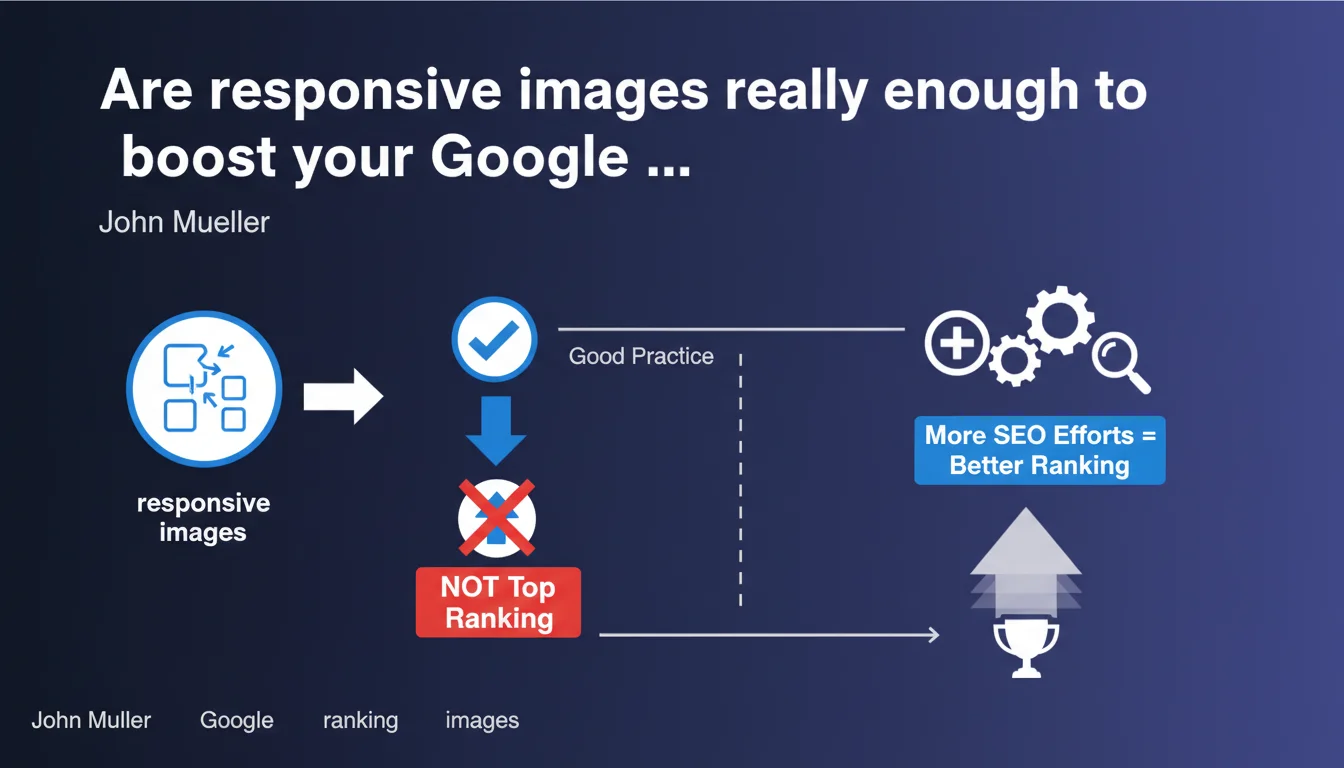
Google confirms that responsive images are a good technical practice, but they're not a decisive ranking factor. Mueller is clear: on competitive generic terms, image optimization alone will never make the difference against competitors who excel across all other criteria.
What you need to understand
Why does Google downplay the impact of responsive images?
Mueller isn't saying responsive images are useless — he's setting the record straight about their actual weight in the algorithm. They're good for UX and performance, period. But expecting to gain rankings just by serving images adapted to each device is drastically overestimating their influence.
Context matters: we're talking about generic terms, which are ultra-competitive. On these queries, Google compares hundreds of signals. Responsive images check a technical box, but they don't compensate for weaknesses in content, backlinks, or domain authority.
What's the difference between a best practice and a ranking factor?
A best practice improves user experience and can indirectly influence behavioral metrics. A ranking factor has direct and measurable impact on positioning.
Responsive images fall into the first category. They reduce page weight, speed up loading on mobile, and potentially improve Core Web Vitals. But it's not a lever Google actively uses to differentiate two competitors on equal footing.
What does "you need to do more" mean in practice?
Mueller points out an obvious truth that some forget: technical optimization alone never cuts it on competitive queries. Responsive images fit into a coherent set of optimizations, but they don't replace solid foundational work.
"Doing more" means working simultaneously on content, site authority, semantic structure, engagement signals, and backlink quality. Images are just one link in the chain.
- Responsive images aren't a major ranking factor, just a good technical practice
- On competitive generic terms, they can't compensate for any structural weakness on your site
- Their impact is limited to improving performance and mobile UX
- Google values overall coherence, not isolated optimizations
SEO Expert opinion
Is this statement consistent with what we see in the field?
Absolutely. I regularly see technically flawless sites — responsive images, lazy loading, performant CDN — stalling on page 2 or 3 on generic queries. Conversely, sites with poorly optimized images but solid domain authority and exhaustive content dominate the top positions.
The problem is that technical optimizations are often oversold as miracle solutions. Responsive images are part of the minimum baseline expected on mobile today, not a competitive advantage.
When does this rule not apply?
On ultra-niche queries with little competition, yes, responsive images can tip the scales. If all competitors are technically mediocre and you're the only one serving adapted images, it can matter.
But let's be honest: these cases are marginal. On 95% of queries, you're facing sites that already master these basics. That's where Mueller is right to reset expectations.
How should you prioritize image optimizations?
Responsive images come after more fundamental criteria: total file weight, modern compression (WebP, AVIF), lazy loading, and especially relevant alt text for image SEO.
Prioritizing responsive versions before you've compressed your images or optimized their naming is putting the cart before the horse. Mueller reminds us we need to see the whole picture — and images are just a subset of a subset of ranking criteria.
Practical impact and recommendations
What should you concretely do with this information?
Continue implementing responsive images via srcset and sizes attributes, but don't expect any miracles in terms of rankings. Treat them as a technical standard, not a SEO lever.
Focus your efforts where impact is measurable: content quality and depth, semantic optimization, strategic internal linking, and acquiring quality backlinks to your priority pages.
What mistakes should you absolutely avoid?
Never sacrifice content quality or link strategy time to endlessly refine your responsive images. This is a classic trap: over-investing in comfortable technical optimizations (because they're measurable, controllable) at the expense of less tangible foundational work.
Another common mistake: implementing responsive images without prior compression. You're then simply serving oversized files at different sizes, which solves nothing.
How do you integrate this optimization into a global strategy?
Responsive images are part of a basic technical audit. Checklist item to check off, but not strategic priority. On an e-commerce site with thousands of product pages, yes, automate them. On a corporate blog, just verify your CMS generates them correctly.
And remember that on generic queries, you're competing against rivals who've had all this in place for years. Your differentiation will come elsewhere: editorial relevance, treatment angle, content freshness, and the strength of your link profile.
- Verify your CMS automatically generates
srcsetandsizesattributes - Compress all images to WebP or AVIF before making them responsive
- Implement lazy loading on images below the fold
- Audit Core Web Vitals (especially LCP) to measure real performance impact
- Don't spend more than 10% of your SEO time on image optimizations for competitive queries
- Prioritize exhaustive content, backlinks, and topical authority as main levers
🎥 From the same video 11
Other SEO insights extracted from this same Google Search Central video · published on 07/08/2025
🎥 Watch the full video on YouTube →
💬 Comments (0)
Be the first to comment.