
Official statement
Other statements from this video 20 ▾
- □ Should you really block AI-generated automatic translations from your site with noindex?
- □ Are site: searches polluting your Search Console data?
- □ Why Is Google Telling You to Ignore Your PageSpeed Insights Scores?
- □ Should you really stop obsessing over Core Web Vitals optimization?
- □ Should you really worry about buying an expired domain?
- □ Can AI Really Produce SEO-Quality Content with Just Human Proofreading?
- □ Can poor machine translation really tank your SEO rankings?
- □ Do affiliate links actually hurt your page's search rankings?
- □ Should you really fix every single broken backlink pointing to your site?
- □ Does Next.js really require specific SEO best practices from the start?
- □ Should you redirect or completely disable an unused subdomain for SEO?
- □ Should you really worry about toxic backlinks pointing to your site?
- □ Should you really match your page title and H1 tag?
- □ Does localized content really escape the duplicate content penalty?
- □ Why does Google discourage using site: queries to verify indexation?
- □ Why does a high ranking not guarantee strong CTR on Google?
- □ Do JavaScript console errors really hurt your site's search rankings?
- □ Could showing all product variants to Googlebot alone be quietly destroying your search visibility?
- □ Do you really need a dedicated page per video to rank in rich video results?
- □ Is content syndication really worth the risk to your organic visibility?
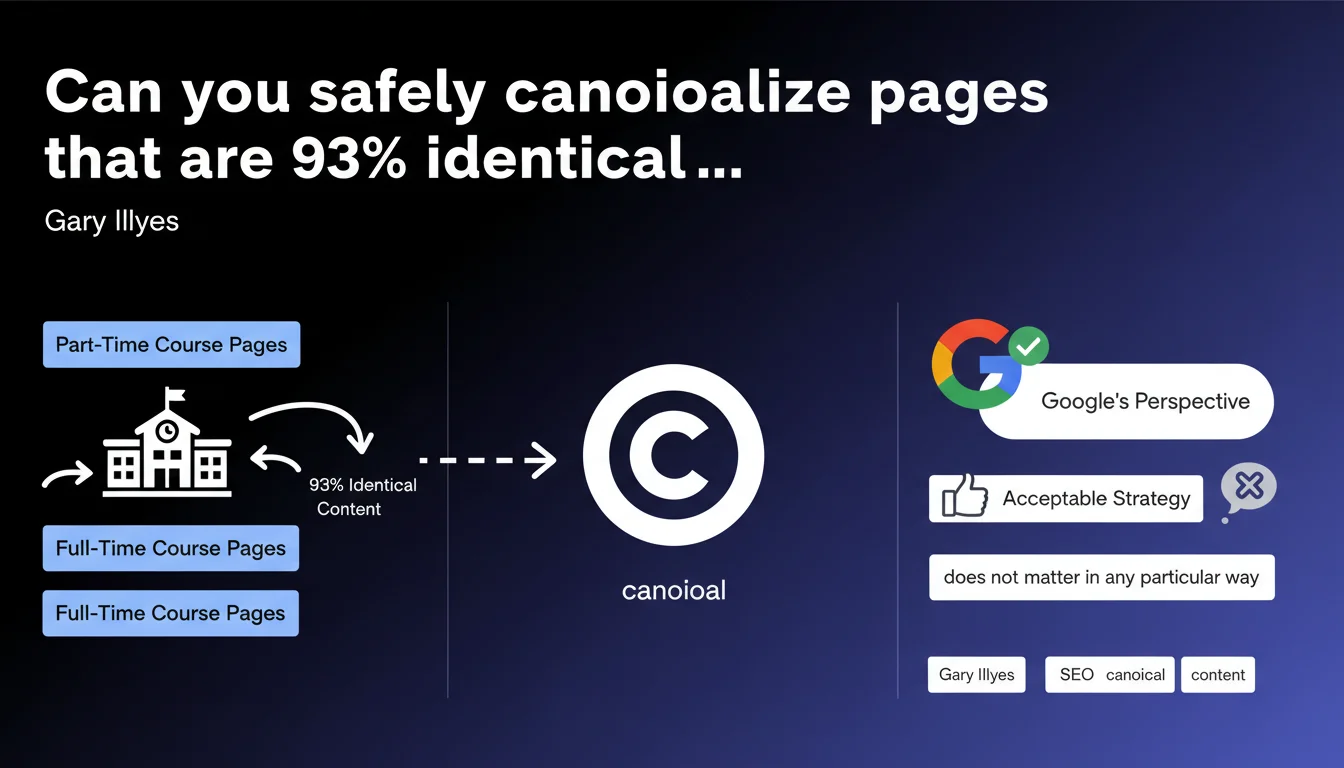
Gary Illyes confirms that it is acceptable to canonicalize pages with 93% identical content (in this case, part-time courses towards full-time courses). Google sees no particular issue with this approach. This statement validates a common field practice used to manage quasi-duplicate content that is structurally similar.
What you need to understand
What does this statement actually change in practice?
Google validates here a duplicate content management practice through canonicalization. When two pages share the bulk of their content (93% in the example), pointing the minor version towards the major version via a canonical tag is a legitimate strategy.
The example given — part-time courses versus full-time courses — illustrates a typical case: identical structures, with only a few mentions of duration or modalities differing. Rather than maintaining two competing pages, you consolidate signals on the main page.
Why does Google see "no particular importance" in this?
Gary Illyes' phrasing is deliberately understated. Google doesn't penalize this practice because it's not cloaking or manipulation.
Canonicalized pages remain accessible to users. The search engine simply interprets that one version references another. This neutrality also reflects that Google manages billions of similar pages daily — it's a routine case for the algorithm.
What are the implicit limits of this tolerance?
Gary doesn't specify an exact threshold beyond which canonicalization becomes problematic. The 93% mentioned doesn't constitute an absolute rule — it's a contextual example.
You must understand that canonicalization works when pages share a common semantic objective. Forcing a canonical between distinct content remains risky: Google may ignore it or misinterpret the intention.
- Google accepts canonicalization of nearly identical pages (93%+ similarity)
- No negative signal is sent if the practice remains consistent
- The canonical tag must reflect a user reality: interchangeable or logically hierarchized pages
- No official threshold communicated — the percentage varies based on context
SEO Expert opinion
Is this statement consistent with field observations?
Yes. SEO practitioners have used canonicalization to manage product variants, regional pages, or alternative formats for years. Gary's example confirms what works on the ground.
However, note this: [To verify] if Google "sees no particular importance," this also means there's no direct SEO benefit to canonicalizing beyond avoiding duplicate content penalty. Some hope for a boost — that's false. You avoid a potential penalty, you don't create added value.
What nuances should be applied depending on site typologies?
Google's tolerance depends on semantic context. An e-commerce site with 10,000 quasi-identical product sheets (only the color changes) can canonicalize without issue. A blog that canonicalizes thematically close articles risks losing visibility if targeted queries differ.
The 93% is not a magic threshold — it's an illustration. An article with 70% shared content but a distinct search intent shouldn't be canonicalized. Conversely, two pages that are 95% identical but target the same query should be.
In what cases does this strategy fail?
Google may ignore the canonical tag if pages present significant differences in terms of backlinks, user engagement, or visible content. I've observed cases where the "minor" page received more external links — Google maintained it as the primary index despite the canonical.
Another classic failure: canonicalizing towards a lower-performing page in CTR or conversion. Google sometimes favors the page with the best behavioral signals, even if technically it should be canonicalized.
Practical impact and recommendations
What should you concretely do to apply this recommendation?
First identify candidate pages: structurally similar content, sharing 80%+ of text, targeting the same main query. A similarity audit (tools like Screaming Frog, Siteliner) allows you to detect these duplicates.
Implement the <link rel="canonical" href="main-URL"> tag in the <head> of minor pages. Verify that the canonical page is the most performant (traffic, backlinks, UX) — never canonicalize towards a weak page.
- Audit your pages to detect duplicates or near-duplicates (80%+ similarity)
- Choose the reference page based on SEO performance, backlinks, and conversion
- Implement the canonical tag on secondary pages
- Verify via Google Search Console that Google respects your directives (Coverage report, Excluded tab)
- Monitor traffic variations over 4-6 weeks post-implementation
- Don't forget internal linking: point towards the canonical page from your internal content
What mistakes should you absolutely avoid?
Never canonicalize pages with different search intents, even if the content resembles each other. A user searching for "online SEO training" doesn't have the same expectations as "in-person SEO training" — two distinct pages are necessary.
Avoid canonical chains (A → B → C). Google can lose track and ignore the directive. A canonical must point directly to the final page.
How do you verify that the strategy is working?
Use Google Search Console, Coverage section. Canonicalized pages appear under "Excluded" with the status "Duplicate, page identified by user as canonical." If Google indexes them anyway, your directive is being ignored.
Compare organic traffic before/after on the affected pages. A temporary drop (2-4 weeks) is normal — Google reattributes signals. A prolonged decline indicates a problem: poor choice of canonical page or loss of long-tail traffic.
❓ Frequently Asked Questions
Quel pourcentage de similarité justifie une canonicalisation ?
Google peut-il ignorer ma balise canonical ?
Faut-il noindexer les pages canonicalisées ?
Quelle impact sur le crawl budget si je canonicalise massivement ?
Puis-je canonicaliser des pages en langues différentes ?
🎥 From the same video 20
Other SEO insights extracted from this same Google Search Central video · published on 13/06/2024
🎥 Watch the full video on YouTube →
💬 Comments (0)
Be the first to comment.