
Official statement
Other statements from this video 20 ▾
- □ Should you really block AI-generated automatic translations from your site with noindex?
- □ Are site: searches polluting your Search Console data?
- □ Why Is Google Telling You to Ignore Your PageSpeed Insights Scores?
- □ Should you really stop obsessing over Core Web Vitals optimization?
- □ Should you really worry about buying an expired domain?
- □ Can AI Really Produce SEO-Quality Content with Just Human Proofreading?
- □ Can poor machine translation really tank your SEO rankings?
- □ Should you really fix every single broken backlink pointing to your site?
- □ Does Next.js really require specific SEO best practices from the start?
- □ Can you safely canonicalize pages that are 93% identical without damaging your SEO?
- □ Should you redirect or completely disable an unused subdomain for SEO?
- □ Should you really worry about toxic backlinks pointing to your site?
- □ Should you really match your page title and H1 tag?
- □ Does localized content really escape the duplicate content penalty?
- □ Why does Google discourage using site: queries to verify indexation?
- □ Why does a high ranking not guarantee strong CTR on Google?
- □ Do JavaScript console errors really hurt your site's search rankings?
- □ Could showing all product variants to Googlebot alone be quietly destroying your search visibility?
- □ Do you really need a dedicated page per video to rank in rich video results?
- □ Is content syndication really worth the risk to your organic visibility?
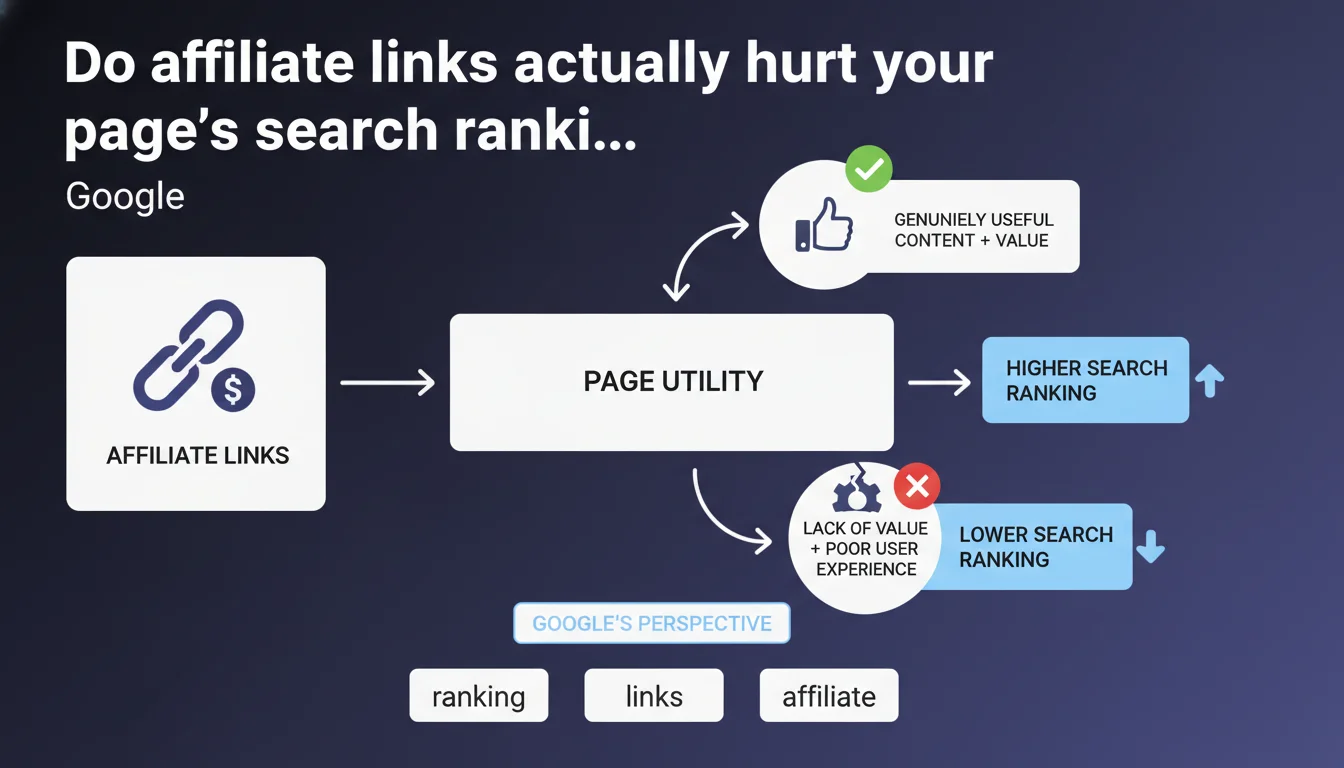
Google states that the presence of affiliate links on a page doesn't automatically make it bad or good for rankings. The sole determining factor: real value delivered to users. The page's overall context and usefulness outweigh the nature of outbound links.
What you need to understand
Why does Google clarify that affiliate links aren't automatically penalizing?
This statement addresses a persistent fear in the SEO community: that affiliate marketing is inherently suspicious in Google's eyes. Many sites still hesitate to monetize their content through affiliate programs, believing it automatically triggers a negative signal.
Google sets the record straight. An affiliate link remains a commercial outbound link, certainly, but it's not treated as spam by default. The algorithm examines the broader context: does the content provide real standalone value, or does it exist only to push monetized links?
What distinguishes an acceptable affiliate page from a problematic one?
The dividing line comes down to editorial intent. A problematic page simply lists products with affiliate links, without analysis, without detailed comparison, without original expertise. The content serves as a pretext for the link.
An acceptable page integrates affiliate links into substantial content: in-depth buying guides, original product tests, well-reasoned comparisons. Affiliation then becomes a natural consequence of useful content, not its reason for existing.
How does Google concretely evaluate this usefulness?
The engine relies on its E-E-A-T criteria (Experience, Expertise, Authoritativeness, Trustworthiness) and Quality Rater Guidelines. An affiliate page is scrutinized like any other content: originality, depth, reliability of information, transparency about the commercial relationship.
Behavioral signals matter too. If users quickly find what they're looking for and don't immediately return to search results, that's a positive signal. Conversely, a high bounce rate on pages stuffed with affiliate links devoid of substance sends the opposite message.
- Affiliate links don't trigger automatic penalties
- Content value trumps the presence of commercial links
- The page's overall context determines its ranking
- Transparency and usefulness are the two pillars of a well-designed affiliate page
- E-E-A-T applies to monetized content too
SEO Expert opinion
Is this statement consistent with real-world observations?
Yes, but with important nuances. Affiliate sites that perform well in SEO share one defining characteristic: solid editorial content. Wirecutter (acquired by the New York Times), The Points Guy, or certain specialized tech blogs maintain robust rankings while heavily monetizing through affiliates.
Conversely, generic affiliate sites—those that duplicate Amazon product sheets with a few contextual sentences—have been systematically devastated by algorithmic updates, notably the Helpful Content Update. The correlation between weak content + affiliation = de-ranking is statistically evident, even if Google refuses to make it an explicit rule.
What are the gray areas not addressed by this statement?
Google remains deliberately vague on several critical points. How many affiliate links per page before it becomes suspect? No threshold communicated. [To verify]: some empirical testing suggests that beyond 30-40% of outbound links being affiliate, the "thin content" signal may trigger, but Google has never confirmed a ratio.
Another gray area: link attribute management. Google recommends using rel="sponsored" for affiliate links but clarifies that it's "not mandatory." Yet failing to do so could theoretically be interpreted as an attempt to manipulate. This ambiguity leaves SEOs uncertain.
Finally, the statement ignores the question of affiliate link cloaking. Many sites hide their affiliate links behind internal redirects to prevent PageRank leak or improve UX. Does Google tolerate this practice? Officially, as long as there's no deception about the final destination, yes. In practice, some sites have been penalized for similar techniques. [To verify]
In what cases doesn't this rule provide sufficient protection?
Affiliate sites operating in YMYL niches (Your Money Your Life) face much more severe scrutiny. A site comparing insurance or credit products, even with substantial content, will be evaluated with drastically higher E-E-A-T criteria than a tech blog.
Similarly, sites generating content at scale (AI-generated or content mills) with automatic affiliate link insertion are systematically detected. Google can say that "links don't automatically make pages useless," but if 1,000 similar pages appear simultaneously on a domain, the algorithm won't treat them individually—it will pattern-match a spam strategy.
Practical impact and recommendations
What should you concretely do to optimize pages with affiliate content?
First reflex: audit your content-to-links ratio. For each monetized page, calculate the amount of original editorial content versus the number of affiliate links. If you fall below 200 words of unique content per affiliate link, you're entering a risk zone.
Second axis: invest in visible expertise. Add bylines with identifiable authors, detailed biographies, photos, links to their social profiles. Google wants to see humans behind the content, especially on commercial pages. Anonymous pages are automatically suspect.
Third lever: monetization transparency. A clear mention "This article contains affiliate links" at the top of the page, combined with systematic use of rel="sponsored", avoids any suspicion of manipulation. Some sites go so far as to explain their business model on a dedicated page—that boosts trust.
What mistakes must you absolutely avoid?
Never duplicate manufacturer content by slapping affiliate links on it. Google instantly detects product descriptions copy-pasted from Amazon or retail sites. If you need to discuss a product, write your own angle, your own arguments, test the product if possible.
Also avoid satellite pages created solely to rank on commercial searches without offering differentiated value. "Best X 2024," "Top 10 Y" are ultra-competitive formats where only sites with real authority and dense content survive. If your site lacks that authority, favor more specific angles.
Last pitfall: neglecting content freshness. An outdated affiliate page with discontinued products, obsolete prices, broken links sends a catastrophic signal. Google favors maintained pages, especially in shopping niches.
How can you verify that your site meets Google's expectations?
Run a competitive analysis: for your 10 most important affiliate pages, compare them to competitor pages ranking in positions 1-3. Measure their content length, number of sections, H2/H3 structure, media usage (images, videos), freshness. If you're significantly below, you have your answer.
Also use Search Console data. If an affiliate page gets lots of impressions but few clicks, that's a signal your title/description aren't convincing—or Google is testing your page but observes poor user engagement and gradually demotes it.
- Minimum ratio of 200 words of original content per affiliate link
- Systematic use of rel="sponsored" on all affiliate links
- Clear mention of commercial relationship at the start of the article
- Identifiable authors with biography and visible expertise
- 100% original content, never copy-paste product sheets
- Regular updates of prices, availability, and recommendations
- Real testing or experience with recommended products when possible
- Competitive analysis with well-ranking competitors
❓ Frequently Asked Questions
Dois-je obligatoirement utiliser l'attribut rel="sponsored" sur mes liens d'affiliation ?
Existe-t-il un nombre maximum de liens d'affiliation par page ?
Les pages d'affiliation peuvent-elles ranker aussi bien que des pages non commerciales ?
Faut-il divulguer la présence de liens d'affiliation sur chaque page ?
Le cloaking de liens d'affiliation est-il autorisé par Google ?
🎥 From the same video 20
Other SEO insights extracted from this same Google Search Central video · published on 13/06/2024
🎥 Watch the full video on YouTube →
💬 Comments (0)
Be the first to comment.