
Official statement
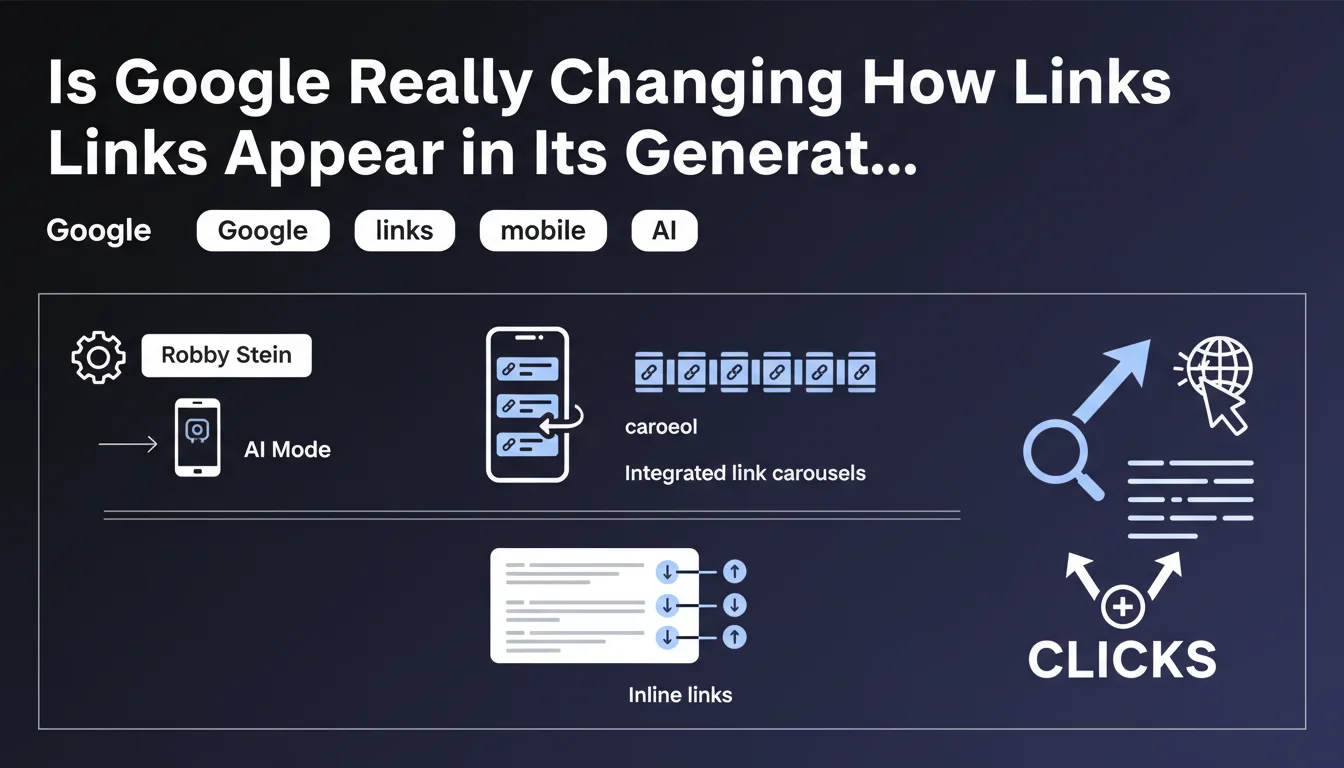
Among the announced innovations: Integrated link carousels: These carousels, already visible in AI responses on desktop, will soon be rolled out on mobile as well, to highlight multiple links directly in the results.
Inline links: Google will improve the integration of links directly within AI-generated text, as users tend to click more when they have context about the linked content.
Expanded Web Guide: The pilot "Web Guide" experience, which aims to intelligently organize and present the most relevant links, will move from the simple Web tab to the main "All" tab for users enrolled in the test. Google emphasizes its commitment to making links more visible and attractive to stimulate web exploration, while continuously evaluating which types and formats of links best serve users and publishers. Initial reactions highlight the importance for Google to give more visibility to source links, an aspect confirmed by the planned improvements.
What you need to understand
Google AI Overviews (formerly Search Generative Experience) has raised serious concerns among publishers since its launch. The main fear: that AI-generated responses would directly answer users' questions without them needing to click through to source sites.
This official statement marks a major strategic turning point. Google implicitly acknowledges that its AI system must better redistribute traffic to publishers, or risk drying up the ecosystem that feeds its data in the first place.
Three concrete mechanisms are being deployed to increase click-through rates from AI responses:
- Integrated link carousels: visual highlighting of multiple sources directly in the AI response, with expansion to mobile
- Contextual inline links: insertion of links directly within generated text, with explicit context about the destination
- Expanded Web Guide: organized experience presenting the most relevant sources, now in the main tab
This evolution confirms that visibility in AI citations is becoming a major new SEO challenge, beyond simple ranking in traditional organic results.
SEO Expert opinion
This announcement is consistent with field observations from recent months. Data indeed shows very low click-through rates on initial AI Overviews, sometimes below 5% according to certain industry studies. Google is reacting to pressure from publishers and probably to its own internal metrics.
However, an important nuance: these improvements primarily target complex informational queries. For simple direct-answer queries ("age of X", "capital of Y"), AI will probably continue to suffice without generating clicks. The nature of the query remains determining.
The emphasis on "links with context" is revealing: Google is trying to qualify the destination before the click. This means that cited pages must have perfectly optimized titles, metadata, and snippets to be selected and contextualized by the AI.
Practical impact and recommendations
- Optimize your content for AI citation: clearly structure your information with concise answers, verifiable factual data, and authoritative sources
- Work on your title tags and meta descriptions: they serve as context for links displayed in AI and directly influence click-through rates
- Create high-value-added content: AI will favor sources offering in-depth analysis, exclusive data, or specialized expertise rather than generic content
- Implement enhanced schema.org markup: articles, FAQs, how-tos, and structured data facilitate extraction and citation by AI systems
- Monitor your mentions in AI Overviews: use Search Console and specialized tracking tools to identify when and how you're being cited
- Diversify your content formats: images, videos, and interactive content can appear in carousels and increase your visibility
- Strengthen your topical authority: Google preferentially cites sites recognized as references in their field of expertise
- Avoid purely transactional content without context: AI favors rich explanatory and informational content
These new optimization requirements for generative AI add to traditional SEO criteria and require a sophisticated technical and editorial approach. Analyzing your positioning in AI citations, adapting your content architecture, and fine-tuning your metadata require specific expertise.
For companies looking to secure their visibility in this rapidly evolving ecosystem, support from a specialized SEO agency can prove valuable. A personalized analysis will help precisely identify your citation opportunities, adapt your content strategy to new AI formats, and implement effective monitoring of your performance in this new channel.
💬 Comments (0)
Be the first to comment.