
Official statement
Other statements from this video 20 ▾
- □ Should you really block AI-generated automatic translations from your site with noindex?
- □ Are site: searches polluting your Search Console data?
- □ Why Is Google Telling You to Ignore Your PageSpeed Insights Scores?
- □ Should you really stop obsessing over Core Web Vitals optimization?
- □ Should you really worry about buying an expired domain?
- □ Can AI Really Produce SEO-Quality Content with Just Human Proofreading?
- □ Can poor machine translation really tank your SEO rankings?
- □ Do affiliate links actually hurt your page's search rankings?
- □ Should you really fix every single broken backlink pointing to your site?
- □ Does Next.js really require specific SEO best practices from the start?
- □ Can you safely canonicalize pages that are 93% identical without damaging your SEO?
- □ Should you redirect or completely disable an unused subdomain for SEO?
- □ Should you really worry about toxic backlinks pointing to your site?
- □ Should you really match your page title and H1 tag?
- □ Does localized content really escape the duplicate content penalty?
- □ Why does Google discourage using site: queries to verify indexation?
- □ Why does a high ranking not guarantee strong CTR on Google?
- □ Do JavaScript console errors really hurt your site's search rankings?
- □ Could showing all product variants to Googlebot alone be quietly destroying your search visibility?
- □ Do you really need a dedicated page per video to rank in rich video results?
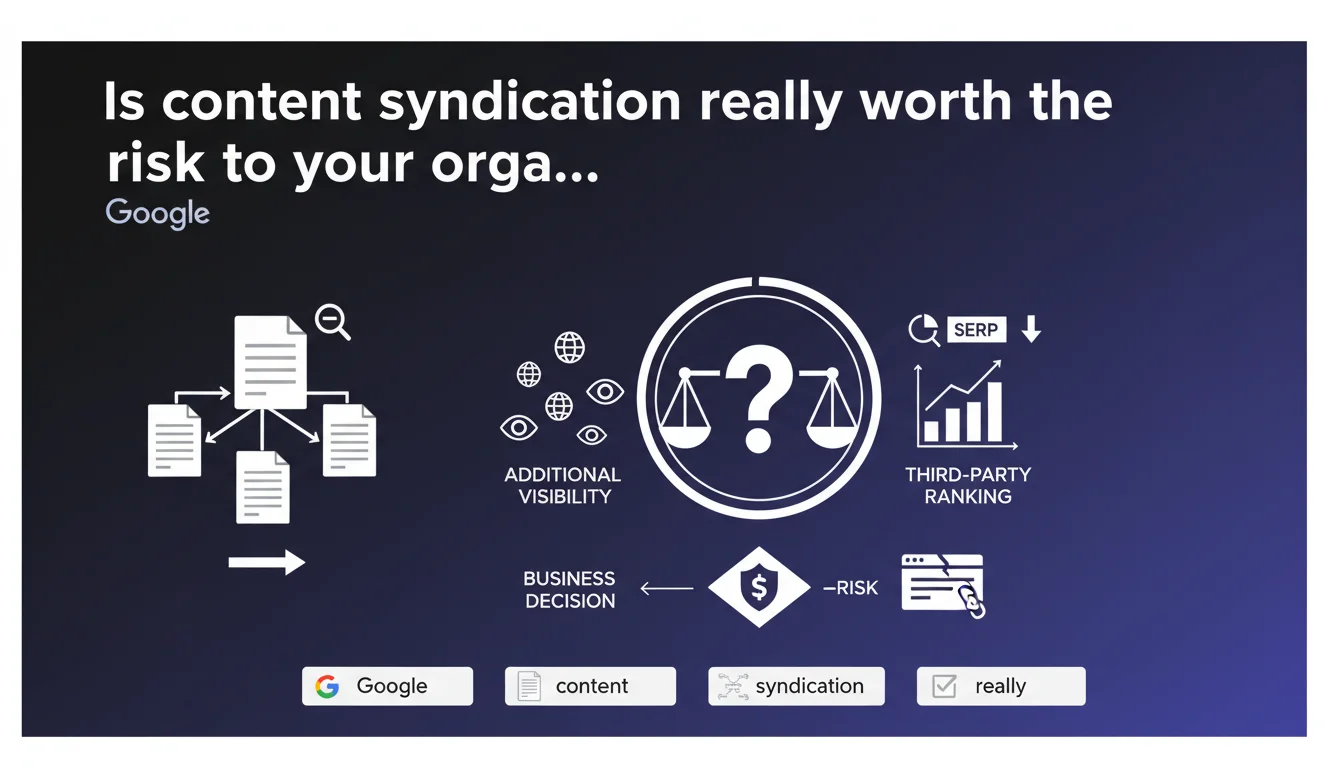
Google makes it crystal clear: republishing your content elsewhere means trading additional visibility for the risk that the syndication platform outranks you in the SERPs. Search results don't necessarily reflect what Google considers the original source — it's a business compromise you need to accept with full awareness.
What you need to understand
What is Google really saying about the original source?
Google puts its cards on the table here: appearing in search results doesn't mean being recognized as the original source. In other words, even if you're the initial author, nothing guarantees that your URL will rank first.
The search engine chooses the page it deems most relevant and most useful for the user at any given moment. If the third-party platform has greater authority, better internal linking, or answers the intent more effectively, it can easily outrank you.
Why does Google refer to syndication as a "business decision"?
Because syndication is a calculated trade-off. You potentially gain in reach, indirect backlinks, and new audience. But you take the risk of cannibalizing your own search visibility.
Google isn't telling you what to do — it's simply reminding you that you can't have your cake and eat it too. If Medium, LinkedIn, or Forbes republishes your article and their domain crushes yours, it's your strategic choice that's at stake.
What does this mean for managing duplicate content?
The statement implies that the canonical tag isn't a magic bullet. Even with rel=canonical pointing to your site, Google can decide to prioritize the syndicated version if it offers a better user experience or stronger authority signals.
Duplicate content isn't a penalty in itself, but it creates a context of internal competition that you voluntarily establish. Google picks a winner — and it's not always you.
- Search results don't guarantee that Google considers your site the original source
- Republishing content = trading visibility for the risk of relative demotion
- Syndication is a business arbitrage, not a consequence-free SEO tactic
- The canonical tag doesn't impose anything on Google — it's a signal, not a directive
SEO Expert opinion
Is this statement consistent with real-world observations?
Yes, absolutely. We regularly see situations where an article published on Medium or LinkedIn outranks the original version on the author's blog. Domain authority, social signals, and engagement count tremendously.
Google doesn't just detect who published first. It evaluates which result will best serve the user. If the third-party platform offers optimal UX, better loading speed, or attracts more clicks, it wins — even if you're the original author.
What nuances should we add to this discourse?
First point: Google remains vague on how it determines the original source internally. It says SERP results don't reflect this recognition, but it doesn't say whether it records it somewhere or how it influences other ranking signals. [Worth verifying]
Second nuance: syndication isn't just passive duplicate content. If you republish with a different introduction, a CTA tailored to the platform, or a reworked editorial angle, you create a content variation that can coexist without major conflict.
Third nuance: this logic applies mainly to informational content. For transactional content or product pages, syndication rarely makes sense — and the risks of cannibalization are significantly higher.
In what cases doesn't this rule really apply?
If your domain has crushing authority in your niche, syndication becomes less risky. A reference media that republishes elsewhere often keeps the upper hand in the SERPs.
Similarly, if you syndicate only to closed platforms (newsletters, premium members, private professional networks), the SEO impact is nearly zero. The conflict only exists if both versions are indexable and in direct competition.
Practical impact and recommendations
What should you do concretely before syndicating content?
First, evaluate the benefit/risk ratio. If you're a young site with little authority, syndicating on Medium or LinkedIn can bring you immediate traffic and valuable backlinks. But if you already have a solid audience, the game might not be worth the candle.
Next, wait a few days after original publication before syndicating. This gives Google time to crawl and index your version first. It's not a guarantee, but it improves your chances of being recognized as the initial source.
Finally, always use the canonical tag pointing to your site — even if Google can ignore it, it's a clear signal of your intent. And add a link at the beginning of the syndicated version: "Originally published on [your site]".
What mistakes should you avoid at all costs?
Don't syndicate everything systematically. Reserve this strategy for your best articles, those with the potential to reach a wide audience and attract quality backlinks.
Never republish instantly. If both versions are crawled at the same time, Google can choose the wrong one — and reversing that decision is a nightmare.
Don't use syndication as a band-aid to compensate for poor distribution. If your site generates no traffic, the problem lies elsewhere: weak content, failing technical SEO, lack of promotion. Syndication won't fix these structural flaws.
How do you measure the real impact of syndication on your SEO?
Track the rankings of your original URLs vs. syndicated ones on the same keywords. Use Search Console to compare impressions and clicks before and after syndication.
Also measure referral traffic from the third-party platform. If you gain 500 qualified visitors via Medium but lose 200 organic visitors on the target query, the balance could be positive — your business objective is the deciding factor.
- Evaluate the relative authority of your site vs. the syndication platform
- Publish first on your site, wait 48-72 hours before syndicating
- Add a canonical tag pointing to your original URL
- Insert an explicit link to the source in the syndicated version
- Track the rankings of both URLs in Search Console
- Syndicate only high-potential content, not your entire catalog
- Avoid automatic and instantaneous syndication
Syndication is a double-edged visibility lever. It can boost your notoriety and generate backlinks, but it puts your URLs in direct competition with often more powerful platforms. The key lies in strategic arbitrage: syndicate selectively, with a time gap, and monitor the impact on your organic rankings.
These optimizations require a careful analysis of your competitive context, domain authority, and business goals. If you want to maximize your content strategy performance without cannibalizing your organic visibility, specialized support can prove invaluable in defining the right trade-offs and measuring real impact on your KPIs.
❓ Frequently Asked Questions
Google pénalise-t-il le contenu dupliqué via syndication ?
La balise canonical suffit-elle à protéger mon classement ?
Vaut-il mieux publier d'abord sur Medium ou sur mon site ?
Quels types de contenu sont les plus risqués à syndiquer ?
Comment savoir si la syndication me coûte du trafic organique ?
🎥 From the same video 20
Other SEO insights extracted from this same Google Search Central video · published on 13/06/2024
🎥 Watch the full video on YouTube →
💬 Comments (0)
Be the first to comment.