
Official statement
Other statements from this video 29 ▾
- □ Does a bloated robots.txt file really hurt your SEO rankings?
- □ Does it really matter whether you submit your sitemap in robots.txt or Search Console?
- □ Do H1-H6 heading tags really still impact Google rankings?
- □ Is a strict heading tag hierarchy really necessary for SEO rankings?
- □ How long does Google actually take to fully process a domain migration?
- □ Can a site migration really boost your SEO rankings or destroy them completely?
- □ Does Googlebot really crawl from just one place when indexing your geo-targeted content?
- □ Can a noindex tag on geolocalized pages wipe your entire website from Google search results?
- □ Should you really ditch geo-redirects for a simple dynamic banner?
- □ How many location pages can you create before Google penalizes you for spam?
- □ Should you redirect mobile users to your app—and what are the hidden SEO risks?
- □ Do you really need to translate your pages word-for-word for hreflang to work effectively?
- □ Does the domain directive in your Disavow file really help you bypass Google's 2MB limit?
- □ Should you really use the Disavow tool only for purchased links?
- □ Should you noindex your internal search results pages to prevent spammers from creating backlinks?
- □ Is AMP still a ranking factor in Google Search?
- □ Is AMP really a ranking factor for Google?
- □ Does removing AMP actually boost crawl on your regular pages?
- □ Should you test removing your Disavow file incrementally, or can you delete it all at once?
- □ Why do knowledge panels display differently across devices and search contexts?
- □ Does Google's synonym system really work without any human intervention?
- □ Should you really create a separate page for each location to implement Local Business schema correctly?
- □ Do you really need to mark up ALL your content with structured data?
- □ Do you really need to display all FAQ schema questions visibly on your page?
- □ Can hidden accordion content really show up in featured snippets?
- □ Why does Google deliberately choose not to index your entire website?
- □ Should you delete pages to boost your site's indexation?
- □ Does search volume of anchor text really impact the value of your internal links?
- □ Should you really add unique content to your e-commerce product pages?
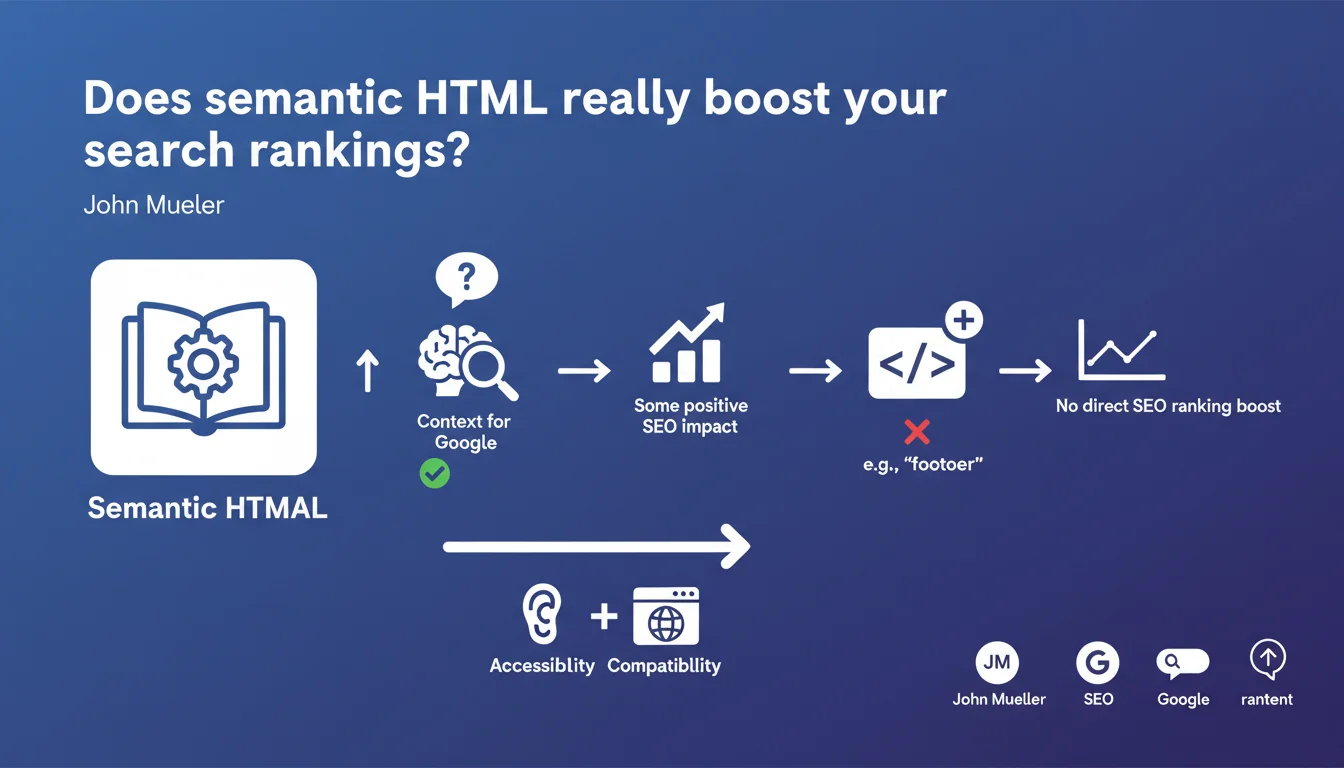
Google confirms that certain semantic HTML elements provide useful context for crawling and content understanding, but tags like <footer> have no direct SEO impact. The main benefit of semantic HTML remains accessibility and browser compatibility — not a major ranking lever.
What you need to understand
Which semantic HTML elements does Google actually find useful?
Mueller doesn't detail precisely which elements provide this "additional context". We can assume he's referring to structural tags like , , , or that help delineate functional zones on a page.
But let's be realistic: Google isn't saying these tags improve rankings. It's saying they "provide a bit more context". Nuance matters. This means Googlebot can better distinguish main content from peripheral elements — useful for data extraction, not for direct ranking.
Why is the footer tag explicitly mentioned as useless?
Because a footer typically contains redundant information: legal notices, navigation links already present elsewhere, contact details. Nothing that helps Google understand the topic covered in the page body.
Mueller puts to rest a common misconception: semantically tagging your footer won't gain you anything in SEO terms. It's clean markup, sure, but with no measurable algorithmic gain.
Should you still use semantic HTML despite these findings?
Yes, but for the right reasons. Accessibility first: screen readers rely on these tags to navigate effectively. Browser compatibility second: well-structured semantic markup limits interpretation issues across different environments.
And let's be honest — Google doesn't say it's useless, just that direct SEO impact is marginal. A well-tagged site remains easier to maintain, audit, and evolve.
- Some semantic elements help Google contextualize content, but this isn't a ranking factor
- Tags like footer bring no SEO value — these are too generic zones
- Semantic HTML remains recommended for accessibility and technical robustness
- Don't confuse "useful context" and "ranking boost"
SEO Expert opinion
Is this statement consistent with real-world observations?
Overall, yes. No serious study has ever shown that a page marked up in semantic HTML5 ranks better than an equivalent page in div-soup — with equal content and external signals.
What counts for ranking is content quality, logical structure (H1-H6 headings), engagement signals, backlinks. Wrapping content in an instead of a But — and this is where Mueller remains vague — some semantic elements can facilitate featured snippet extraction or implicit structured data. [To verify]: Do , , or influence automatic rich results generation? Google doesn't say explicitly. Mueller says "some elements" without specifying which. That's typical of Google responses: vague enough to not commit, precise enough to debunk myths. Second nuance: indirect impact. A well-structured semantic HTML site is often better coded, faster, more maintainable. Those factors have SEO impact — but it's not the tag boosting your ranking, it's the fact that clean code facilitates technical optimizations. Where it helps: third-party crawlers and analysis tools. Some scrapers, content aggregators, or monitoring tools rely on semantic tags to automatically extract information. If your content is syndicated, republished, or analyzed by external tools, clean markup makes their job easier — and thus boosts your content distribution. Not direct SEO impact, but a meaningful collateral benefit.What nuances should we add to this claim?
In what cases might semantic HTML still play a role?
Practical impact and recommendations
What should you do concretely with this information?
Stop over-optimizing your semantic HTML thinking each tag will earn you points. Focus on what really matters: logical title structure, content quality, page speed, Core Web Vitals.
If you're launching a new site or redesign, use semantic HTML by default — it's a best practice. But if your existing site runs on div everywhere and performs well, don't justify a refactor solely to "switch to semantic HTML5".
What mistakes should you avoid after this statement?
Don't fall into the opposite trap: neglecting semantics entirely on the grounds that "Google doesn't care". Clean code remains easier to maintain, debug, and evolve.
Classic mistake: spending hours correctly tagging your footer, sidebar, widgets — while real SEO work lies elsewhere. Prioritize. The time you invest in semantic markup should be proportional to its actual impact.
How do you verify your site is using semantic HTML correctly?
Use W3C validation tools to ensure your markup is clean — not for SEO, but to limit interpretation bugs. Check with Lighthouse that your accessibility is solid: that's where semantic HTML truly delivers value.
Test your pages with screen readers (NVDA, JAWS) to see if logical navigation works. If yes, you've done the job. If no, fix it — but for accessibility, not to climb SERPs.
- Use semantic HTML on new projects, but don't refactor existing code solely for SEO
- Focus on logical structure (H1-H6) and content hierarchy — that's what matters
- Don't over-optimize zones like footer or sidebar: zero SEO impact
- Validate your markup for accessibility and compatibility, not for ranking
- Prioritize high-impact optimizations: content, links, technical, speed
❓ Frequently Asked Questions
Est-ce que baliser mon contenu avec <article> ou <section> améliore mon positionnement ?
Faut-il quand même utiliser le HTML sémantique si ça n'impacte pas le SEO ?
Quels éléments sémantiques Google juge-t-il utiles pour le contexte ?
Pourquoi Google mentionne-t-il spécifiquement le footer comme inutile ?
Dois-je refactoriser mon site existant pour passer en HTML5 sémantique ?
🎥 From the same video 29
Other SEO insights extracted from this same Google Search Central video · published on 14/01/2022
🎥 Watch the full video on YouTube →
💬 Comments (0)
Be the first to comment.