
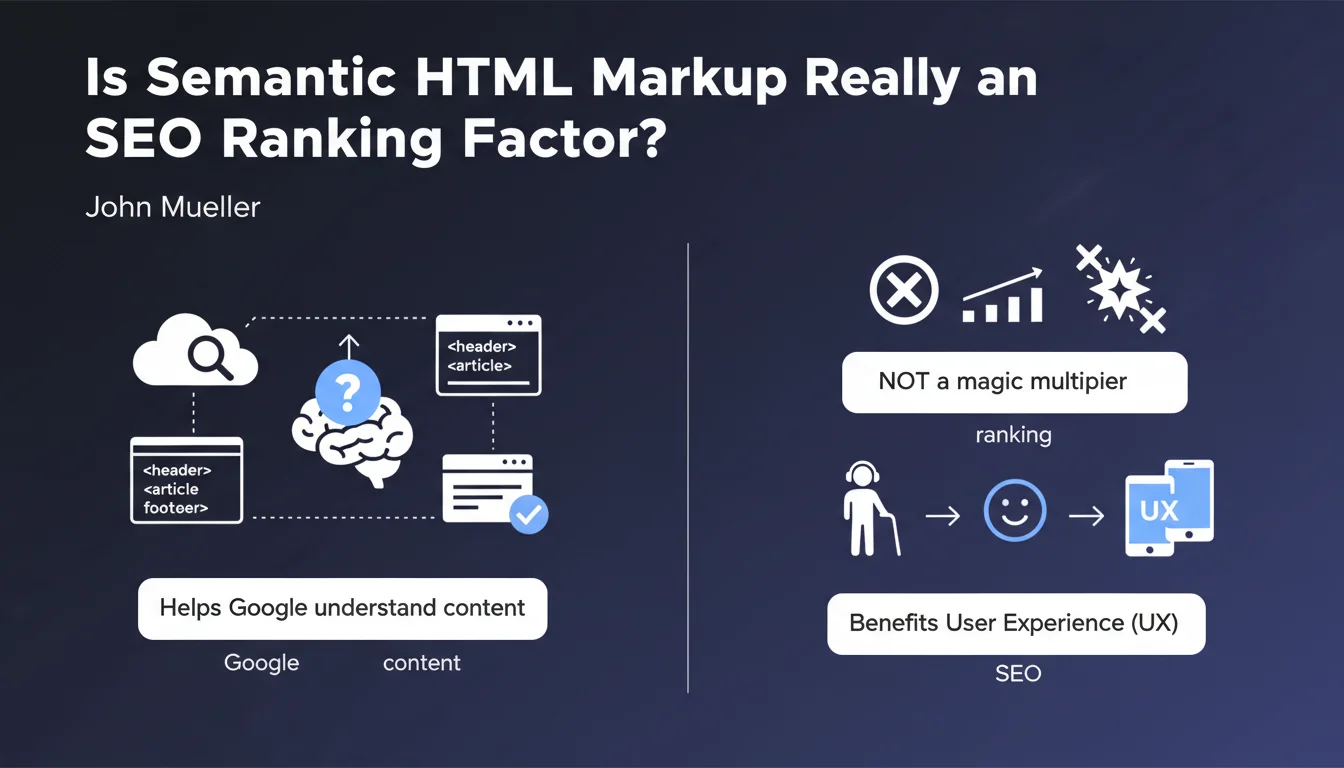
Official statement
What you need to understand
What exactly does semantic HTML markup mean?
Semantic HTML markup involves using the right tags to structure a web page's content. It means employing elements like <header>, <nav>, <article>, <section>, or heading levels <h1> to <h6> in a logical and hierarchical manner.
This approach allows search engines to understand the structure and meaning of the content, rather than simply seeing a series of generic divisions. It's like giving Google a clear reading map to navigate your page effectively.
What is Google's official position on this topic?
Google confirms that semantic HTML helps with content understanding, but tempers expectations. The company clearly states that it is not a "magic multiplier" for improving rankings.
This statement means that semantic markup is a necessary but not sufficient condition. It's an SEO fundamental, just like technical optimization or loading speed, but it doesn't guarantee good positioning on its own.
Why does Google also emphasize accessibility?
Beyond pure SEO, Google highlights that semantic HTML improves user experience, particularly for people with disabilities. Screen readers and other assistive technologies rely on this structure to navigate.
This dimension shows that Google values sites that offer an inclusive and universal experience. This is consistent with the algorithm's evolution toward overall quality criteria, including UX and accessibility.
- Semantic markup facilitates Google's understanding of content
- It's not a direct and determining ranking factor
- Accessibility is becoming an increasingly important quality criterion
- It's an essential technical prerequisite, not an advanced optimization
SEO Expert opinion
Is this statement consistent with what we observe in the field?
Absolutely. In my 15 years of practice, I've found that sites with neglected HTML markup never rank sustainably on competitive queries. But I've also seen technically perfect sites stagnate for lack of relevant content or quality backlinks.
Semantic markup is like the foundation of a house: invisible but essential. Without it, everything collapses. With it, you can build, but it's only the beginning of the project. Google is transparent on this point and it corresponds to field reality.
What important nuances should we add to this statement?
The first nuance concerns rich content and advanced features. For certain types of results (featured snippets, rich results, knowledge panels), structured markup (schema.org) becomes much more than a simple facilitator: it's a genuine visibility lever.
The second nuance relates to the difference between sites according to their sector. For a complex e-commerce site with thousands of pages, rigorous semantic markup has a massive indirect impact on crawl budget and indexation. For a 50-article blog, the relative impact is lower.
In what cases does this principle reach its limits?
Semantic markup alone will never compensate for poor quality or irrelevant content for the targeted query. I've audited sites with perfect HTML but duplicate or thin content: they stagnate on page 5.
Similarly, on ultra-competitive queries, the battle is mainly fought on domain authority and backlink quality. A competitor with imperfect HTML but superior authority will outrank you. Semantic markup is an entry ticket, not a victory guarantee.
Practical impact and recommendations
What should you concretely implement on your site?
Start by correctly hierarchizing your headings: a single <h1> per page (usually the main title), then <h2> for main sections, <h3> for subsections. This structure must follow clear editorial logic.
Next, use the appropriate HTML5 semantic tags. Wrap your navigation in a <nav>, your main content in <main>, your articles in <article>, and your footer in <footer>. Avoid overusing generic <div> when a semantic tag exists.
Finally, structure your content with <section>, use <aside> for complementary content, and don't forget alt attributes on images and <figure> tags with <figcaption> for important illustrations.
What critical mistakes should you absolutely avoid?
The most common error is using multiple <h1> tags per page or completely omitting this tag. Each page must have a unique main title clearly identified for Google.
Another common mistake: skipping heading levels (going from <h2> to <h4> without <h3>). This creates an illogical structure that disrupts both algorithmic and human content understanding.
Finally, avoid using tags for their visual effect rather than their semantic meaning. Text bolded for style should use <strong> or CSS, not an <h3> heading simply to enlarge the font.
How can you audit and validate your site's semantic markup?
Use the HeadingsMap extension to instantly visualize your heading structure. It displays the complete tree and immediately reveals hierarchy inconsistencies.
Validate your HTML with the W3C validator which detects syntax errors and unclosed tags. Invalid HTML can disrupt rendering and interpretation by robots.
Check Google Search Console, "Page Experience" and "Mobile Usability" sections, which can flag structural issues impacting indexing or display.
- Verify the presence of a unique and descriptive <h1> on each page
- Check the logical hierarchy of headings without level skipping
- Replace generic <div> with semantic HTML5 tags
- Add relevant alt attributes to all important images
- Validate HTML code with W3C standard tools
- Test accessibility with a screen reader or dedicated tools
- Document the standard structure to maintain consistency across the entire site
Semantic HTML markup is an essential fundamental of modern SEO, but does not constitute a positioning lever on its own. It's a technical foundation that facilitates Google's understanding of your content and improves accessibility for all users.
Implementing rigorous semantic structure across an entire site, particularly if it's large, can prove complex and time-consuming. It requires deep understanding of web standards and an overall vision of site architecture. For large-scale projects or technical overhauls, guidance from a specialized SEO agency ensures implementation compliant with best practices, while simultaneously optimizing other critical dimensions of natural referencing.
💬 Comments (0)
Be the first to comment.