
Official statement
Other statements from this video 29 ▾
- □ Does a bloated robots.txt file really hurt your SEO rankings?
- □ Does it really matter whether you submit your sitemap in robots.txt or Search Console?
- □ Do H1-H6 heading tags really still impact Google rankings?
- □ Is a strict heading tag hierarchy really necessary for SEO rankings?
- □ How long does Google actually take to fully process a domain migration?
- □ Can a site migration really boost your SEO rankings or destroy them completely?
- □ Does Googlebot really crawl from just one place when indexing your geo-targeted content?
- □ Can a noindex tag on geolocalized pages wipe your entire website from Google search results?
- □ Should you really ditch geo-redirects for a simple dynamic banner?
- □ How many location pages can you create before Google penalizes you for spam?
- □ Should you redirect mobile users to your app—and what are the hidden SEO risks?
- □ Do you really need to translate your pages word-for-word for hreflang to work effectively?
- □ Does the domain directive in your Disavow file really help you bypass Google's 2MB limit?
- □ Should you really use the Disavow tool only for purchased links?
- □ Should you noindex your internal search results pages to prevent spammers from creating backlinks?
- □ Does semantic HTML really boost your search rankings?
- □ Is AMP still a ranking factor in Google Search?
- □ Is AMP really a ranking factor for Google?
- □ Does removing AMP actually boost crawl on your regular pages?
- □ Why do knowledge panels display differently across devices and search contexts?
- □ Does Google's synonym system really work without any human intervention?
- □ Should you really create a separate page for each location to implement Local Business schema correctly?
- □ Do you really need to mark up ALL your content with structured data?
- □ Do you really need to display all FAQ schema questions visibly on your page?
- □ Can hidden accordion content really show up in featured snippets?
- □ Why does Google deliberately choose not to index your entire website?
- □ Should you delete pages to boost your site's indexation?
- □ Does search volume of anchor text really impact the value of your internal links?
- □ Should you really add unique content to your e-commerce product pages?
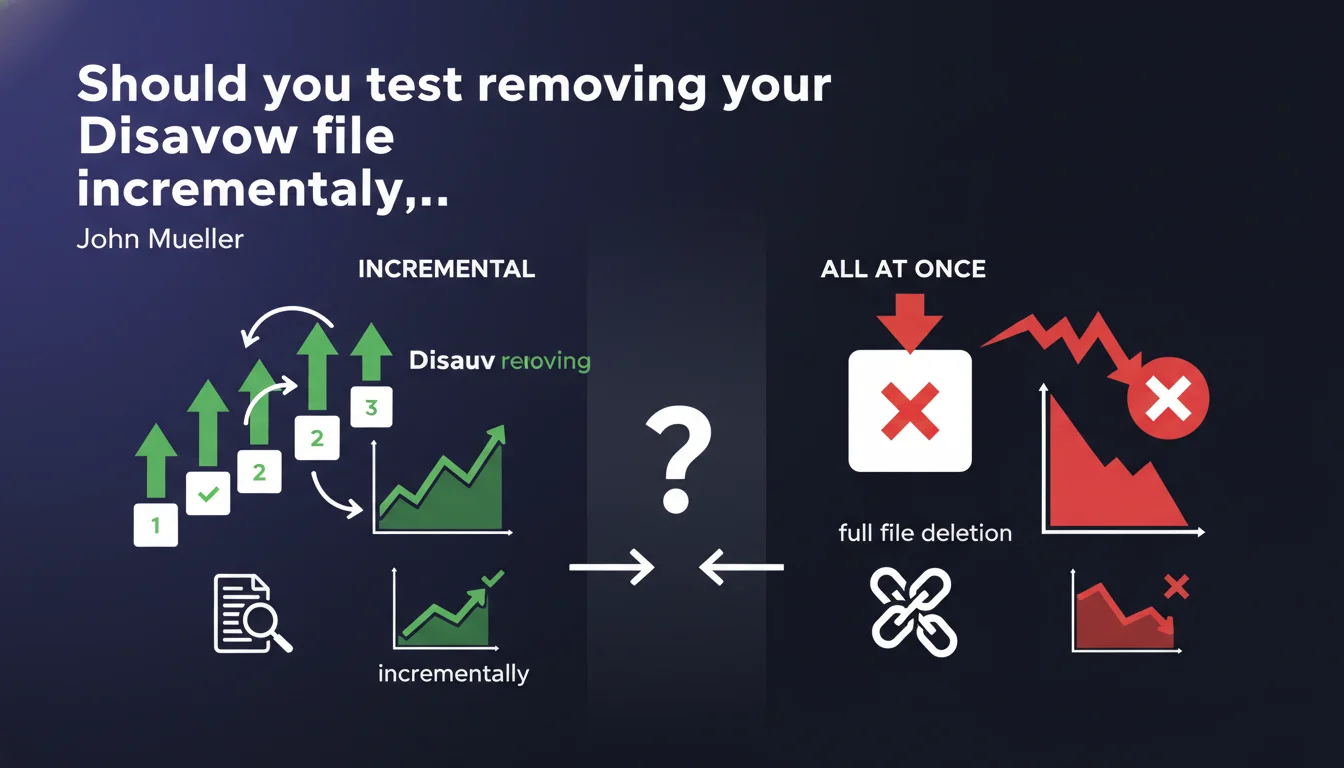
Google recommends not removing a Disavow file all at once, but rather proceeding in stages by gradually removing sections to measure the impact. This approach makes it possible to identify which disavowed links actually influence rankings and avoid a sudden drop in visibility. In practice: divide the file into several parts, remove one section, wait for the next algorithm update, analyze the results, then iterate.
What you need to understand
Why does Google recommend an incremental approach for removing Disavow?
The Disavow tool allows you to tell Google to ignore certain backlinks when calculating PageRank. Removing this file all at once means instantly reintroducing all these links into the equation — with one risk: if some were genuinely toxic, your site could suffer an algorithmic penalty or a sudden drop in rankings.
The incremental approach proposed by John Mueller is based on a simple principle: test in small steps. Divide the file into several sections — for example by domain, by link type or by anchor text — and remove one section at a time. After each modification, you must wait for Google to recrawl the relevant pages and apply the changes, which can take several weeks or even several months.
This method allows you to precisely detect which segments of links negatively impact the site. If a removed section causes a traffic drop, you immediately reintegrate it into the Disavow. If nothing changes — or if traffic increases — it means these links weren't actually a problem.
- Disavow is not an instant action: Google must recrawl the URLs concerned to apply the changes
- Removing the entire file at once exposes you to a risk of sudden drop in rankings that is difficult to diagnose
- The step-by-step approach requires patience: plan for 1 to 2 months minimum between each test to assess the impact
- You must segment the file coherently: by referring domain, by anchor type or by period of link acquisition
In what concrete cases does this strategy apply?
This recommendation primarily concerns sites that have historically used Disavow aggressively — often following a Penguin penalty or out of excessive caution. Many SEO professionals have disavowed hundreds or even thousands of domains without really analyzing their actual toxicity. Result: they may have also blocked perfectly legitimate links that could have contributed positively to rankings.
With the end of Penguin as a manual filter and its gradual integration into the Core Algorithm, Google has become more tolerant of low-quality links. The algorithm now knows how to naturally ignore spam links without manual intervention. Disavow becomes less necessary than before — except in very specific cases of massive negative SEO.
Testing incremental removal of the Disavow allows you to verify whether certain links you had deemed toxic are actually neutral or even beneficial. It is an optimization approach that can unlock ranking potential — provided you conduct it with rigor and method.
What are the concrete risks of immediate total removal?
The main danger: reintroducing all at once hundreds of spammy links that will dilute your backlink profile. If Google considers that some of these links artificially manipulate PageRank, your site can lose key positions overnight. And without having segmented the file, there's no way to know which domain or section is problematic.
Another risk: loss of control. In case of sudden drop, you will need to reactivate the entire Disavow file and wait several additional weeks before Google takes your instructions into account again. During this time, your organic traffic can remain at its lowest. The incremental approach avoids this situation by limiting exposure with each test.
- A total removal can cause a sudden drop in visibility with no possibility of quick diagnosis
- Reactivating the Disavow after an error takes time: Google must recrawl the pages concerned
- Some historically disavowed links may actually be toxic — better to keep them under control
- Without segmentation, it is impossible to identify which group of links is problematic in case of ranking decline
SEO Expert opinion
Is this recommendation consistent with practices observed in the field?
Yes, and it reflects an evolution in Google's doctrine on Disavow. Historically, Google has always been cautious with this tool — probably because it knows that many SEO professionals use it with excessive zeal. Mueller's recommendation here is conservative and pragmatic: it assumes you don't really know which links are toxic, so you might as well test progressively.
In practice, we observe that most sites that removed their Disavow all at once did not experience ranking drops. Some even gained visibility. But — and this is crucial — these sites had often disavowed links out of excessive precaution, not following a real penalty. For sites that have truly suffered massive negative SEO or that are emerging from a manual penalty, caution remains warranted.
The problem with this recommendation is that it is time-consuming. Dividing a file of 500 domains into 10 sections and testing each over 1-2 months can take more than a year. During this time, your competition moves forward. You must therefore weigh the benefit/risk ratio: does the potential gain justify this investment in time and resources?
What nuances should be added to this statement?
Mueller does not specify how to segment the file. Yet, the way you divide the sections directly influences the relevance of the test. Segment by referring domain? By anchor type (exact match vs branded)? By period of acquisition? Each approach will yield different results and requires prior analysis of your backlink profile.
Another missing point: what delay to wait between each test? Google doesn't recrawl all links at the same frequency. Some highly authoritative domains are crawled daily, others every three months. You must therefore cross-reference Search Console data (crawl frequency of URLs concerned) with ranking evolution to determine if the impact is truly visible. [To verify]: Google has never officially communicated a delay between two Disavow tests.
Finally, this recommendation assumes you have clean historical data to measure impact. If your traffic already fluctuates naturally due to seasonality, Core Updates or changes to the site, how do you isolate the Disavow effect? You need a stable testing environment — which is rarely the case in operational SEO.
In what cases is this incremental approach not relevant?
If your Disavow file contains only a few dozen domains, the incremental approach becomes unnecessary. You might as well manually analyze each domain and decide case-by-case whether to remove it or not. Testing by sections only makes sense for large files (several hundreds of lines) where unit analysis is too costly.
Similarly, if you have clear evidence of negative SEO with documented proof (massive forum spam, detected PBN networks, etc.), there is no reason to remove these domains from the Disavow. They are toxic, period. The incremental approach applies mainly to ambiguous cases — links about which you are uncertain whether they actually harm.
Finally, on sites with high traffic volatility (seasonal e-commerce, news, etc.), measuring the impact of an incremental Disavow modification becomes very complex. You would need advanced statistical models to isolate the specific effect of the Disavow — which far exceeds the capabilities of most SEO teams.
Practical impact and recommendations
How do you concretely segment your Disavow file to test removal?
First step: export and analyze your current Disavow file. Classify domains by type: suspected PBNs, low-quality directories, spam forums, off-topic foreign sites, etc. You can also segment by anchor (aggressive exact match vs natural anchor) or by acquisition period if you have a history.
Then create multiple versions of the file, each excluding a different section. Example: version A removes directories, version B removes forums, version C removes foreign domains, etc. Start by testing the section that seems least risky to you — usually low-authority domains with few links pointing to your site.
Upload the first version to the Search Console and document the date precisely. Wait a minimum of 4 to 6 weeks before analyzing results — this is the average time for Google to recrawl the URLs concerned and apply the changes. Monitor key KPIs: evolution of positions on your strategic queries, overall organic traffic, click-through rate in Search Console.
- Export the current Disavow file and save it in multiple versions
- Segment by domain type, anchor or period of acquisition according to business logic
- Start by removing the least risky section (low authority, few links)
- Wait a minimum of 4 to 6 weeks between each test to measure real impact
- Document each modification with date, section removed and KPIs observed
- Prepare a rollback plan: if a section causes a drop, reintegrate it immediately
What errors should you avoid during this testing process?
Error #1: testing during a Core Update. If you remove a section of the Disavow at the time Google deploys a Core Update, there's no way to know if the traffic variation comes from the Disavow or the update. Check the algorithmic update calendar before launching a test.
Error #2: not isolating other variables. If you simultaneously modify the Disavow and launch a redesign, change internal linking or publish massive content, you lose all analytical capability. During the testing phase, the site must remain as stable as possible technically and editorially.
Error #3: drawing conclusions too quickly. A week after removing a section, you see no changes? That's normal. Google probably hasn't recrawled all the links concerned yet. It requires patience — and checking in the Search Console the crawl frequency of removed domains to estimate the actual timeline.
What should you do if a removed section causes a ranking drop?
As soon as you notice a significant and sustained decline (not a one-day fluctuation), immediately reintegrate the section into the Disavow. Upload the previous version to the Search Console and document the incident. You have just confirmed that these links were genuinely toxic.
Then wait for Google to take the Disavow into account again — once again, several weeks may be necessary. During this time, monitor whether rankings stabilize or continue to decline. If the drop persists despite Disavow reintegration, it means another factor is at play — an algorithmic update, a technical problem or a manual action.
Draw a strategic conclusion from it: if a section causes a drop, the links it contains must remain disavowed. Don't try to clean them manually, it's too risky. Keep them in the Disavow and focus on acquiring quality links to dilute their impact.
❓ Frequently Asked Questions
Combien de temps faut-il attendre entre deux tests de suppression incrémentale du Disavow ?
Peut-on supprimer totalement le fichier Disavow si on n'a jamais eu de pénalité manuelle ?
Comment savoir quels domaines retirer en priorité lors du test incrémental ?
Que faire si on constate une baisse de trafic après avoir retiré une section du Disavow ?
Le Disavow est-il encore nécessaire avec l'évolution de l'algorithme Google ?
🎥 From the same video 29
Other SEO insights extracted from this same Google Search Central video · published on 14/01/2022
🎥 Watch the full video on YouTube →
💬 Comments (0)
Be the first to comment.